Intra-abdominal fat volume estimation by multi-detector rows computed tomography: relevance in surgical fellowship training program in Shanghai: a retrospective study
- PMID: 37096062
- PMCID: PMC10122455
- DOI: 10.7717/peerj.15156
Intra-abdominal fat volume estimation by multi-detector rows computed tomography: relevance in surgical fellowship training program in Shanghai: a retrospective study
Abstract
Background: Intra-abdominal fat volume (IFV) has been shown to have a negative impact on surgical outcomes in gastric cancer (GC) and other gastrointestinal surgeries. The purpose of this study is to look into the relationship between IFV and perioperative outcomes in GC patients using multi-detector rows computed tomography (MDCT) and assess the importance of implementing this observation in current surgical fellowship training programs.
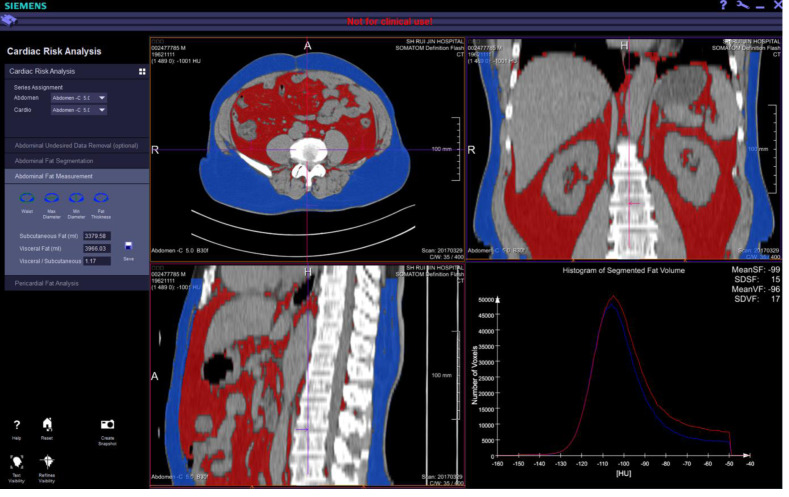
Methods: Patients with GC who underwent open D2 gastrectomy between May 2015 and September 2017 were included in the study. Based on MDCT estimation, patients were divided into high IFV (IFV ≥ 3,000 ml) and low IFV (IFV < 3,000 ml) groups. Perioperative outcomes for cancer staging, type of gastrectomy, intraoperative blood loss (IBL), anastomotic leakage, and hospital stay were compared between the two groups. This study was registered as CTR2200059886.
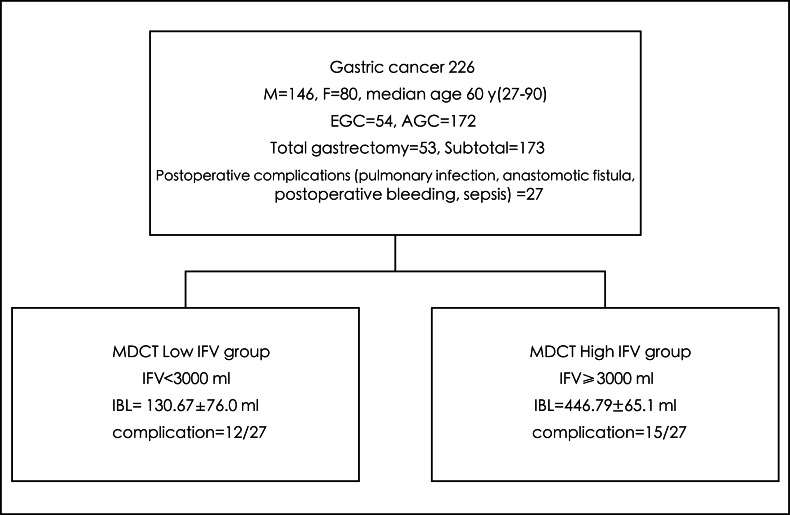
Results: Out of 226 patients, 54 had early gastric carcinoma (EGC), while 172 had advanced gastric carcinoma (AGC). There were 64 patients in the high IFV group and 162 in the low IFV group. The high IFV group had significantly higher IBL mean values (p = 0.008). Therefore, having a high IFV was a risk factor for the occurrence of perioperative complications (p = 0.008).
Conclusions: High IFV estimated by MDCT prior to GC surgery was associated with increased IBL and postoperative complications. Incorporating this CT-IFV estimation into surgical fellowship programs may aid aspiring surgeons in selecting patients during independent practice in their learning curve and surgical practice for the most appropriate approach for treating GC patients.
Keywords: Blood loss; D2 gastrectomy; Fellowship training; Gastric cancer; Intra-abdominal fat volume; Obesity.
©2023 Shah et al.
Conflict of interest statement
Tian Li is an Academic Editor for PeerJ.
Figures
References
-
- Abu-Abid S, Szold A, Klausner J. Obesity and cancer. Journal of Medicine. 2002;33:73–86. - PubMed
-
- Bastard JP, Maachi M, Lagathu C, Kim MJ, Caron M, Vidal H, Capeau J, Feve B. Recent advances in the relationship between obesity, inflammation, and insulin resistance. European Cytokine Network. 2006;17:4–12. - PubMed
-
- Han M, Qie R, Li Q, Liu L, Huang S, Wu X, Zhang D, Cheng C, Zhao Y, Liu D, Guo C, Zhou Q, Tian G, Zhang Y, Wu Y, Li Y, Yang X, Zhao Y, Feng Y, Qin P, Hu F, Zhang M, Hu D. Chinese visceral adiposity index, a novel indicator of visceral obesity for assessing the risk of incident hypertension in a prospective cohort study. British Journal of Nutrition. 2021a;126:612–620. doi: 10.1017/S0007114520004298. - DOI - PubMed
-
- Han M, Qin P, Li Q, Qie R, Liu L, Zhao Y, Liu D, Zhang D, Guo C, Zhou Q, Tian G, Huang S, Wu X, Li Y, Yang X, Zhao Y, Feng Y, Liu Y, Li H, Sun X, Chen Q, Wang T, Chen X, Hu D, Zhang M. Chinese visceral adiposity index: a reliable indicator of visceral fat function associated with risk of type 2 diabetes. Diabetes/Metabolism Research and Reviews. 2021b;37(2):e3370. - PubMed
Publication types
MeSH terms
LinkOut - more resources
Full Text Sources
Medical
Miscellaneous