


Examining the Early Distribution of the Artemisinin-Resistant Plasmodium falciparum kelch13 R561H Mutation in Areas of Higher Transmission in Rwanda
- PMID: 37096145
- PMCID: PMC10122489
- DOI: 10.1093/ofid/ofad149
Examining the Early Distribution of the Artemisinin-Resistant Plasmodium falciparum kelch13 R561H Mutation in Areas of Higher Transmission in Rwanda
Abstract
Background: Artemisinin resistance mutations in Plasmodium falciparum kelch13 (Pfk13) have begun to emerge in Africa, with Pfk13-R561H being the first reported in Rwanda in 2014, but limited sampling left questions about its early distribution and origin.
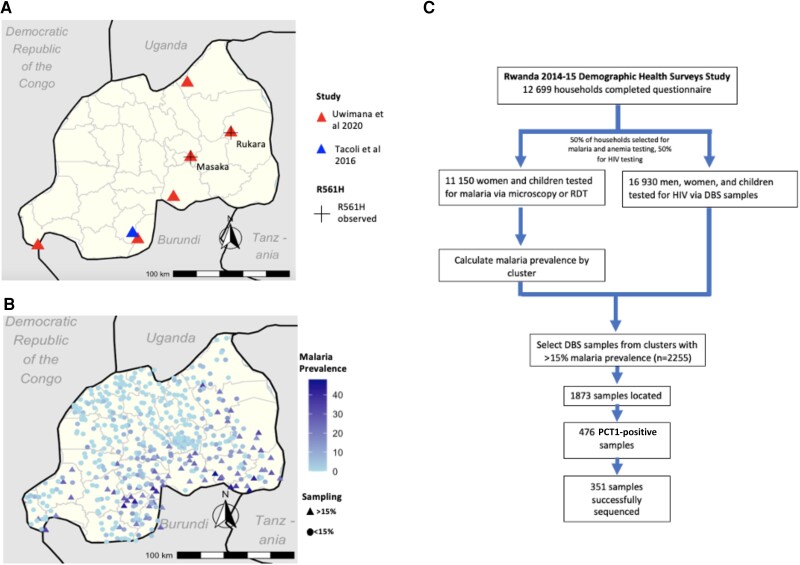
Methods: We genotyped P. falciparum positive dried blood spot (DBS) samples from a nationally representative 2014-2015 Rwanda Demographic Health Surveys (DHS) HIV study. DBS were subsampled from DHS sampling clusters with >15% P. falciparum prevalence, as determined by rapid testing or microscopy done during the DHS study (n clusters = 67, n samples = 1873).
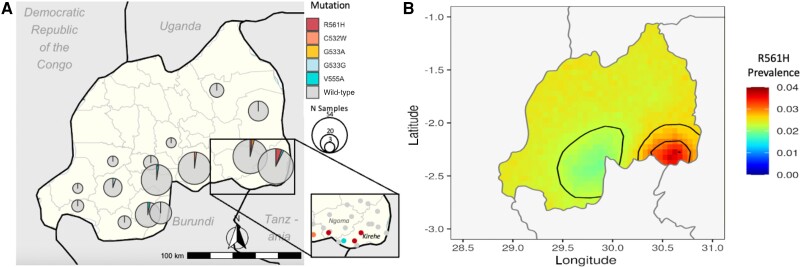
Results: We detected 476 parasitemias among 1873 residual blood spots from a 2014-2015 Rwanda Demographic Health Survey. We sequenced 351 samples: 341/351 were wild-type (97.03% weighted), and 4 samples (1.34% weighted) harbored R561H that were significantly spatially clustered. Other nonsynonymous mutations found were V555A (3), C532W (1), and G533A (1).
Conclusions: Our study better defines the early distribution of R561H in Rwanda. Previous studies only observed the mutation in Masaka as of 2014, but our study indicates its presence in higher-transmission regions in the southeast of the country at that time.
Keywords: antimalarial resistance; artemisinin; drug resistance; k13; kelch13; r561H.
© The Author(s) 2023. Published by Oxford University Press on behalf of Infectious Diseases Society of America.
Conflict of interest statement
Potential conflicts of interest. All authors: no reported conflicts.
Figures
References
Grants and funding
LinkOut - more resources
Full Text Sources
Research Materials
