


Creatine supplementation and endurance performance: surges and sprints to win the race
- PMID: 37096381
- PMCID: PMC10132248
- DOI: 10.1080/15502783.2023.2204071
Creatine supplementation and endurance performance: surges and sprints to win the race
Abstract
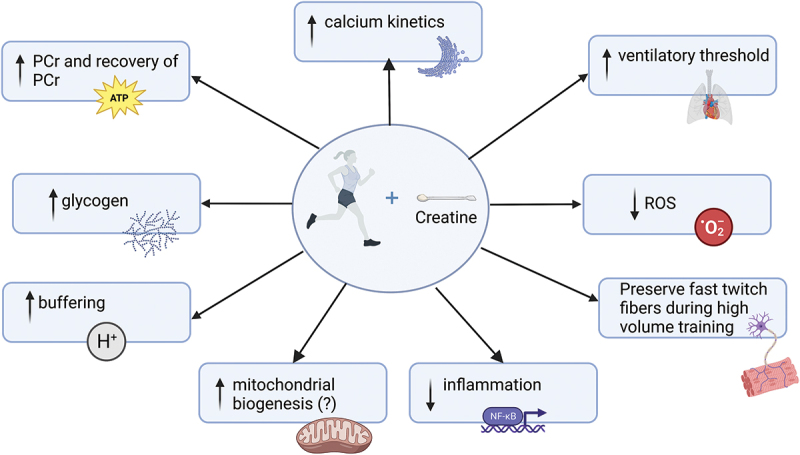
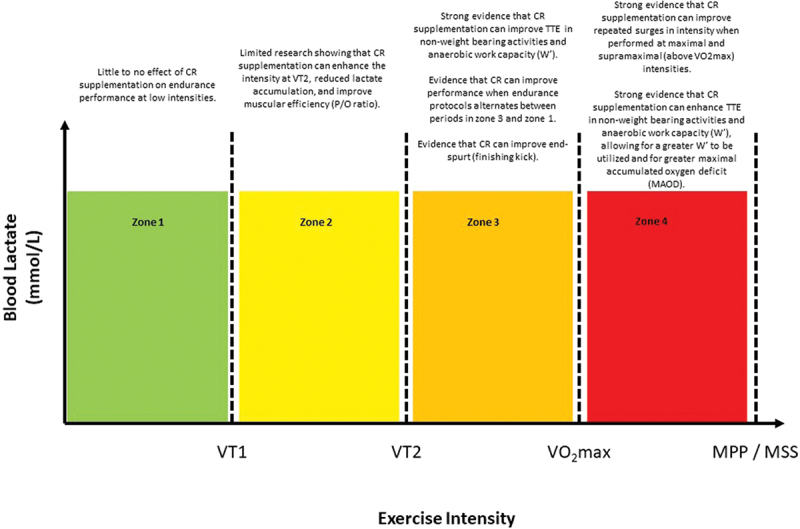
Creatine supplementation is an effective ergogenic aid to augment resistance training and improve intense, short duration, intermittent performance. The effects on endurance performance are less known. The purpose of this brief narrative review is to discuss the potential mechanisms of how creatine can affect endurance performance, defined as large muscle mass activities that are cyclical in nature and are >~3 min in duration, and to highlight specific nuances within the literature. Mechanistically, creatine supplementation elevates skeletal muscle phosphocreatine (PCr) stores facilitating a greater capacity to rapidly resynthesize ATP and buffer hydrogen ion accumulation. When co-ingested with carbohydrates, creatine enhances glycogen resynthesis and content, an important fuel to support high-intensity aerobic exercise. In addition, creatine lowers inflammation and oxidative stress and has the potential to increase mitochondrial biogenesis. In contrast, creatine supplementation increases body mass, which may offset the potential positive effects, particularly in weight-bearing activities. Overall, creatine supplementation increases time to exhaustion during high-intensity endurance activities, likely due to increasing anaerobic work capacity. In terms of time trial performances, results are mixed; however, creatine supplementation appears to be more effective at improving performances that require multiple surges in intensity and/or during end spurts, which are often key race-defining moments. Given creatines ability to enhance anaerobic work capacity and performance through repeated surges in intensity, creatine supplementation may be beneficial for sports, such as cross-country skiing, mountain biking, cycling, triathlon, and for short-duration events where end-spurts are critical for performance, such as rowing, kayaking, and track cycling.
Keywords: Ergogenic aids; aerobic; anaerobic; exercise; supplements.
Conflict of interest statement
JA is Chief Executive Officer and EB is the vice president of the ISSN, an academic nonprofit that receives support and/or sponsorship from companies that manufacture and/or sell creatine or creatine-containing products. EB has an affiliate link with Thorne that sells creatine. DGC has received research grants and performed industry sponsored research involving creatine supplementation, received creatine donation for scientific studies and travel support for presentations involving creatine supplementation at scientific conferences. In addition, DGC serves on the Scientific Advisory Board for Alzchem (a company which manufactures creatine) and the editorial review board for the Journal of the International Society of Sports Nutrition and is a sports science advisor to the ISSN. Furthermore, DGC has previously served as the Chief Scientific Officer for a company that sells creatine products. SCF has served as a scientific advisor for a company that sells creatine products. JGL owns a company that sells creatine products. All other authors declare no conflicts of interests.
Figures
References
-
- Wax B, Kerksick C, Jagim A, et al. Creatine for exercise and sports performance, with recovery considerations for healthy populations. Nutrients [Internet]. 2021. Jul 8];13(6). https://pubmed.ncbi.nlm.nih.gov/34199588/ - PMC - PubMed
-
- Wyss M, Kaddurah-Daouk R.. Creatine and creatinine metabolism. Physiol Rev. 2021. Jul 8 2000;80:1107–228. [Internet]. Available from https://pubmed.ncbi.nlm.nih.gov/10893433/ - PubMed
-
- Ostojic SM, Forbes SC. Perspective: creatine, a conditionally essential nutrient: building the case. Adv Nutr. 2022. Mar 8;13:34–37. [Internet]. Available from https://pubmed.ncbi.nlm.nih.gov/34662902/ - PMC - PubMed
-
- Kreider RB, Jäger R, Purpura M. Bioavailability, efficacy, safety, and regulatory status of creatine and related compounds: a critical review. Nutrients. [cited 2022 Dec 17] 2022;14:1035. [Internet]. Available from https://pubmed.ncbi.nlm.nih.gov/35268011/ - PMC - PubMed
Publication types
MeSH terms
Substances
LinkOut - more resources
Full Text Sources
Medical
Miscellaneous
