


Mechanisms of lipid oxidation in water-in-oil emulsions and oxidomics-guided discovery of targeted protective approaches
- PMID: 37097053
- PMCID: PMC10962568
- DOI: 10.1111/1541-4337.13158
Mechanisms of lipid oxidation in water-in-oil emulsions and oxidomics-guided discovery of targeted protective approaches
Abstract
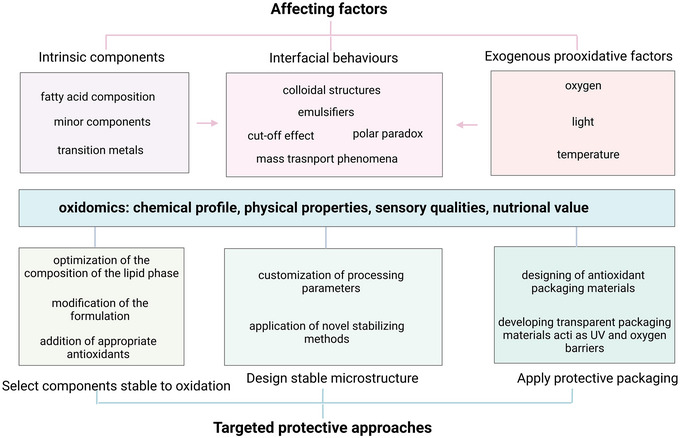
Lipid oxidation is an inevitable event during the processing, storage, and even consumption of lipid-containing food, which may cause adverse effects on both food quality and human health. Water-in-oil (W/O) food emulsions contain a high content of lipids and small water droplets, which renders them vulnerable to lipid oxidation. The present review provides comprehensive insights into the lipid oxidation of W/O food emulsions. The key influential factors of lipid oxidation in W/O food emulsions are presented systematically. To better interpret the specific mechanisms of lipid oxidation in W/O food emulsions, a comprehensive detection method, oxidative lipidomics (oxidomics), is proposed to identify novel markers, which not only tracks the chemical molecules but also considers the changes in supramolecular properties, sensory properties, and nutritional value. The microstructure of emulsions, components from both phases, emulsifiers, pH, temperature, and light should be taken into account to identify specific oxidation markers. A correlation of these novel oxidation markers with the shelf life, the organoleptic properties, and the nutritional value of W/O food emulsions should be applied to develop targeted protective approaches for limiting lipid oxidation. Accordingly, the processing parameters, the application of antioxidants and emulsifiers, as well as packing and storage conditions can be optimized to develop W/O emulsions with improved oxidative stability. This review may help in emphasizing the future research priorities of investigating the mechanisms of lipid oxidation in W/O emulsion by oxidomics, leading to practical solutions for the food industry to prevent oxidative rancidity in W/O food emulsions.
Keywords: W/O emulsion; interface; lipid oxidation; oxidomics; water droplets.
© 2023 The Authors. Comprehensive Reviews in Food Science and Food Safety published by Wiley Periodicals LLC on behalf of Institute of Food Technologists.
Conflict of interest statement
The authors declare no conflicts of interest.
Figures



References
-
- Almajano, M. P. , & Gordon, M. H. (2004). Synergistic effect of BSA on antioxidant activities in model food emulsions. Journal of the American Oil Chemists' Society, 81, 275–280. 10.1007/s11746-004-0895-6 - DOI
-
- Al‐Maqtari, Q. A. , Ghaleb, A. D. S. , Mahdi, A. A. , Al‐Ansi, W. , Noman, A. E. , Wei, M. , Al‐Adeeb, A. , & Yao, W. (2021). Stabilization of water‐in‐oil emulsion of Pulicaria jaubertii extract by ultrasonication: Fabrication, characterization, and storage stability. Food Chemistry, 350, 129249. 10.1016/j.foodchem.2021.129249 - DOI - PubMed
-
- Ambrosone, L. , Cinelli, G. , Mosca, M. , & Ceglie, A. (2006). Susceptibility of water‐emulsified extra virgin olive oils to oxidation. Journal of the American Oil Chemists' Society, 83, 165–170. 10.1007/s11746-006-1190-2 - DOI
-
- Ambrosone, L. , Mosca, M. , & Ceglie, A. (2006). Oxidation of water emulsified olive oils. Food Hydrocolloids, 20, 1080–1086. 10.1016/j.foodhyd.2005.12.004 - DOI
-
- Ambrosone, L. , Mosca, M. , & Ceglie, A. (2007). Impact of edible surfactants on the oxidation of olive oil in water‐in‐oil emulsions. Food Hydrocolloids, 21, 1163–1171. 10.1016/j.foodhyd.2006.09.003 - DOI
Publication types
MeSH terms
Substances
Grants and funding
LinkOut - more resources
Full Text Sources
Medical
