


The association between risk perceptions, anxiety, and self-reported changes in tobacco and nicotine product use due to COVID-19 in May-June 2020 in Israel
- PMID: 37098558
- PMCID: PMC10126559
- DOI: 10.1186/s12889-023-15351-1
The association between risk perceptions, anxiety, and self-reported changes in tobacco and nicotine product use due to COVID-19 in May-June 2020 in Israel
Abstract
Background: Early in the COVID-19 pandemic, reports about a possible protective effect of nicotine on COVID-19 conflicted with messaging by public health organizations about increased risks of COVID-19 due to smoking. The ambiguous information the public received, combined with COVID-19-induced anxiety, may have led to changes in tobacco or other nicotine product use. This study examined changes in use of combustible cigarettes (CCs), nargila (hookah/waterpipe), e-cigarettes, and IQOS and home-smoking behaviors. We also assessed COVID-19 related anxiety and perceptions regarding changes in risk of COVID-19 severity due to smoking.
Methods: We used cross-sectional data from a population telephone survey that was conducted in Israel in the early phase of the COVID-19 pandemic (May-June 2020) and included 420 adult (age 18+) individuals who reported having ever used CCs (n = 391), nargila (n = 193), and/or electronic cigarettes (e-cigarettes)/heated tobacco products (e.g., IQOS) (n = 52). Respondents were asked about the effect that COVID-19 had on their nicotine product use (quit/reduced use, no change, increased use). We assessed changes in product use, risk perceptions, and anxiety using adjusted multinomial logistic regression analyses.
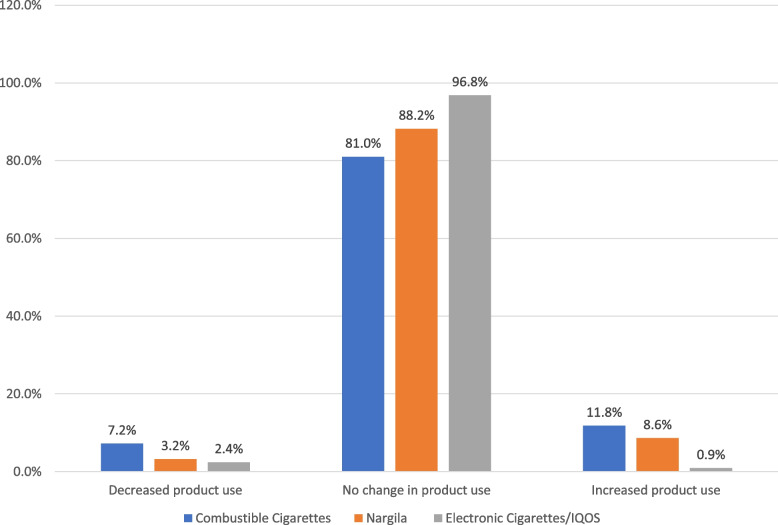
Results: Most respondents did not change their frequency of product use (CCs: 81.0%, nargila: 88.2%, e-cigarettes/IQOS: 96.8%). A small percentage either decreased use (CCs: 7.2%, nargila: 3.2%, e-cigarettes/IQOS:2.4%) or increased use (CCs:11.8%, nargila:8.6%, e-cigarettes/IQOS:+ 0.9%). 55.6% of respondents used a product in the home prior to COVID-19; but during the first lockdown COVID-19 period, a greater percentage increased (12.6%) than decreased (4.0%) their home use. Higher levels of anxiety due to COVID-19 were associated with increased home smoking (aOR = 1.59, 95% CI:1.04-2.42, p = 0.02). Many respondents believed that increased severity of COVID-19 illness was associated with CCs (62.0%) and e-cigarettes/vaping (45.3%), with uncertainty about the association being lower for CCs (20.5%) than for vaping (41.3%).
Conclusions: While many respondents believed that nicotine product use (particularly CCs and e-cigarettes) was associated with increased risk of COVID-19 disease severity, the majority of users did not change their tobacco/nicotine use. The confusion about the relationship between tobacco use and COVID-19 calls for clear evidence-based messaging from governments. The association between home smoking and increased COVID-19-related stress suggests the need for campaigns and resources to prevent smoking in the home, particularly during times of stress.
Keywords: COVID-19; Cultural differences; Electronic cigarettes; Home smoking; IQOS; Nargila; Smoking; Tobacco use.
© 2023. The Author(s).
Conflict of interest statement
Laura J. Rosen has received funds from the Israel National Institute of Health Policy Research to investigate knowledge of tobacco and nicotine products in Israel (ITC/Israel Survey). She has provided expert testimony to the Israeli Supreme Court on a pro bono basis in an administrative case against the relevant governmental ministries for not protecting apartment dwellers from smoke penetration from outside of the home. Geoffrey T. Fong has served as a member of the WHO Expert Group on COVID-19 and Tobacco Use and has served as an expert witness or consultant for governments defending their country’s policies or regulations in litigation. He was a member of the Scientific Advisory Board on Vaping Products for Health Canada (2017–2020). Geoffrey T. Fong and Shannon Gravely served as paid expert consultants to the Ministry of Health of Singapore in reviewing the evidence on plain/standardized packaging. All other authors state that they have no conflict of interest.
Geoffrey T. Fong has served as a member of the WHO Expert Group on COVID-19 and Tobacco Use, and has served as an expert witness or consultant for governments defending their country’s policies or regulations in litigation. He was a member of the Scientific Advisory Board on Vaping Products for Health Canada (2017–2020). Geoffrey T. Fong and Shannon Gravely served as paid expert consultants to the Ministry of Health of Singapore in reviewing the evidence on plain/standardized packaging. Laura J. Rosen has provided expert testimony to the Israeli Supreme Court on a pro bono basis in an administrative case against the relevant governmental ministries for not protecting apartment dwellers from smoke penetration from outside of the home. All others state that they have no conflict of interest.
Figures
References
-
- U.S.Centers for Disease Control . COVID-19: Smoking Current or Former. 2021.
Publication types
MeSH terms
Substances
LinkOut - more resources
Full Text Sources
Medical
