


Social determinants of cognitive outcomes in survivors of pediatric brain tumors treated with conformal radiation therapy
- PMID: 37099477
- PMCID: PMC10547513
- DOI: 10.1093/neuonc/noad080
Social determinants of cognitive outcomes in survivors of pediatric brain tumors treated with conformal radiation therapy
Abstract
Background: Social determinants of health including parental occupation, household income, and neighborhood environment are predictors of cognitive outcomes among healthy and ill children; however, few pediatric oncology studies have investigated this relationship. This study utilized the Economic Hardship Index (EHI) to measure neighborhood-level social and economic conditions to predict cognitive outcomes among children treated for brain tumors (BT) with conformal radiation therapy (RT).
Methods: Two hundred and forty-one children treated on a prospective, longitudinal, phase II trial of conformal photon RT (54-59.4 Gy) for ependymoma, low-grade glioma, or craniopharyngioma (52% female, 79% white, age at RT = 7.76 ± 4.98 years) completed serial cognitive assessments (intelligence quotient [IQ], reading, math, and adaptive functioning) for ten years. Six US census tract-level EHI scores were calculated for an overall EHI score: unemployment, dependency, education, income, crowded housing, and poverty. Established socioeconomic status (SES) measures from the extant literature were also derived.
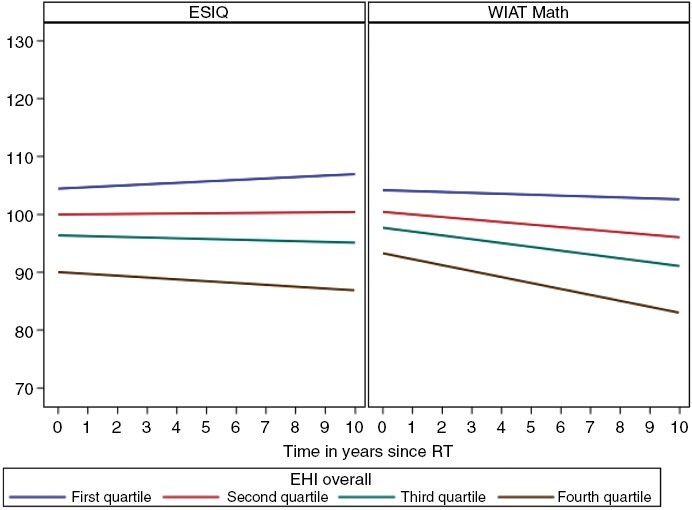
Results: Correlations and non-parametric tests revealed EHI variables share modest variance with other SES measures. Income, unemployment, and poverty overlapped most with individual SES measures. Linear mixed models, accounting for sex, age at RT, and tumor location, revealed EHI variables predicted all cognitive variables at baseline and change in IQ and math over time, with EHI overall and poverty most consistent predictors. Higher economic hardship was associated with lower cognitive scores.
Conclusions: Neighborhood-level measures of socioeconomic conditions can help inform understanding of long-term cognitive and academic outcomes in survivors of pediatric BT. Future investigation of poverty's driving forces and the impact of economic hardship on children with other catastrophic diseases is needed.
Keywords: cognitive outcomes; economic hardship index; pediatric oncology; poverty; socioeconomic status.
© The Author(s) 2023. Published by Oxford University Press on behalf of the Society for Neuro-Oncology. All rights reserved. For permissions, please e-mail: journals.permissions@oup.com.
Conflict of interest statement
The authors declare that there is no conflict of interest.
Figures
Comment in
-
Social determinants of health: A forgotten risk factor for neurocognition in pediatric brain tumor survivors.Neuro Oncol. 2023 Oct 3;25(10):1852-1853. doi: 10.1093/neuonc/noad127. Neuro Oncol. 2023. PMID: 37486932 Free PMC article. No abstract available.
References
-
- Bradley RH, Corwyn RF.. Socioeconomic status and child development. Annu Rev Psychol. 2002;53:371–399. - PubMed
-
- Vukojević M, Grbeša AZ, Talic I, Tanovic M, Resic B, Vrdoljak I, Spalvski B.. Parental socioeconomic status as a predictor of physical and mental health outcomes in children: Literature review. Acta Clin Croat. 2017;56(4):742–748. - PubMed
-
- Adler NE, Ostrove JM.. Socioeconomic status and health: What we know and what we don’t. Ann N Y Acad Sci. 1999;896(1):3–15. - PubMed
-
- Noble KG, Norman MF, Farah MJ.. Neurocognitive correlates of socioeconomic status in kindergarten children. Dev Sci. 2005;8(1):74–87. - PubMed
Publication types
MeSH terms
Grants and funding
LinkOut - more resources
Full Text Sources
Medical
