A survey on algorithms to characterize transcription factor binding sites
- PMID: 37099664
- PMCID: PMC10422928
- DOI: 10.1093/bib/bbad156
A survey on algorithms to characterize transcription factor binding sites
Abstract
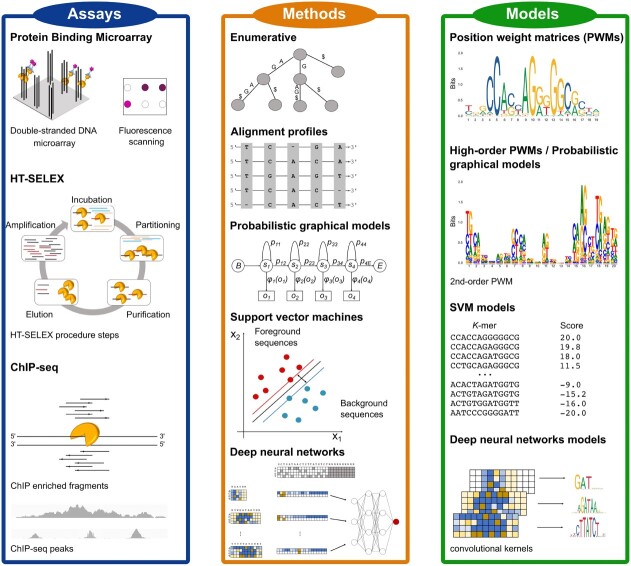
Transcription factors (TFs) are key regulatory proteins that control the transcriptional rate of cells by binding short DNA sequences called transcription factor binding sites (TFBS) or motifs. Identifying and characterizing TFBS is fundamental to understanding the regulatory mechanisms governing the transcriptional state of cells. During the last decades, several experimental methods have been developed to recover DNA sequences containing TFBS. In parallel, computational methods have been proposed to discover and identify TFBS motifs based on these DNA sequences. This is one of the most widely investigated problems in bioinformatics and is referred to as the motif discovery problem. In this manuscript, we review classical and novel experimental and computational methods developed to discover and characterize TFBS motifs in DNA sequences, highlighting their advantages and drawbacks. We also discuss open challenges and future perspectives that could fill the remaining gaps in the field.
Keywords: motif discovery algorithms; motif models; transcription factors; transcription factors motif discovery.
© The Author(s) 2023. Published by Oxford University Press. All rights reserved. For Permissions, please email: journals.permissions@oup.com.
Figures