Meta-Analysis
. 2023 Apr 26;13(1):6809.
doi: 10.1038/s41598-023-33182-3.

Prevalence and incidence of stroke in Latin America and the Caribbean: a systematic review and meta-analysis

Affiliations
Meta-Analysis

Prevalence and incidence of stroke in Latin America and the Caribbean: a systematic review and meta-analysis

Diego Cagna-Castillo et al. Sci Rep. .

Abstract

Stroke is a recurrent and well-known cardiovascular event and a leading cause of death worldwide. We identified reliable epidemiological evidence of stroke in Latin America and the Caribbean (LAC) and estimated the prevalence and incidence of stroke, overall and by sex, in that region. A systematic search in OVID (Medline, Embase and Global Health) and in the Latin America and Caribbean Health Sciences Literature (LILACS) until the end of 2020 was made for all cross-sectional or longitudinal studies estimating (or allowing the estimation of) the prevalence or incidence of stroke among individuals of the general population ≥ 18 years from LAC countries. No language restriction was applied. Studies were assessed for methodological quality and risk of bias. Pooled estimates were calculated using random effect meta-analysis as high heterogeneity was expected. A total of 31 papers for prevalence and 11 papers for incidence were included in the review for analysis. The overall pooled stroke prevalence was 32 (95% CI 26-38) per 1000 subjects and were similar among men (21; 95% CI 17-25) and women (20; 95% CI 16-23) per 1000 subjects. The overall pooled stroke incidence was 255 (95% CI 217-293) per 100 000 person-years, being higher in men (261; 95% CI 221-301) compared to women (217; 95% CI 184-250) per 100 000 person-years. Our results highlight the relevance of the prevalence and incidence of stroke in the LAC region. The estimates were similar in stroke prevalence by sex, but with higher incidence rates among males than females. Subgroup analyses highlight the need for standardized methodologies to obtain appropriate prevalence and incidence estimates at the population level in a region with a great burden of cardiovascular events.


Conflict of interest statement

The authors declare no competing interests.

Figures
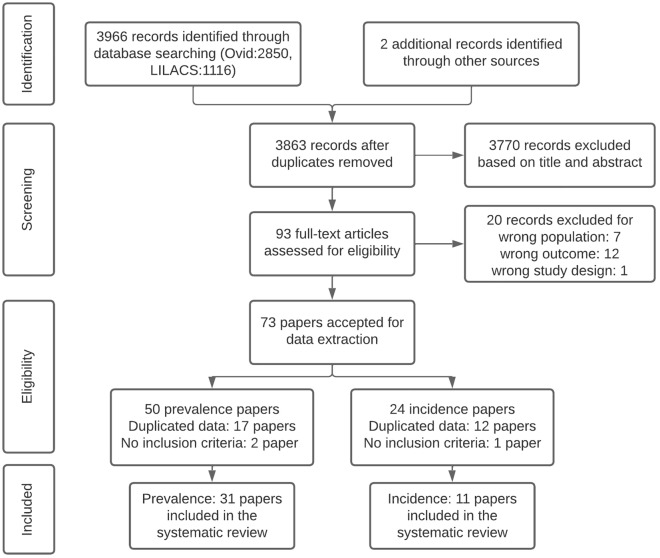
Figure 1
Figure 1
Study selection flowchart. The inclusion and exclusion criteria and the search strategy constructed are shown in detail in the main text and Supplementary Table I.
Figure 2
Figure 2
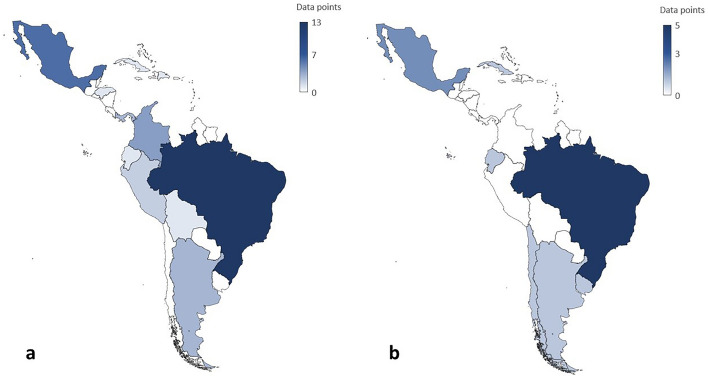
Scientific output map. Total data points for prevalence (a) and incidence (b) studies in the general population by country and geographic data gaps. Countries in which data were not available are shown in white.
Figure 3
Figure 3
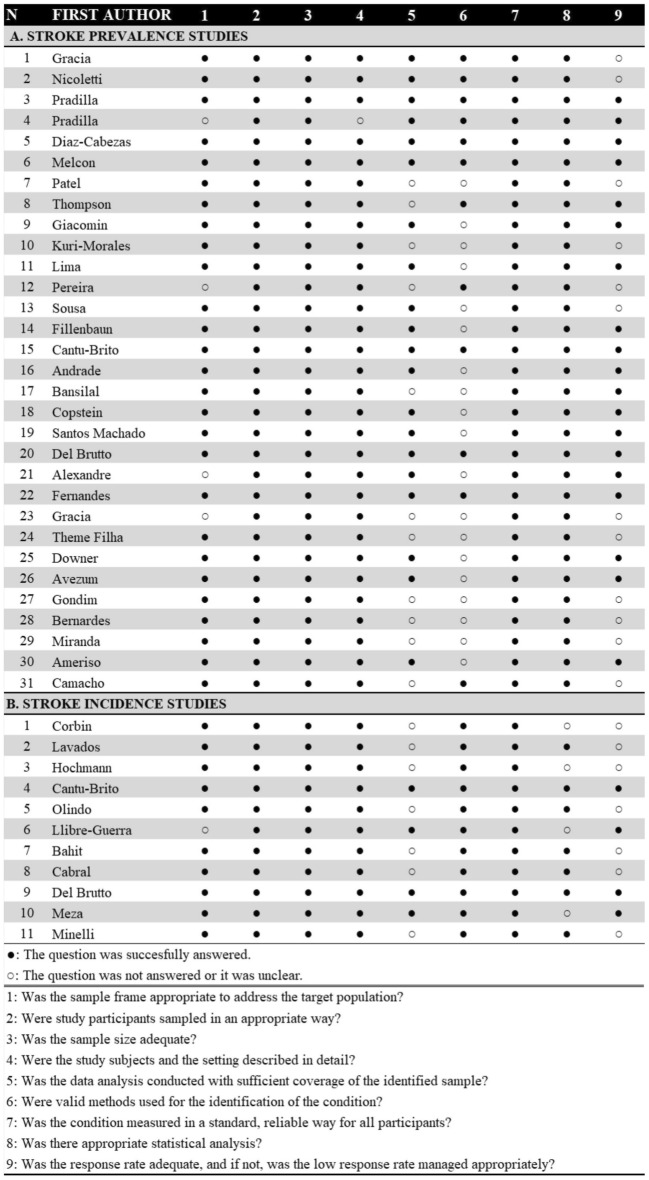
Quality assessment. Assessed with the Critical Appraisal Checklist. (a) Prevalence studies. (b) Incidence studies. A low risk of bias was defined as ≥ 8 points, and a high risk of bias was defined as < 8 points in the checklist.
Figure 4
Figure 4
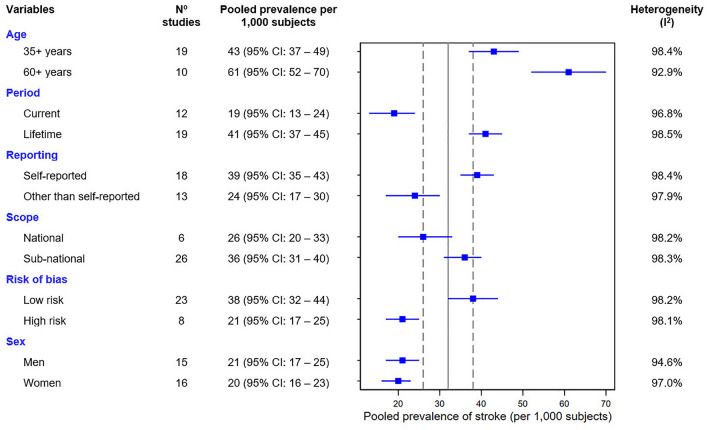
Forest plot of prevalence rate about stroke in subgroup analysis according to different variables of interest. Meta-analysis was calculated by fitting a logistic-normal random-effect model without covariates and heterogeneity was assessed with the statistical test I2. Vertical continuous line represents the overall estimate of the prevalence of stroke in the general population and dashed lines represent the 95% confidence interval (CI). Detailed forest plot of the general population prevalence rate in Supplementary Figure I.
Figure 5
Figure 5
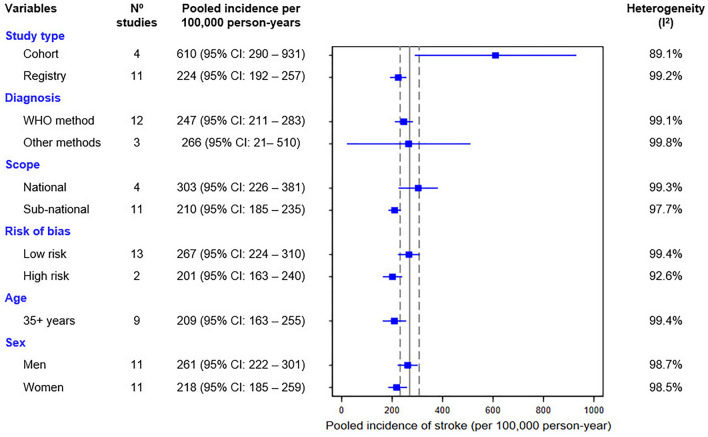
Forest plot of incidence rate about stroke in subgroup analysis according to different variables of interest. Meta-analysis was calculated by fitting a logistic-normal random-effect model without covariates and heterogeneity was assessed with the statistical test I2. Vertical continuous line represents the overall estimate of the incidence of stroke in the general population and dashed lines represent the 95% confidence interval (CI). Detailed forest plot of the general population incidence rate in Supplementary Figure II.

References

    1. Aho K, et al. Cerebrovascular disease in the community: Results of a WHO collaborative study. Bull. World Health Organ. 1980;58:113–130. - PMC - PubMed
    1. Brønnum-Hansen H, Davidsen M, Thorvaldsen P. Long-term survival and causes of death after stroke. Stroke. 2001;32:2131–2136. doi: 10.1161/hs0901.094253. - DOI - PubMed
    1. Feigin VL, et al. Global, regional, and national burden of stroke and its risk factors, 1990–2019: A systematic analysis for the Global Burden of Disease Study 2019. Lancet Neurol. 2021 doi: 10.1016/S1474-4422(21)00252-0. - DOI - PMC - PubMed
    1. World Bank. World Bank Country and Lending Groups.
    1. Sudlow CLM, Warlow CP. Comparing stroke incidence worldwide: What makes studies comparable? Stroke. 1996;27:550–558. doi: 10.1161/01.STR.27.3.550. - DOI - PubMed

Publication types