


Neurocognitive Dysfunction With Neuronal Injury in People With HIV on Long-Duration Antiretroviral Therapy
- PMID: 37105760
- PMCID: PMC10264056
- DOI: 10.1212/WNL.0000000000207339
Neurocognitive Dysfunction With Neuronal Injury in People With HIV on Long-Duration Antiretroviral Therapy
Abstract
Background and objectives: Neurologic outcomes in people with HIV (PWH) on long-duration antiretroviral therapy (ART) are not fully understood, and the underlying pathophysiology is unclear. To address this, we established a cohort of such individuals and compared them with HIV-negative controls using a novel matching technique. Both groups underwent extensive cognitive testing, evaluation for psychiatric measures, and MRI and CSF analyses.
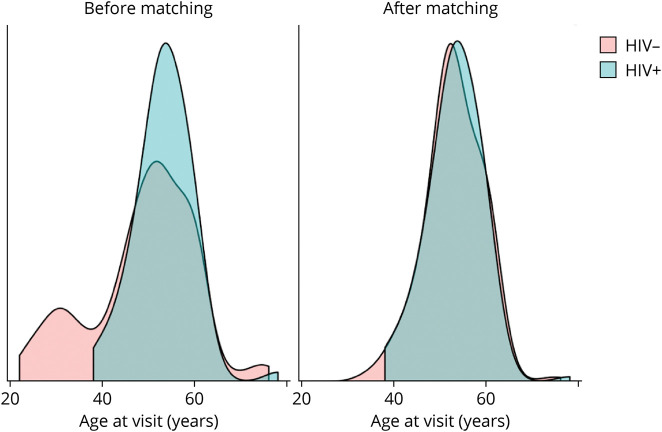
Methods: Participants underwent comprehensive neuropsychological testing and completed standardized questionnaires measuring depressive symptoms, perceptions of own functioning, and activities of daily living as part of an observational study. Brain MRI and lumbar puncture were optional. Coarsened Exact Matching was used to reduce between-group differences in age and sex, and weighted linear/logistic regression models were used to assess the effect of HIV on outcomes.
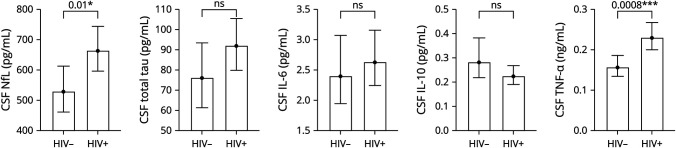
Results: Data were analyzed from 155 PWH on ART for at least 15 years and 100 HIV-negative controls. Compared with controls, PWH scored lower in the domains of attention/working memory (PWH least square mean [LSM] = 50.4 vs controls LSM = 53.1, p = 0.008) and motor function (44.6 vs 47.7, p = 0.009) and a test of information processing speed (symbol search 30.3 vs 32.2, p = 0.003). They were more likely to self-report a higher number of cognitive difficulties in everyday life (p = 0.011). PWH also reported more depressive symptoms, general anxiety, and use of psychiatric medications (all with p < 0.05). PWH had reduced proportions of subcortical gray matter on MRI (β = -0.001, p < 0.001), and CSF showed elevated levels of neurofilament light chain (664 vs 529 pg/mL, p = 0.01) and tumor necrosis factor α (0.229 vs 0.156 ng/mL, p = 0.0008).
Discussion: PWH, despite effective ART for over a decade, displayed neurocognitive deficits and mood abnormalities. MRI and CSF analyses revealed reduced brain volume and signs of ongoing neuronal injury and neuroinflammation. As the already large proportion of virologically controlled PWH continues to grow, longitudinal studies should be conducted to elucidate the implications of cognitive, psychiatric, MRI, and CSF abnormalities in this group.
Written work prepared by employees of the Federal Government as part of their official duties is, under the U.S. Copyright Act, a “work of the United States Government” for which copyright protection under Title 17 of the United States Code is not available. As such, copyright does not extend to the contributions of employees of the Federal Government.
Conflict of interest statement
The authors report no relevant disclosures. Go to
Figures
References
-
- Cysique LA, Brew BJ. Prevalence of non-confounded HIV-associated neurocognitive impairment in the context of plasma HIV RNA suppression. J Neurovirol. 2011;17(2):176-183. - PubMed
-
- Ellis RJ, Deutsch R, Heaton RK, et al. . Neurocognitive impairment is an independent risk factor for death in HIV infection. San Diego HIV Neurobehavioral Research Center Group. Arch Neurol. 1997;54(4):416-424. - PubMed
Publication types
MeSH terms
LinkOut - more resources
Full Text Sources
Medical
Research Materials
