


Ethnic diversity fosters the social integration of refugee students
- PMID: 37106079
- PMCID: PMC10289893
- DOI: 10.1038/s41562-023-01577-x
Ethnic diversity fosters the social integration of refugee students
Abstract
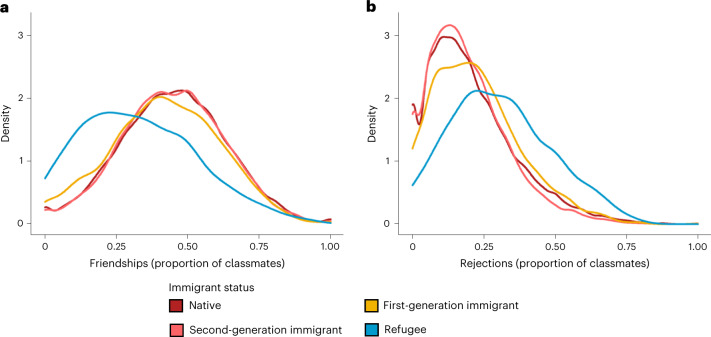
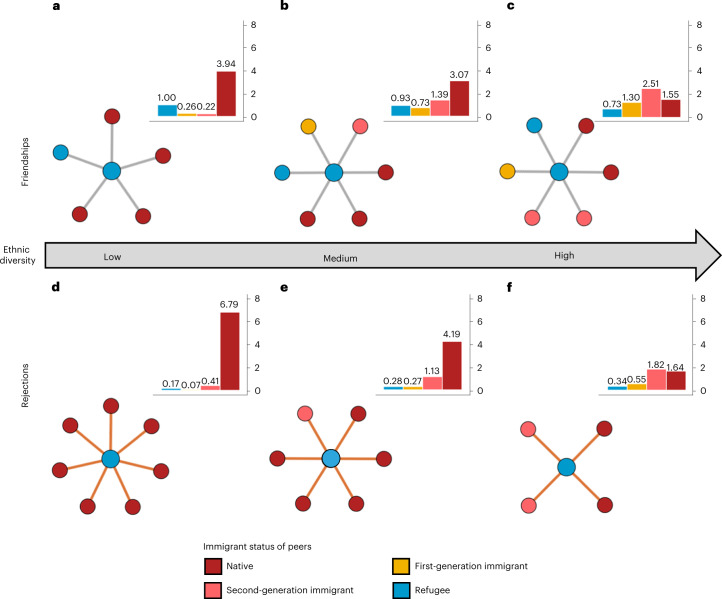
Forced migration has become a global megatrend, and many refugees are school aged. As social integration is key to their wellbeing and success, it is pivotal to determine factors that promote the social integration of refugee youth within schools. Here, using a large, nationally representative social network dataset from Germany, we examine the relationships of refugee adolescents with their peers (304 classrooms, 6,390 adolescents and 487 refugees). We find that refugee adolescents have fewer friends and are more often rejected as desk mates than their classmates. Crucially, however, they are less rejected in more diverse classrooms. This results from two basic processes: (1) more opportunities to meet other ethnic minority peers, who are more accepting of refugees in general and (2) higher acceptance of refugee adolescents by ethnic majority peers in more diverse settings. Our results can help promote the social adjustment of young refugees in school and mitigate the negative consequences of prejudice.
© 2023. The Author(s).
Conflict of interest statement
The authors declare that there are no conflicts of interest.
Figures

References
-
- Global trends 2019. Forced displacement in 2019. UNHCR The UN Refugee Agencyhttps://www.unhcr.org/5ee200e37.pdf (2020).
-
- Latest statistics and graphics on refugee and migrant children. Latest information on children arriving in Europe. UNICEFhttps://www.unicef.org/eca/emergencies/latest-statistics-and-graphics-re... (2020).
-
- Suárez-Orozco C, Motti-Stefanidi F, Marks A, Katsiaficas D. An integrative risk and resilience model for understanding the adaptation of immigrant-origin children and youth. Am. Psychol. 2018;73:781–796. - PubMed
-
- Larson R, Richards MH. Daily companionship in late childhood and early adolescence: changing developmental contexts. Child Dev. 1991;62:284–300. - PubMed
-
- Lorenz G, Boda Z, Salikutluk Z, Jansen M. Social influence or selection? Peer effects on the development of adolescents’ educational expectations in Germany. Br. J. Sociol. Educ. 2020;41:643–669.
Publication types
MeSH terms
Grants and funding
LinkOut - more resources
Full Text Sources
Research Materials
