


Implementation of Exome Sequencing in Clinical Practice for Neurological Disorders
- PMID: 37107571
- PMCID: PMC10137364
- DOI: 10.3390/genes14040813
Implementation of Exome Sequencing in Clinical Practice for Neurological Disorders
Abstract
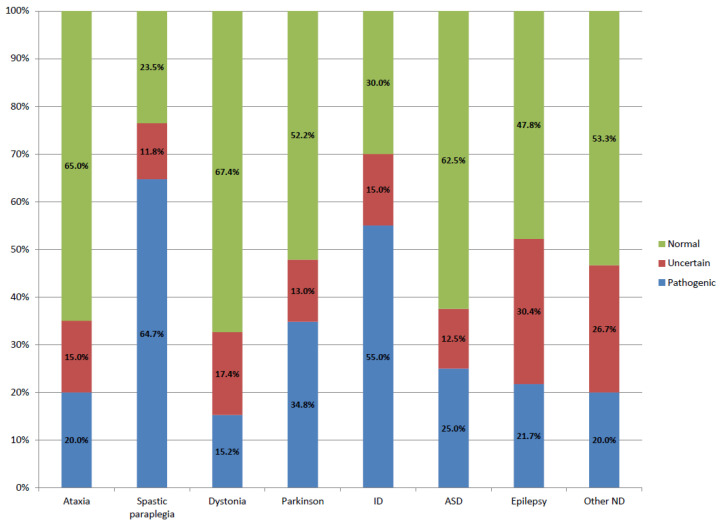
Neurological disorders (ND) are diseases that affect the brain and the central and autonomic nervous systems, such as neurodevelopmental disorders, cerebellar ataxias, Parkinson's disease, or epilepsies. Nowadays, recommendations of the American College of Medical Genetics and Genomics strongly recommend applying next generation sequencing (NGS) as a first-line test in patients with these disorders. Whole exome sequencing (WES) is widely regarded as the current technology of choice for diagnosing monogenic ND. The introduction of NGS allows for rapid and inexpensive large-scale genomic analysis and has led to enormous progress in deciphering monogenic forms of various genetic diseases. The simultaneous analysis of several potentially mutated genes improves the diagnostic process, making it faster and more efficient. The main aim of this report is to discuss the impact and advantages of the implementation of WES into the clinical diagnosis and management of ND. Therefore, we have performed a retrospective evaluation of WES application in 209 cases referred to the Department of Biochemistry and Molecular Genetics of the Hospital Clinic of Barcelona for WES sequencing derived from neurologists or clinical geneticists. In addition, we have further discussed some important facts regarding classification criteria for pathogenicity of rare variants, variants of unknown significance, deleterious variants, different clinical phenotypes, or frequency of actionable secondary findings. Different studies have shown that WES implementation establish diagnostic rate around 32% in ND and the continuous molecular diagnosis is essential to solve the remaining cases.
Keywords: Parkinson; ataxia; autism spectrum disorder; dystonia; epilepsy; neurodevelopmental disorders; neurological disorders; spastic paraplegia; whole exome sequencing.
Conflict of interest statement
The authors declare no conflict of interest.
Figures
References
-
- Hartman P., Beckman K., Silverstein K., Yohe S., Schomaker M., Henzler C., Onsongo G., Lam H.C., Munro S., Daniel J., et al. Next generation sequencing for clinical diagnostics: Five year experience of an academic laboratory. Mol. Genet. Metab. Rep. 2019;19:100464. doi: 10.1016/j.ymgmr.2019.100464. - DOI - PMC - PubMed
-
- Marshall C.R., Chowdhury S., Taft R.J., Lebo M.S., Buchan J.G., Harrison S.M., Rowsey R., Klee E.W., Liu P., Worthey E.A., et al. Best practices for the analytical validation of clinical whole-genome sequencing intended for the diagnosis of germline disease. NPJ Genom. Med. 2020;5:47. doi: 10.1038/s41525-020-00154-9. - DOI - PMC - PubMed
-
- Miller D.T., Adam M.P., Aradhya S., Biesecker L.G., Brothman A.R., Carter N.P., Church D.M., Crolla J.A., Eichler E.E., Epstein C.J., et al. Consensus Statement: Chromosomal Microarray Is a First-Tier Clinical Diagnostic Test for Individuals with Developmental Disabilities or Congenital Anomalies. Am. J. Hum. Genet. 2010;86:749–764. doi: 10.1016/j.ajhg.2010.04.006. - DOI - PMC - PubMed
Publication types
MeSH terms
LinkOut - more resources
Full Text Sources
Medical
