


Do you Hear what I Hear? A Qualitative Study Examining Psychological Associations Underlying Evaluations of Everyday Sounds in Patients with Chronic Tinnitus
- PMID: 37109076
- PMCID: PMC10145674
- DOI: 10.3390/jpm13040690
Do you Hear what I Hear? A Qualitative Study Examining Psychological Associations Underlying Evaluations of Everyday Sounds in Patients with Chronic Tinnitus
Abstract
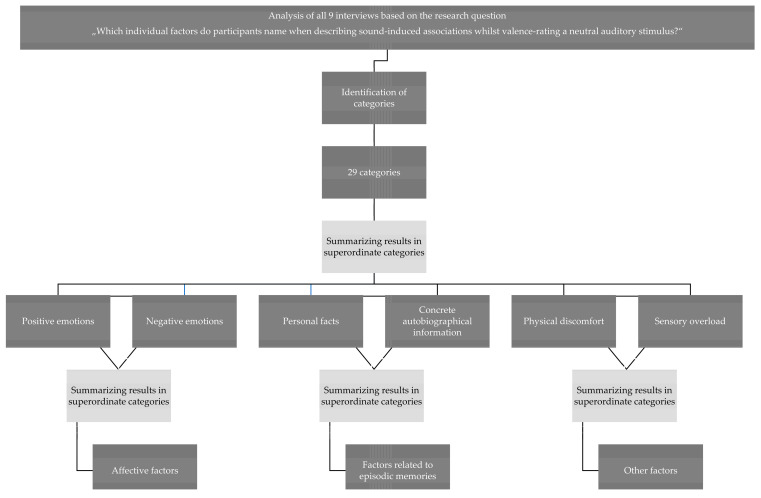
Tinnitus is a multifactorial phenomenon and psychological, audiological, or medical factors can facilitate its onset or maintenance. A growing body of research investigates individuals' perceptions, associations, and experiences of living with tinnitus. This body of research examines tinnitus as a condition rather than a symptom. We examine a sample of chronic tinnitus patients in terms of associations that are induced by neutral sounds. In particular, we investigate how patients with chronic tinnitus ascribe meaning to those neutral sounds. The present study uses Mayring's content analysis to explore the content of psychological associations underlying valence ratings of everyday neutral sounds. Nine tinnitus patients completed a hearing exercise, during which they listened to seven neutral sounds, following which we examined their sound-induced associations using semi-structured interviews. Three groups of factors influenced patients' associations and valence ratings of neutral sounds: affect, episodic memory, and 'other'. The former two factors further comprised two subcategories. In line with previous psychoaudiological research designs, our findings suggest that neutral, everyday auditory stimuli evoke strong affective reactions-possibly through serving as retrieval cues for episodic memories. Based on these findings, we discuss our results in the context of previous psychoaudiological findings and propose further research concerning psychological associations that may specifically underlie the tinnitus sound.
Keywords: associations; neutral sounds; qualitative design; tinnitus.
Conflict of interest statement
The authors declare no conflict of interest.
Figures
References
-
- Jastreboff P.J., Hazell J.W.P. Tinnitus Retraining Therapy: Implementing the Neurophysiological Model. Cambridge University Press; Cambridge, UK: 2007. p. 292.
-
- Basso L., Boecking B., Brueggemann P., Pedersen N.L., Canlon B., Cederroth C.R., Mazurek B. Subjective hearing ability, physical and mental comorbidities in individuals with bothersome tinnitus in a Swedish population sample. Prog. Brain Res. 2021;260:51–78. doi: 10.1016/bs.pbr.2020.10.001. - DOI - PubMed
LinkOut - more resources
Full Text Sources
