Review
. 2023 Mar 31;11(4):916.
doi: 10.3390/microorganisms11040916.

Anti- Pseudomonas aeruginosa Vaccines and Therapies: An Assessment of Clinical Trials

Affiliations
Review

Anti- Pseudomonas aeruginosa Vaccines and Therapies: An Assessment of Clinical Trials

Moamen M Elmassry et al. Microorganisms. .

Abstract

Pseudomonas aeruginosa is a Gram-negative opportunistic pathogen that causes high morbidity and mortality in cystic fibrosis (CF) and immunocompromised patients, including patients with ventilator-associated pneumonia (VAP), severely burned patients, and patients with surgical wounds. Due to the intrinsic and extrinsic antibiotic resistance mechanisms, the ability to produce several cell-associated and extracellular virulence factors, and the capacity to adapt to several environmental conditions, eradicating P. aeruginosa within infected patients is difficult. Pseudomonas aeruginosa is one of the six multi-drug-resistant pathogens (ESKAPE) considered by the World Health Organization (WHO) as an entire group for which the development of novel antibiotics is urgently needed. In the United States (US) and within the last several years, P. aeruginosa caused 27% of deaths and approximately USD 767 million annually in health-care costs. Several P. aeruginosa therapies, including new antimicrobial agents, derivatives of existing antibiotics, novel antimicrobial agents such as bacteriophages and their chelators, potential vaccines targeting specific virulence factors, and immunotherapies have been developed. Within the last 2-3 decades, the efficacy of these different treatments was tested in clinical and preclinical trials. Despite these trials, no P. aeruginosa treatment is currently approved or available. In this review, we examined several of these clinicals, specifically those designed to combat P. aeruginosa infections in CF patients, patients with P. aeruginosa VAP, and P. aeruginosa-infected burn patients.

Keywords: Pseudomonas aeruginosa virulence factors; antibiotics; bacteriophages; biofilms; chronic lung infection; clinical trials; cystic fibrosis; immunotherapy; vaccines; ventilator-associated pneumonia.


Conflict of interest statement

The authors declare no conflict of interest.

Figures
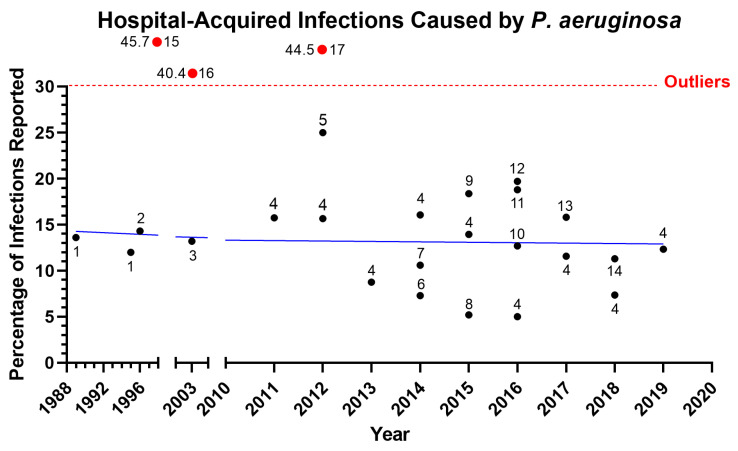
Figure 1
Figure 1
Infection rates of P. aeruginosa in hospitalized patients over the past 3 decades (1989–2019). Hospital-acquired infections reported included bloodstream infections and catheter-associated bloodstream infections, catheter-associated urinary tract infection, surgical site infections and burn wound infections, and hospital-associated and ventilator-associated pneumonia; although not every article reported every category, all except two included three or more categories. The blue line is a regression line for the data excluding outliers, which are shown above the dotted red line. The numbers associated with the black circles indicate reference numbers; the numbers to the left of the red circles are the percentages, and those to the left are the reference numbers. References: 1. [5], 2. [6], 3. [7], 4. [8], 5. [9], 6. [10], 7. [11], 8. [12], 9. [13], 10. [14], 11. [15], 12. [16], 13. [17], 14. [18]. Outliers: 15. [19], 16. [20], 17. [21].
Figure 2
Figure 2
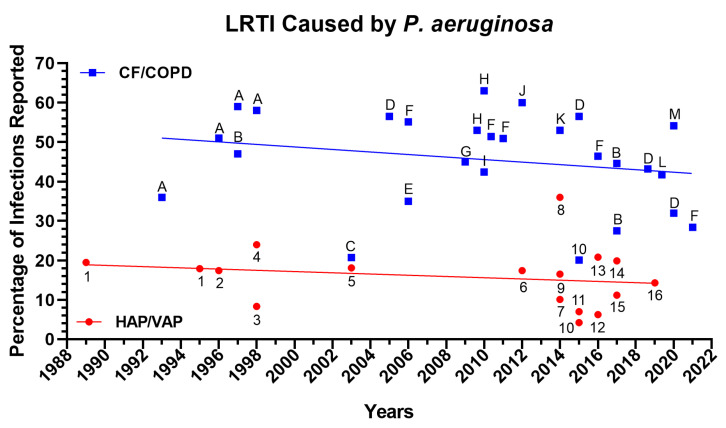
Lower respiratory tract infection (LTRI) rates of P. aeruginosa. Reported rates of hospital-associated and ventilator-associated pneumonia (HAP/VAP) over the past 3 decades (1989–2019) and the regression line for the data are in red. The rates for patients with cystic fibrosis (CF) or chronic obstructive pulmonary disease (COPD) and the associated regression line are in blue. The numbers and letters associated with the red circles and blue squares, respectively, indicate the reference numbers. References for HAP/VAP: 1. [5], 2. [6], 3. [22], 4. [19], 5. [7], 6. [21], 7. [11], 8. [23], 9. [10], 10. [24], 11. [12], 12. [15], 13. [16], 14. [17], 15. [25], 16. [8]. References for CF/COPD: A. [26], B. [27], C. [28], D. [29], E. [30], F. [31], G. [32], H. [33], I. [34], J. [35], K. [36], L. [37], M. [38], 10. [24].
Figure 3
Figure 3
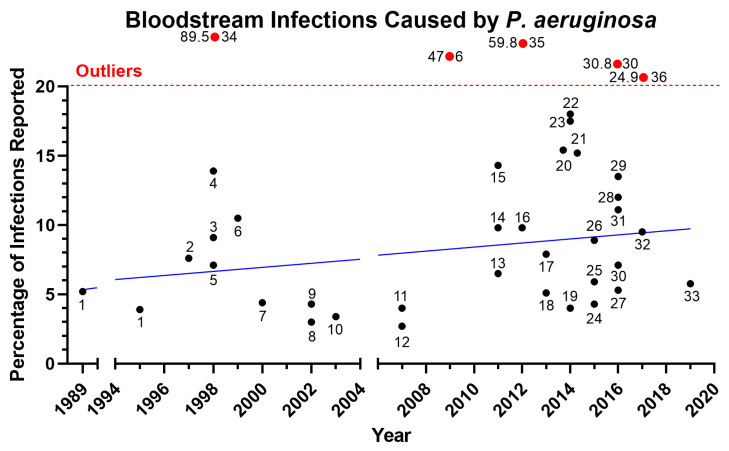
Rates for bloodstream infections caused by P. aeruginosa in hospitalized patients over the past 3 decades (1989–2019). Hospital-acquired infections included bloodstream infections and catheter-associated bloodstream infections, catheter-associated urinary tract infection, surgical site infections and burn wound infections, and hospital-associated and ventilator-associated pneumonia; although not every article reported every category, most included at least three. Each circle represents the rate reported in the study, and the year corresponds to the last collection date of the data. The solid blue line represents the linear regression of the infection rate over the years excluding outliers, which are shown above the dotted red line. The numbers associated with the black circles indicate reference numbers; the numbers to the left of the red circles are the percentages, and those to the right are the reference numbers. References: 1. [5], 2. [39], 3. [22], 4. [19], 5. [40], 6. [41], 7. [42], 8. [43], 9. [3], 10. [7], 11. [44], 12. [45], 13. [46], 14. [47], 15. [48], 16. [49], 17. [50], 18. [51], 19. [10], 20. [52], 21. [11], 22. [53], 23. [54], 24. [55], 25. [56], 26. [57], 27. [58], 28. [59], 29. [60], 30. [61], 31. [16], 32. [17], 33. [8]. Outliers: 34. [62], 35. [21], 36. [63].

References

    1. Al-Hasan M.N., Wilson J.W., Lahr B.D., Eckel-Passow J.E., Baddour L.M. Incidence of Pseudomonas aeruginosa bacteremia: A population-based study. Am. J. Med. 2008;121:702–708. doi: 10.1016/j.amjmed.2008.03.029. - DOI - PMC - PubMed
    1. Peleg A.Y., Hooper D.C. Hospital-acquired infections due to gram-negative bacteria. N. Engl. J. Med. 2010;362:1804–1813. doi: 10.1056/NEJMra0904124. - DOI - PMC - PubMed
    1. Wisplinghoff H., Bischoff T., Tallent S.M., Seifert H., Wenzel R.P., Edmond M.B. Nosocomial bloodstream infections in US hospitals: Analysis of 24,179 cases from a prospective nationwide surveillance study. Clin. Infect. Dis. 2004;39:309–317. doi: 10.1086/421946. - DOI - PubMed
    1. Telling K., Laht M., Brauer A., Remm M., Kisand V., Maimets M., Tenson T., Lutsar I. Multidrug resistant Pseudomonas aeruginosa in Estonian hospitals. BMC Infect. Dis. 2018;18:513. doi: 10.1186/s12879-018-3421-1. - DOI - PMC - PubMed
    1. Fridkin S.K., Welbel S.F., Weinstein R.A. Magnitude and prevention of nosocomial infections in the intensive care unit. Infect. Dis. Clin. N. Am. 1997;11:479–496. doi: 10.1016/S0891-5520(05)70366-4. - DOI - PubMed

LinkOut - more resources