. 2023 Apr 14;13(8):1360.
doi: 10.3390/nano13081360.

Parabolic-Gaussian Double Quantum Wells under a Nonresonant Intense Laser Field

Affiliations

Parabolic-Gaussian Double Quantum Wells under a Nonresonant Intense Laser Field

Esin Kasapoglu et al. Nanomaterials (Basel). .

Abstract

In this paper, we investigate the electronic and optical properties of an electron in both symmetric and asymmetric double quantum wells that consist of a harmonic potential with an internal Gaussian barrier under a nonresonant intense laser field. The electronic structure was obtained by using the two-dimensional diagonalization method. To calculate the linear and nonlinear absorption, and refractive index coefficients, a combination of the standard density matrix formalism and the perturbation expansion method was used. The obtained results show that the electronic and thereby optical properties of the considered parabolic-Gaussian double quantum wells could be adjusted to obtain a suitable response to specific aims with parameter alterations such as well and barrier width, well depth, barrier height, and interwell coupling, in addition to the applied nonresonant intense laser field.

Keywords: double quantum well; intense laser field; parabolic–Gaussian potential.


Conflict of interest statement

The authors declare no conflict of interest.

Figures

Figure 1
Figure 1
Parabolic–Gaussian symmetric DQW (zo=0) potential for a constant value of k(=20 nm) versus the z-coordinate. Parabolic–Gaussian symmetric DQW, solid (dashed) curves are for A2=2.0 (A2=4.0) and black (red) curves A1=0.2 (A1=0.5) (a), Parabolic–Gaussian symmetric DQW confinement profiles and squared modulus of the wave-functions corresponding to the first 4 energy levels for αo=0 (solid curves) and αo=10 nm (dashed curves) (b), and Parabolic–Gaussian symmetric DQW potential and squared modulus of the wave-functions corresponding to the first 4 energy levels for αo=0 (solid curves) and αo=20 nm (dashed curves) (c). Results are for k=20 nm, A1=0.4 and A2=2.0.
Figure 2
Figure 2
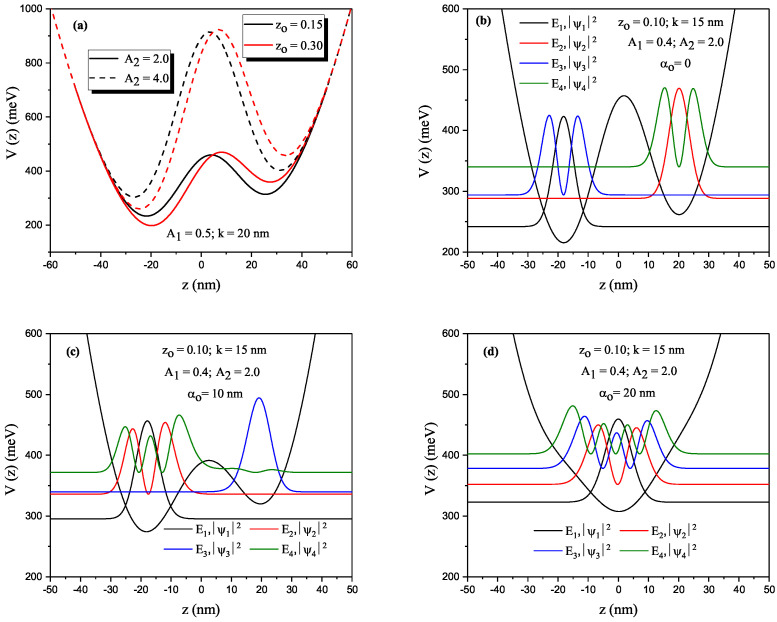
(a) Parabolic–Gaussian asymmetric DQW confinement profiles for the parameters of k=20 nm, A1=0.5, A2=2.0 (solid curves) and A2=4.0 (dashed curves) and for two different zo values, black (red) curve is for zo=0.15 (zo=0.30), parabolic–Gaussian asymmetric DQW potential and squared modulus of the wave functions corresponding to the first four energy levels for (b) αo=0, (c) αo=10 nm, and (d) αo=20 nm. The results in Figure 2b–d are for zo=0.10, k=15 nm, A1=0.4, A2=2.0.
Figure 3
Figure 3
For k=25 nm, A2=2.0, zo=0, (a) changes in the energies of the electron confined within parabolic–Gaussian symmetric DQW under the intense laser field versus parameter A1; (b) variation of energy differences between related levels versus the A1 parameter. Solid, dashed, and dotted curves are for αo=0, αo=10 nm, and αo=20 nm, respectively.
Figure 4
Figure 4
For A1=0.4, A2=2.0 and zo=0, (a) changes in the energies of the electron confined within parabolic–Gaussian symmetric DQW under the intense laser field versus the k parameter; (b) variation of energy differences between related levels versus the k parameter. Solid and dashed curves are for αo=0 and αo=10 nm, respectively.
Figure 5
Figure 5
For k=25 nm, A2=2.0 and zo=0, (a) variation in the total absorption coefficient versus the photon energy corresponding to the (2-3) transition in parabolic–Gaussian symmetric DQW; (b) variation in the total refractive index versus the photon energy, where black (red) curves are for A1=0.4 (A1=0.5) and solid, dashed, and dotted curves are for αo=0, αo=10 nm, and αo=20 nm, respectively.
Figure 6
Figure 6
For the transitions between energy levels in parabolic–Gaussian symmetric DQW with parameters zo=0, A1=0.4 and A2=2.0, (a) change in total absorption coefficients versus the photon energy; (b) variation in the total refractive index versus the photon energy, where black (red) curves are for k=25 nm (k=15 nm) and solid, dashed, and dotted curves are for αo=0, αo=10 nm, and αo=20 nm, respectively.
Figure 7
Figure 7
For A1=0.5 and A2=2.0 and k=25 nm, (a) variations in the first four lowest energy levels of the electron confined within parabolic–Gaussian asymmetric DQW under an intense laser field with respect to the zo parameter; (b) variation in energy differences between some levels versus the zo parameter. Solid, dashed, and dotted curves are for αo=0, αo=10 nm, and αo=20 nm, respectively.
Figure 8
Figure 8
For A1=0.4 and A2=2.0 and zo=0.10, (a) changes of the first four lowest energy levels of electron confined within parabolic–Gaussian asymmetric DQW under the intense laser field versus the k-parameter; (b) variation in energy differences between some levels versus the k parameter. Solid and dashed curves are for αo=0 and αo=10 nm, respectively.
Figure 9
Figure 9
For some transitions in parabolic–Gaussian asymmetric DQW with k=15 nm, zo=0.10, A1=0.4 and A2=2.0. (a) Variation in total absorption coefficients versus photon energy; (b) variation in total refractive index versus photon energy. Solid, dashed, and dotted curves are for αo=0, αo=10 nm, and αo=20 nm, respectively.
Figure 10
Figure 10
For some transitions in parabolic–Gaussian asymmetric DQW with k=25 nm, zo=0.10, A1=0.4 and A2=2.0. (a) Variation in the total absorption coefficients concerning photon energy; (b) variation in total refractive index concerning photon energy. Solid, dashed, and dotted curves are for αo=0, αo=10 nm, and αo=20 nm, respectively.

References

    1. Morse P.M. Diatomic molecules according to the wave machanics. II. Vibrational levels. Phys. Rev. 1929;34:57–64. doi: 10.1103/PhysRev.34.57. - DOI
    1. Rong Z., Kjaergaard H.G., Sage M.L. Comparison of the Morse and Deng-Fan potentials for X-H bonds in small molecules. Mol. Phys. 2003;101:2285–2294. doi: 10.1080/0026897031000137706. - DOI
    1. Jia C.S., Diao Y.F., Liu X.J., Wang P.Q., Liu J.Y., Zhang G.D. Equivalence of the Wei potential model and Tietz potential model for diatomic molecules. J. Chem. Phys. 2012;137:014101. doi: 10.1063/1.4731340. - DOI - PubMed
    1. Wang P.Q., Zhang L.H., Jia C.S., Liu J.Y. Equivalence of the three empirical potential energy models for diatomic molecules. J. Mol. Spectrosc. 2012;274:5–8. doi: 10.1016/j.jms.2012.03.005. - DOI
    1. Wang P.Q., Liu J.Y., Zhang L.H., Cao S.Y., Jia C.S. Improved expressions for the Schiöberg potential energy models for diatomic molecules. J. Mol. Spectrosc. 2012;278:23–26. doi: 10.1016/j.jms.2012.07.001. - DOI

LinkOut - more resources