. 2023 Mar 28;16(4):499.
doi: 10.3390/ph16040499.

Diverse Biological Activity of Benzofuroxan/Sterically Hindered Phenols Hybrids

Affiliations

Diverse Biological Activity of Benzofuroxan/Sterically Hindered Phenols Hybrids

Elena Chugunova et al. Pharmaceuticals (Basel). .

Abstract

Combining two pharmacophores in a molecule can lead to useful synergistic effects. Herein, we show hybrid systems that combine sterically hindered phenols with dinitrobenzofuroxan fragments exhibit a broad range of biological activities. The modular assembly of such phenol/benzofuroxan hybrids allows variations in the phenol/benzofuroxan ratio. Interestingly, the antimicrobial activity only appears when at least two benzofuroxan moieties are introduced per phenol. The most potent of the synthesized compounds exhibit high cytotoxicity against human duodenal adenocarcinoma (HuTu 80), human breast adenocarcinoma (MCF-7), and human cervical carcinoma cell lines. This toxicity is associated with the induction of apoptosis via the internal mitochondrial pathway and an increase in ROS production. Encouragingly, the index of selectivity relative to healthy tissues exceeds that for the reference drugs Doxorubicin and Sorafenib. The biostability of the leading compounds in whole mice blood is sufficiently high for their future quantification in biological matrices.

Keywords: ROS production; anti-cancer activity; apoptosis; benzofuroxan; cytotoxicity; sterically hindered phenol.


Conflict of interest statement

The authors declare no conflict of interest.

Figures
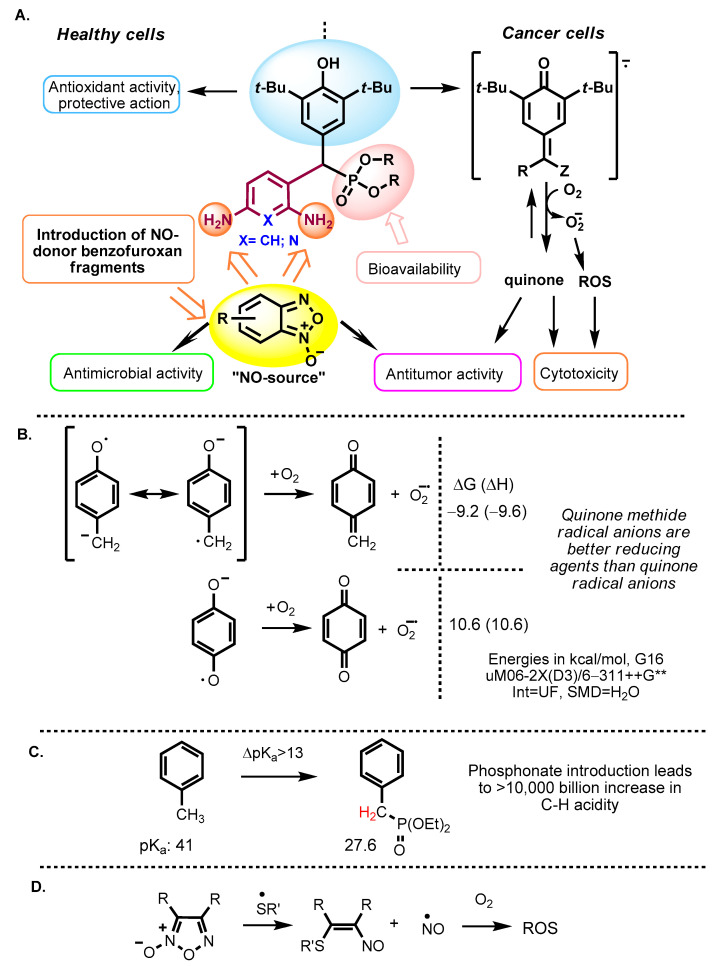
Figure 1
Figure 1
(A) General approach to the creation of new types of hybrid antitumor agents based on sterically hindered phenols (SHP) and benzofuroxans. (B) Redox cycling between phenols and quinone methides creates radical anions that can reduce molecular oxygen to a superoxide anion. (C) Phosphonate group greatly activates benzylic C-H bonds and facilitates quinone methide radical-anion formation. (D) Generation of NO and ROS from furoxans. ROS = Reactive Oxygen Species.
Scheme 1
Scheme 1
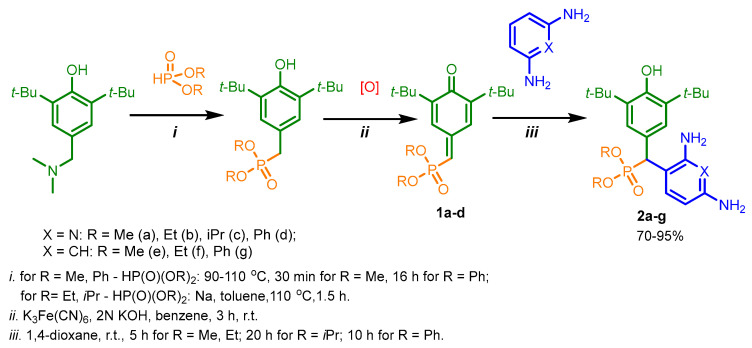
The synthesis of the starting SHPs 2 containing diaminopyridine or diaminophenyl fragments.
Scheme 2
Scheme 2
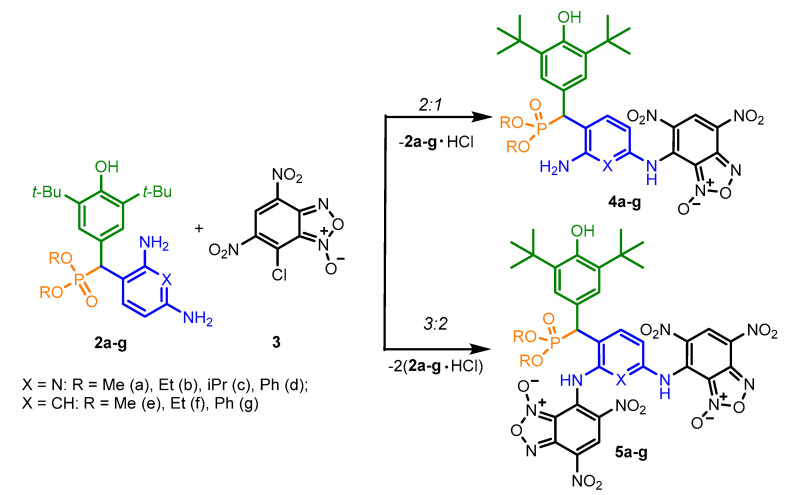
Synthesis of SHP/furoxan hybrids of varying composition.
Scheme 3
Scheme 3
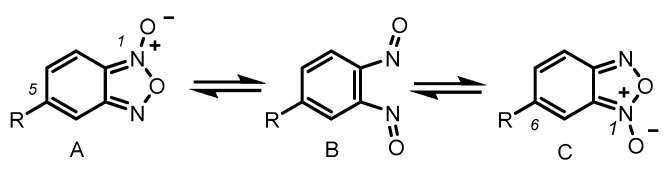
N-1-oxide/N-3-oxide tautomerism in benzofuroxan derivatives.
Figure 2
Figure 2
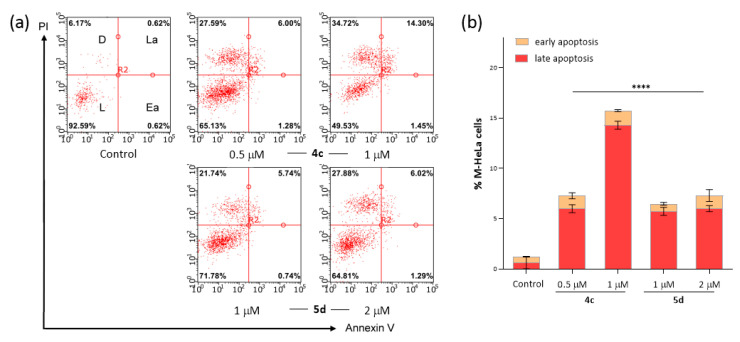
Induction of apoptosis in M-HeLa cancer cells by compounds 4c and 5d, evaluated by Flow Cytometry Assay, after cell labeling with propidium iodide (PI) and Annexin V- Alexa Fluor 647 (a). L, D, La and Ea labels in the top right control plot correspond to Live, Dead, Late apoptosis and Early apoptosis, respectively. Cells were either unlabeled and untreated (Control) or treated with IC50 and IC50/2 doses of test compounds for 48 h, as indicated. The quantitative analysis of early and late apoptotic cells after drug exposure is represented in (b). Data are presented as mean ± error of the mean (n = 3). **** p ≤ 0.0001 compared to control (one-way ANOVA). Concentration for 4c was (IC50/2- 0.5 µM and IC50—1.0 µM); for 5d (IC50/2—1.0 µM and IC50—2.0 µM).
Figure 3
Figure 3
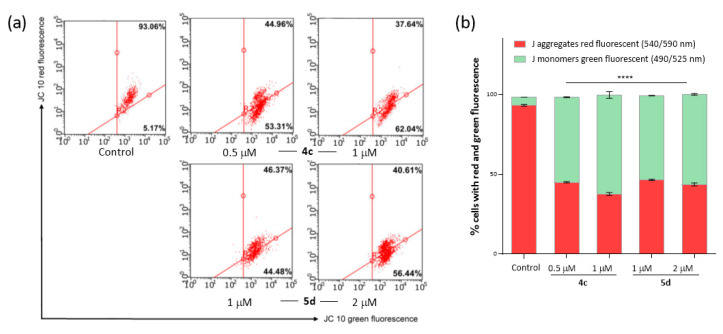
(a) Flow cytometry analysis of M-Hela cells treated with compounds 4c and 5d. (b) Quantitative determination of % cells with red aggregates and green monomers. Data are presented as mean ± error of the mean (n = 3). **** p ≤ 0.0001 compared to control (one-way ANOVA). Concentration for 4c was (IC50/2—0.5 µM and IC50—1.0 µM); for 5d (IC50/2—1.0 µM and IC50—2.0 µM).
Figure 4
Figure 4
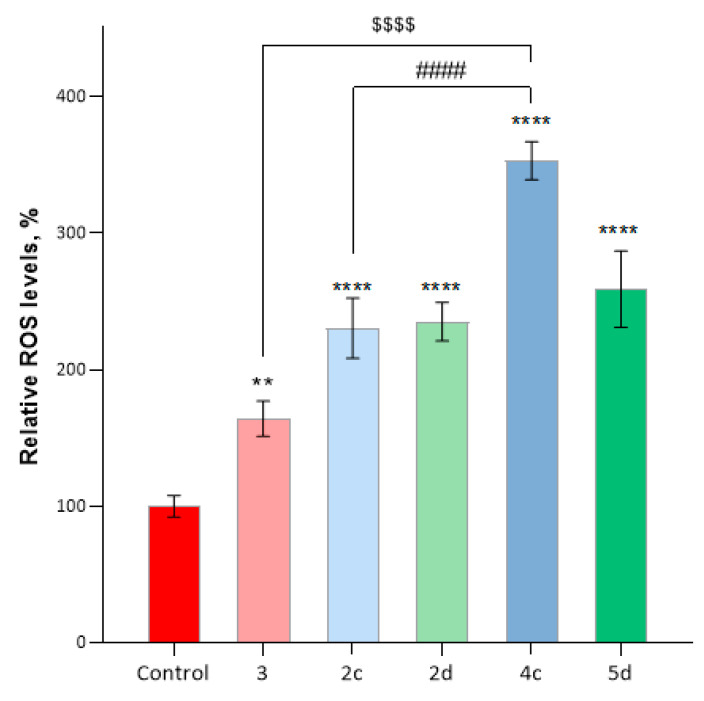
Induction of ROS production by compounds 2c, 2d, 3, 4c and 5d. The data were obtained with flow cytometry and the CellROX® Deep Red kit. Concentration for compounds was equivalent to IC50 cytotoxicity on M-HeLa cells. Data are presented as mean ± SD (n = 3). ** p < 0.01, **** p < 0.0001 compared to control; #### p ≤ 0.0001, compared to 2c; $$$$ p ≤ 0.0001 and compared to 3 (one-way ANOVA).

References

    1. Wild C.P., Weiderpass E., Stewart B.W., editors. World Cancer Report: Cancer Research for Cancer Prevention. International Agency for Research on Cancer; Lyon, France: 2020.
    1. Gonzalez F.J. Role of cytochromes P450 in chemical toxicity and oxidative stress: Studies with CYP2E1. Mutat. Res. Mol. Mech. Mutagen. 2005;569:101–110. doi: 10.1016/j.mrfmmm.2004.04.021. - DOI - PubMed
    1. Halliwell B. Oxidative stress and cancer: Have we moved forward? Biochem. J. 2007;401:1–11. doi: 10.1042/BJ20061131. - DOI - PubMed
    1. Policastro L.L., Ibañez I.L., Notcovich C., Duran H.A., Podhajcer O.L. The Tumor Microenvironment: Characterization, Redox Considerations, and Novel Approaches for Reactive Oxygen Species-Targeted Gene Therapy. Antioxid. Redox Signal. 2013;19:854–895. doi: 10.1089/ars.2011.4367. - DOI - PubMed
    1. Sotgia F., Martinez-Outschoorn U.E., Lisanti M.P. Mitochondrial oxidative stress drives tumor progression and metastasis: Should we use antioxidants as a key component of cancer treatment and prevention? BMC Med. 2011;9:62. doi: 10.1186/1741-7015-9-62. - DOI - PMC - PubMed

LinkOut - more resources