Review
. 2023 Apr 4;16(4):541.
doi: 10.3390/ph16040541.

Therapeutic Potential of Molecular Hydrogen in Metabolic Diseases from Bench to Bedside

Affiliations
Review

Therapeutic Potential of Molecular Hydrogen in Metabolic Diseases from Bench to Bedside

Fei Xie et al. Pharmaceuticals (Basel). .

Abstract

Oxidative stress and chronic inflammation have been implicated in the pathophysiology of metabolic diseases, including diabetes mellitus (DM), metabolic syndrome (MS), fatty liver (FL), atherosclerosis (AS), and obesity. Molecular hydrogen (H2) has long been considered a physiologically inert gas. In the last two decades, accumulating evidence from pre-clinical and clinical studies has indicated that H2 may act as an antioxidant to exert therapeutic and preventive effects on various disorders, including metabolic diseases. However, the mechanisms underlying the action of H2 remain unclear. The purpose of this review was to (1) provide an overview of the current research on the potential effects of H2 on metabolic diseases; (2) discuss the possible mechanisms underlying these effects, including the canonical anti-oxidative, anti-inflammatory, and anti-apoptotic effects, as well as suppression of ER stress, activation of autophagy, improvement of mitochondrial function, regulation of gut microbiota, and other possible mechanisms. The potential target molecules of H2 will also be discussed. With more high-quality clinical trials and in-depth mechanism research, it is believed that H2 will eventually be applied to clinical practice in the future, to benefit more patients with metabolic disease.

Keywords: clinical trials; metabolic diseases; molecular hydrogen (H2); oxidative stress; pre-clinical studies.


Conflict of interest statement

The authors declare no conflict of interest.

Figures
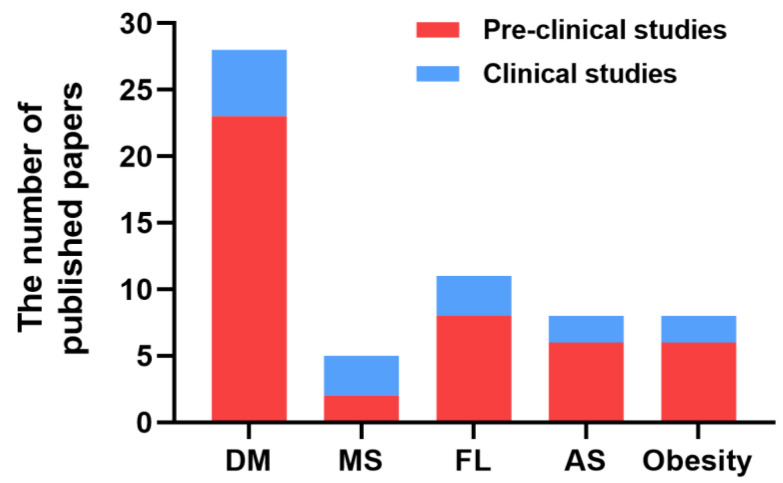
Figure 1
Figure 1
The number of papers published on the effects of H2 on metabolic diseases.
Figure 2
Figure 2
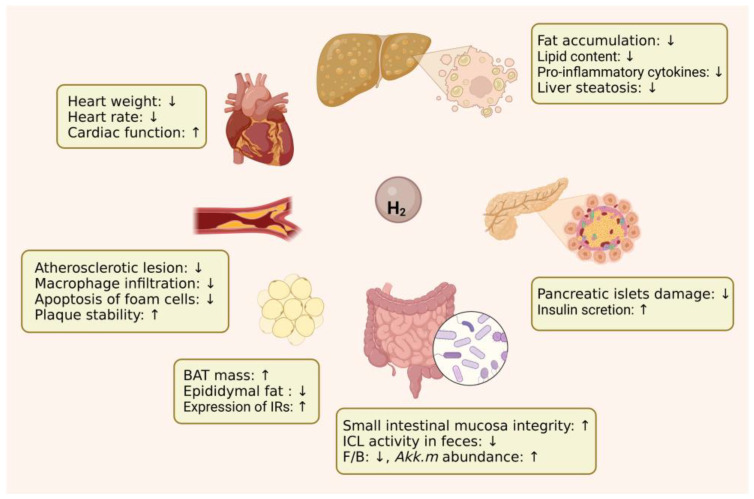
The main effects of H2 on various tissues in metabolic diseases. Abbreviations: BAT, brown adipose tissue; IRs: insulin receptors; ICL: isocitrate lyase; F/B, Firmicutes/Bacteroidetes; Akk.m, Akkermansia muciniphila.
Figure 3
Figure 3
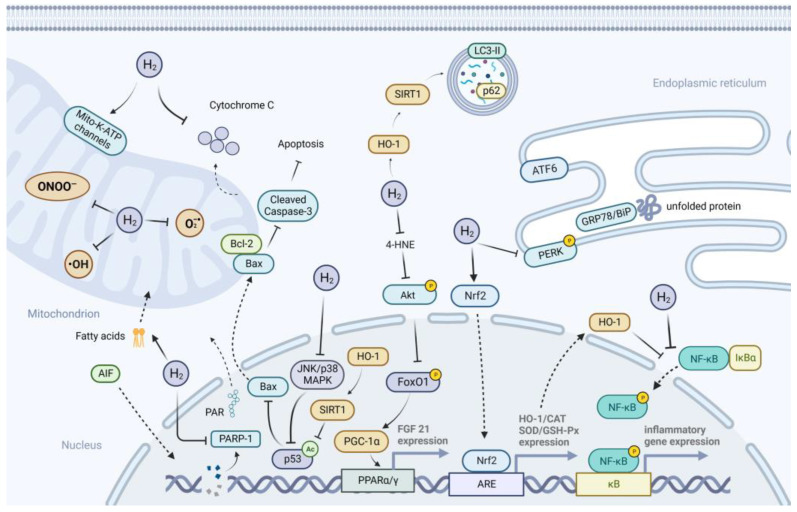
The possible mechanisms underlying the effects of H2 on metabolic diseases. The figure demonstrates the potential mechanisms underlying the effects of H2 on metabolic diseases, including scavenging or inhibiting generation of ROS; activating Mito-K-ATP channels; promoting the transport of fatty acids into mitochondria; as well as the pathways involved in the anti-oxidative, anti-inflammatory, and anti-apoptotic effects, and suppression of ER stress and activation of autophagy, including the Nrf2/ARE/HO-1, PARP-1/AIF, HO-1/SIRT1/p53, JNK/p38 MAPK/p53, Akt/FoxO1/PGC-1α/PPARα/γ, NF-kB-mediated, and PERK-mediated UPR pathways. Abbreviations: Mito-K-ATP, mitochondrial ATP-sensitive potassium; SIRT1, Sirtuin1; LC3-II, microtubule-associated protein light chain 3-II; HO-1, heme oxygenase-1; ATF6, activating transcription factor 6; GRP78/BiP, glucose-regulated protein 78/binding immunoglobulin protein; PERK, proteins R (PKR)-like endoplasmic reticulum kinase; 4-HNE, 4-hydoxy-2-nonenal; FoxO1, forkhead box O1; PGC-1α, peroxisome proliferator-activated receptor gamma coactivator-1 alpha; PPARα/γ, peroxisome proliferator-activated receptor alpha/gamma; Nrf2, nuclear factor erythroid 2-related factor 2; ARE, antioxidant responsive element; NF-kB, nuclear factor-kappaB; IkBα, inhibitory subunit of NF-kB alpha; JNK/p38 MAPK, c-Jun N-terminal kinase/p38 mitogen-activated protein kinase; Bcl-2, B-cell lymphoma 2; Bax, Bcl-2-associated X protein; PARP-1, poly (ADP-ribose) polymerase-1; PAR, poly(ADP-ribose); AIF, apoptosis-inducing factor; CAT, catalase; SOD, superoxide dismutase; GSH-Px, glutathione peroxidase; FGF21, fibroblast growth factor 21.

References

    1. Ohta S. Molecular hydrogen as a novel antioxidant: Overview of the advantages of hydrogen for medical applications. Methods Enzymol. 2015;555:289–317. doi: 10.1016/bs.mie.2014.11.038. - DOI - PubMed
    1. Dole M., Wilson F.R., Fife W.P. Hyperbaric hydrogen therapy: A possible treatment for cancer. Science. 1975;190:152–154. doi: 10.1126/science.1166304. - DOI - PubMed
    1. Gharib B., Hanna S., Abdallahi O.M., Lepidi H., Gardette B., De Reggi M. Anti-inflammatory properties of molecular hydrogen: Investigation on parasite-induced liver inflammation. Comptes Rendus Acad. Sci. III. 2001;324:719–724. doi: 10.1016/S0764-4469(01)01350-6. - DOI - PubMed
    1. Ohsawa I., Ishikawa M., Takahashi K., Watanabe M., Nishimaki K., Yamagata K., Katsura K., Katayama Y., Asoh S., Ohta S. Hydrogen acts as a therapeutic antioxidant by selectively reducing cytotoxic oxygen radicals. Nat. Med. 2007;13:688–694. doi: 10.1038/nm1577. - DOI - PubMed
    1. Ohta S. Molecular hydrogen as a preventive and therapeutic medical gas: Initiation, development and potential of hydrogen medicine. Pharmacol. Ther. 2014;144:1–11. doi: 10.1016/j.pharmthera.2014.04.006. - DOI - PubMed