


Quantification and prospective evaluation of serum NfL and GFAP as blood-derived biomarkers of outcome in acute ischemic stroke patients
- PMID: 37113060
- PMCID: PMC10414005
- DOI: 10.1177/0271678X231172520
Quantification and prospective evaluation of serum NfL and GFAP as blood-derived biomarkers of outcome in acute ischemic stroke patients
Abstract
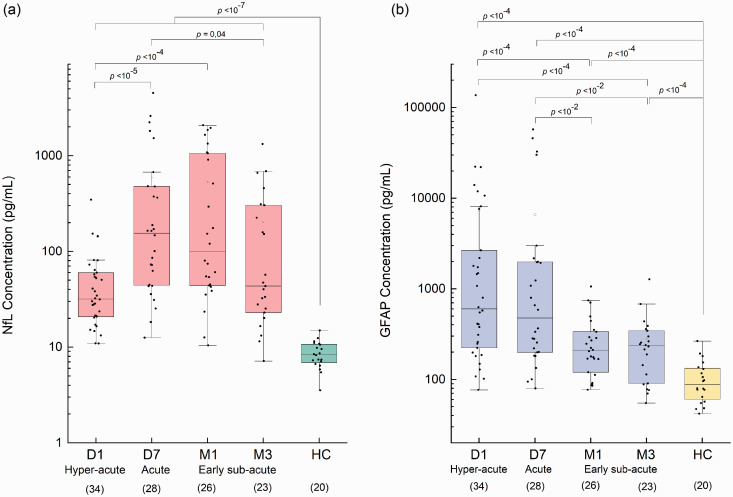
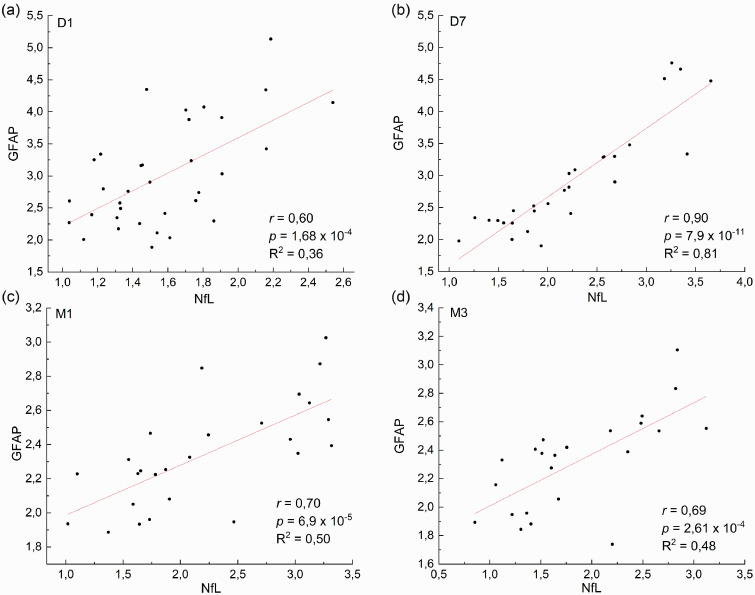
Identification of reliable and accessible biomarkers to characterize ischemic stroke patients' prognosis remains a clinical challenge. Neurofilament light chain (NfL) and glial fibrillary acidic protein (GFAP) are markers of brain injury, detectable in blood by high-sensitive technologies. Our aim was to measure serum NfL and GFAP after stroke, and to evaluate their correlation with functional outcome and the scores in rehabilitation scales at 3-month follow-up. Stroke patients were prospectively enrolled in a longitudinal observational study within 24 hours from symptom onset (D1) and monitored after 7 (D7), 30 ± 3 (M1) and 90 ± 5 (M3) days. At each time-point serum NfL and GFAP levels were measured by Single Molecule Array and correlated with National Institute of Health Stroke Scale (NIHSS), modified Rankin scale (mRS), Trunk Control Test (TCT), Functional Ambulation Classification (FAC) and Functional Independence Measure (FIM) scores. Serum NfL and GFAP showed different temporal profiles: NfL increased after stroke with a peak value at D7; GFAP showed an earlier peak at D1. NfL and GFAP concentrations correlated with clinical/rehabilitation outcomes both longitudinally and prospectively. Multivariate analysis revealed that NfL-D7 and GFAP-D1 were independent predictors of 3-month NIHSS, TCT, FAC and FIM scores, with NfL being the biomarker with the best predictive performance.
Keywords: Blood-derived biomarkers; GFAP; NfL; ischemic stroke; predictive factors.
Conflict of interest statement
The author(s) declared no potential conflicts of interest with respect to the research, authorship, and/or publication of this article..
Figures
References
Publication types
MeSH terms
Substances
LinkOut - more resources
Full Text Sources
Medical
Miscellaneous
