. 2022 Apr;2(4):289-294.
doi: 10.1038/s43587-022-00182-3. Epub 2022 Mar 3.

The burden of rare protein-truncating genetic variants on human lifespan

Affiliations

The burden of rare protein-truncating genetic variants on human lifespan

Jimmy Z Liu et al. Nat Aging. 2022 Apr.

Abstract

Genetic predisposition has been shown to contribute substantially to the age at which we die. Genome-wide association studies (GWASs) have linked more than 20 loci to phenotypes related to human lifespan1. However, little is known about how lifespan is impacted by gene loss of function. Through whole-exome sequencing of 352,338 UK Biobank participants of European ancestry, we assessed the relevance of protein-truncating variant (PTV) gene burden on individual and parental survival. We identified four exome-wide significant (P < 4.2 × 10⁻⁷) human lifespan genes, BRCA1, BRCA2, ATM and TET2. Gene and gene-set, PTV-burden, phenome-wide association studies support known roles of these genes in cancer to impact lifespan at the population level. The TET2 PTV burden was associated with a lifespan through somatic mutation events presumably due to clonal hematopoiesis. The overlap between PTV burden and common variant-based lifespan GWASs was modest, underscoring the value of exome sequencing in well-powered biobank cohorts to complement GWASs for identifying genes underlying complex traits.


Conflict of interest statement

J.Z.L., C.Y.C., E.A.T., C.D.W., D.S., S.J. and H.R. are full-time employees and hold stocks and stock options at Biogen.

Figures
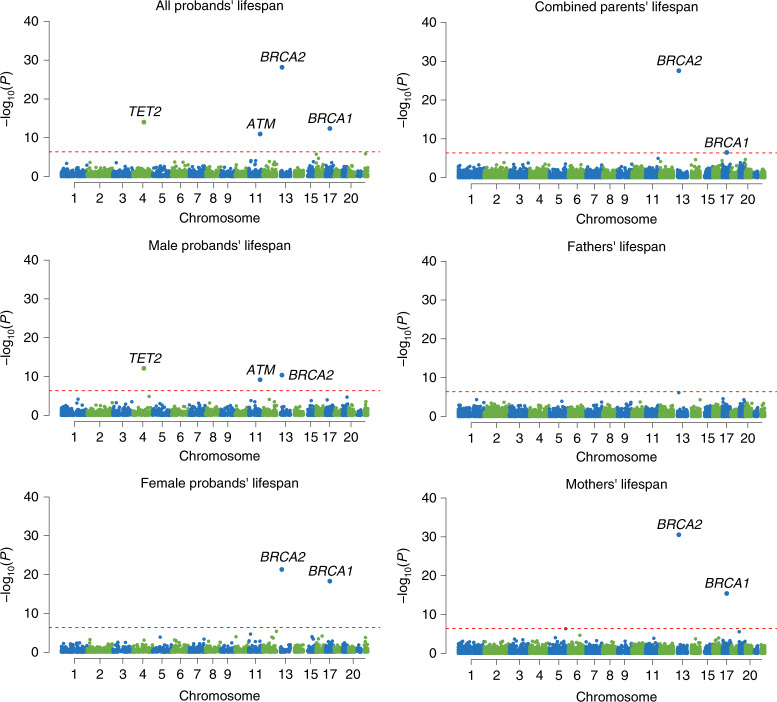
Fig. 1
Fig. 1. Manhattan plots of gene-based PTV-burden survival analyses in the discovery cohort of 238,239 UK Biobank participants for six survival phenotypes analyzed.
Each point represents a gene. The red-dashed line indicates the exome-wide significance threshold of P < 4.17 × 10−7. Genes exceeding this threshold are labeled and colored in red. ATM is displayed for the two outcomes where it exceeded exome significance when results from discovery analyses were combined with the replication cohort.
Fig. 2
Fig. 2. Kaplan–Meier curves for BRCA2 PTV-burden survival analyses across the six survival phenotypes analyzed in the present study in the combined discovery and replication cohorts.
Each cross represents a right censored observation. The shaded areas represent the 95% confidence interval of the survival curve. See Extended Data Fig. 1 for plots of BRCA1, TET2 and ATM.
Extended Data Fig. 1
Extended Data Fig. 1. Kaplan Meier plots for BRCA2, BRCA1, TET2 and ATM in the discovery + replication analysis.
Kaplan Meier plots for BRCA2, BRCA1, TET2 and ATM in the discovery + replication analysis. The shaded areas represent the 95% confidence interval of the survival curve.
Extended Data Fig. 2
Extended Data Fig. 2. Phenome-wide association plots for BRCA2, BRCA1, TET2 and ATM in all probands.
Phenome-wide association plots for BRCA2, BRCA1, TET2 and ATM in all probands. Each point represents a phenotype in the UK Biobank. The y-axis shows the strength of association, while the x-axis orders phenotypes by categories and then alphabetically.
Extended Data Fig. 3
Extended Data Fig. 3. Frequency distribution of variant allele fractions of PTVs in BRCA2, BRCA1 and TET2 heterozygote carriers.
Data Figure 3. Frequency distribution of variant allele fractions of PTVs in BRCA2, BRCA1 and TET2 heterozygote carriers.
Extended Data Fig. 4
Extended Data Fig. 4. Example of a region where a common SNP (in green at chr4:105,236,007) is in close proximity to a TET2 PTV.
Example of a region where a common SNP (in green at chr4:105,236,007) is in close proximity to a TET2 PTV. Sequencing reads spanning both variants are consistent with the PTV (the 1-bp deletion at chr4:105,235,982), being somatic in origin.
Extended Data Fig. 5
Extended Data Fig. 5. Regional association plots from survival analysis in probands at imputed and directly genotyped variants near BRCA2, BRCA1, TET2 and ATM.
Regional association plots from survival analysis in probands at imputed and directly genotyped variants near BRCA2, BRCA1, TET2 and ATM
Extended Data Fig. 6
Extended Data Fig. 6. QQ-plots and genome control (GC) lambdas from the PTV burden analyses across six survival outcomes.
QQ-plots and genome control (GC) lambdas from the PTV burden analyses across six survival outcomes
Extended Data Fig. 7
Extended Data Fig. 7. Scaled Schoenfeld residuals of the PTV status (x) vs time plots for BRCA2, BRCA1, TET2 and ATM burden in each of the six survival outcomes tested.
Scaled Schoenfeld residuals of the PTV status (x) vs time plots for BRCA2, BRCA1, TET2 and ATM burden in each of the six survival outcomes tested. Proportional hazards assumption test p-values for the PTV variable are shown above each plot.

References

    1. Melzer D, Pilling LC, Ferrucci L. The genetics of human ageing. Nat. Rev. Genet. 2020;21:88–101. doi: 10.1038/s41576-019-0183-6. - DOI - PMC - PubMed
    1. Kaplanis J, et al. Quantitative analysis of population-scale family trees with millions of relatives. Science. 2018;360:171. doi: 10.1126/science.aam9309. - DOI - PMC - PubMed
    1. Ruby JG, et al. Estimates of the heritability of human longevity are substantially inflated due to assortative mating. Genetics. 2018;210:1109. doi: 10.1534/genetics.118.301613. - DOI - PMC - PubMed
    1. Deelen J, et al. Genome-wide association meta-analysis of human longevity identifies a novel locus conferring survival beyond 90 years of age. Hum. Mol. Genet. 2014;23:4420–4432. doi: 10.1093/hmg/ddu139. - DOI - PMC - PubMed
    1. Broer L, et al. GWAS of longevity in CHARGE consortium confirms APOE and FOXO3 candidacy. J. Gerontol. Ser. A. 2014;70:110–118. doi: 10.1093/gerona/glu166. - DOI - PMC - PubMed
