. 2023 May 11;127(18):4096-4102.
doi: 10.1021/acs.jpca.3c01312. Epub 2023 Apr 29.

Low-Temperature Gas-Phase Kinetics of Ethanol-Methanol Heterodimer Formation

Affiliations

Low-Temperature Gas-Phase Kinetics of Ethanol-Methanol Heterodimer Formation

Lincoln Satterthwaite et al. J Phys Chem A. .

Abstract

The structures of gas-phase noncovalently bound clusters have long been studied in supersonic expansions. This method of study, while providing a wealth of information about the nature of noncovalent bonds, precludes observation of the formation of the cluster, as the clusters form just after the orifice of the pulsed valve. Here, we directly observe formation of ethanol-methanol dimers via microwave spectroscopy in a controlled cryogenic environment. Time profiles of the concentration of reagents in the cell yielded gas-phase reaction rate constants of kMe-g = (2.8 ± 1.4) × 10-13 cm3 molecule-1 s-1 and kMe-t = (1.6 ± 0.8) × 10-13 cm3 molecule-1 s-1 for the pseudo-second-order ethanol-methanol dimerization reaction at 8 K. The relaxation cross section between the gauche and trans conformers of ethanol was also measured using the same technique. In addition, thermodynamic relaxation between conformers of ethanol over time allowed for selection of conformer stoichiometry in the ethanol-methanol dimerization reaction, but no change in the ratio of dimer conformers was observed with changing ethanol monomer stoichiometry.


Conflict of interest statement

The authors declare no competing financial interest.

Figures

Figure 1
Figure 1
UCSB experimental apparatus. Valve 1 (red) was backed by ethanol, and valve 2 (green) was backed by methanol each at their respective room temperature vapor pressures. Horns were located to provide the best overlap with the expanding gas cloud. The buffer gas cell is roughly 45 cm × 25 cm × 27 cm.
Figure 2
Figure 2
Timing diagram for the experiment. The delay between the first valve and the center of the data collection window is τ. The delay between the ethanol valve and methanol valve is adjusted to change the effective stoichiometry of the dimer-forming reaction. The colors on the bottom trace correspond to the timing trace of the same color, with the green trace being the dimer signal.
Figure 3
Figure 3
Time profile of relative populations of (A) all monomers and (B) the two lowest energy dimer conformations. A sample introduction and diffusion model, eq 3, was fit to the data. Fits from the rising side give reaction rate constant, and fits from the falling side give diffusion rates inside the buffer gas cell. Fit parameters for diffusion are shown in Table 1.
Figure 4
Figure 4
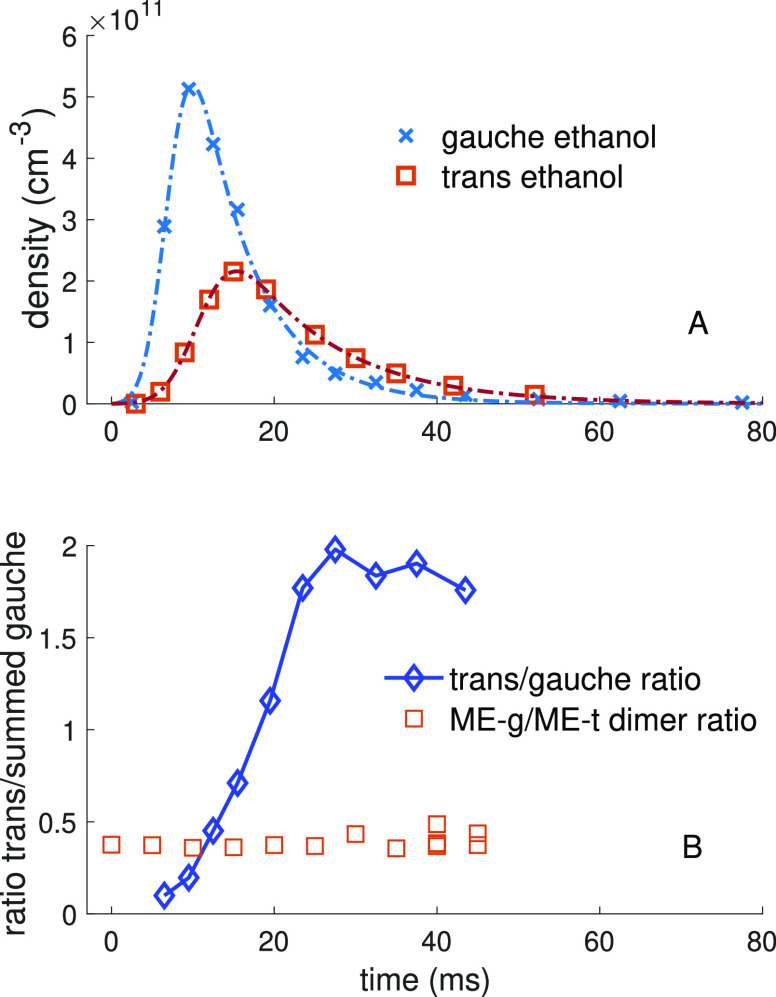
(A) Time-domain plot of reactants. The gauche ethanol trace represents the sum of g+ and g– conformer densities, as these conformers are quasi degenerate. Data are fit to the theoretical diffusion model described in the Results and Discussion. (B) As the ratio of gauche and trans ethanol monomer changes, the ratio ME-g and ME-t does not change.

References

    1. Thomas M.; Suarez-Martinez I.; Yu L.-J.; Karton A.; Chandler G. S.; Robinson M.; Cherchneff I.; Talbi D.; Spagnoli D. Atomistic simulations of the aggregation of small aromatic molecules in homogenous and heterogenous mixtures. Phys. Chem. Chem. Phys. 2020, 22, 21005–21014. 10.1039/D0CP02622K. - DOI - PMC - PubMed
    1. Fatima M.; Steber A. L.; Poblotzki A.; Pérez C.; Zinn S.; Schnell M. Rotational signatures of dispersive stacking in the formation of aromatic dimers. Angew. Chem. 2019, 131, 3140–3145. 10.1002/ange.201812556. - DOI - PubMed
    1. Sandstrom H.; Rahm M. The Beginning of HCN Polymerization: Iminoacetonitrile Formation and Its Implications in Astrochemical Environments. ACS Earth Space Chem. 2021, 5, 2152–2159. 10.1021/acsearthspacechem.1c00195. - DOI - PMC - PubMed
    1. Zou L.; Hays B. M.; Weaver S. L. W. Weakly bound clusters in astrochemistry? Millimeter and submillimeter spectroscopy of trans-HO3 and comparison to astronomical observations. J. Phys. Chem. A 2016, 120, 657–667. 10.1021/acs.jpca.5b09624. - DOI - PubMed
    1. Stein T.; Jose J. Molecular formation upon ionization of van der Waals clusters and implication to astrochemistry. Isr. J. Chem. 2020, 60, 842–849. 10.1002/ijch.201900127. - DOI