. 2023 Jul 11;148(2):144-158.
doi: 10.1161/CIRCULATIONAHA.122.063372. Epub 2023 May 1.

Orally Bioavailable Macrocyclic Peptide That Inhibits Binding of PCSK9 to the Low Density Lipoprotein Receptor

Affiliations

Orally Bioavailable Macrocyclic Peptide That Inhibits Binding of PCSK9 to the Low Density Lipoprotein Receptor

Douglas G Johns et al. Circulation. .

Abstract

Background: Inhibition of PCSK9 (proprotein convertase subtilisin/kexin type 9)-low density lipoprotein receptor interaction with injectable monoclonal antibodies or small interfering RNA lowers plasma low density lipoprotein-cholesterol, but despite nearly 2 decades of effort, an oral inhibitor of PCSK9 is not available. Macrocyclic peptides represent a novel approach to target proteins traditionally considered intractable to small-molecule drug design.

Methods: Novel mRNA display screening technology was used to identify lead chemical matter, which was then optimized by applying structure-based drug design enabled by novel synthetic chemistry to identify macrocyclic peptide (MK-0616) with exquisite potency and selectivity for PCSK9. Following completion of nonclinical safety studies, MK-0616 was administered to healthy adult participants in a single rising-dose Phase 1 clinical trial designed to evaluate its safety, pharmacokinetics, and pharmacodynamics. In a multiple-dose trial in participants taking statins, MK-0616 was administered once daily for 14 days to characterize the safety, pharmacokinetics, and pharmacodynamics (change in low density lipoprotein cholesterol).

Results: MK-0616 displayed high affinity (Ki = 5pM) for PCSK9 in vitro and sufficient safety and oral bioavailability preclinically to enable advancement into the clinic. In Phase 1 clinical studies in healthy adults, single oral doses of MK-0616 were associated with >93% geometric mean reduction (95% CI, 84-103) of free, unbound plasma PCSK9; in participants on statin therapy, multiple-oral-dose regimens provided a maximum 61% geometric mean reduction (95% CI, 43-85) in low density lipoprotein cholesterol from baseline after 14 days of once-daily dosing of 20 mg MK-0616.

Conclusions: This work validates the use of mRNA display technology for identification of novel oral therapeutic agents, exemplified by the identification of an oral PCSK9 inhibitor, which has the potential to be a highly effective cholesterol lowering therapy for patients in need.

Keywords: PCSK9 inhibitors; atherosclerosis; cholesterol; clinical trial; hypercholesterolemia; low density lipoprotein; mRNA display technology; macrocyclic peptide.


Conflict of interest statement

Disclosures D.G.J., L.-C.C., P.B., A.B., T.B., P.G.B., I.C., F.-X.D., R.M.G., E.D.G., Y.G., S.N.H., J.M.J., H.J., E.A.K., K.A.K., J.T.K., E.L., C.L.L., A.Y.H.L., L.L., A.G.N., E.A.O., S.A.S., D.A.T., T.J.T., P.V., K.v.D., D.G.W., A.X., T.Z., D.Z., S.Z., X.Z., H.J.Z., A.M.W., and H.B.W. are current or former employees of Merck Sharp & Dohme LLC, a subsidiary of Merck & Co., Inc., Rahway, NJ and may own stock/stock options in Merck & Co., Inc., Rahway, NJ. The other authors have no conflicts of interest.

Figures

Figure 1.
Figure 1.
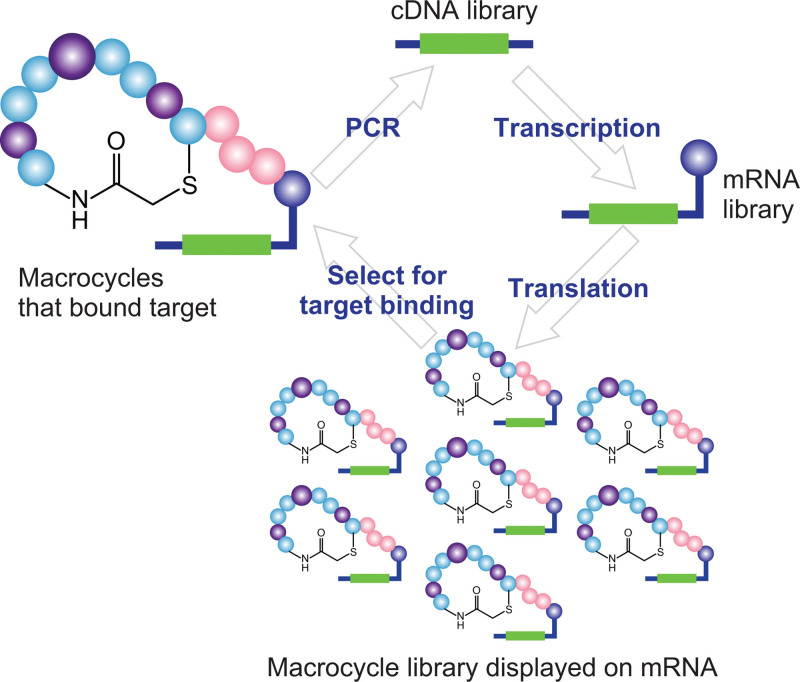
Messenger ribonucleic acid (mRNA) display screening platform. mRNA display is a powerful in vitro affinity selection platform that allows screening of large, genetically encoded peptide libraries. The platform takes advantage of the transcription/translation machinery and post-translation cyclization, under cell-free conditions to prepare the libraries. A key feature is that the mRNA is covalently linked to its encoded peptide which enables amplification of desired peptides shown to interact with a target of interest. cDNA indicates complementary DNA (deoxyribonucleic acid); and PCR, polymerase chain reaction.
Figure 2.
Figure 2.
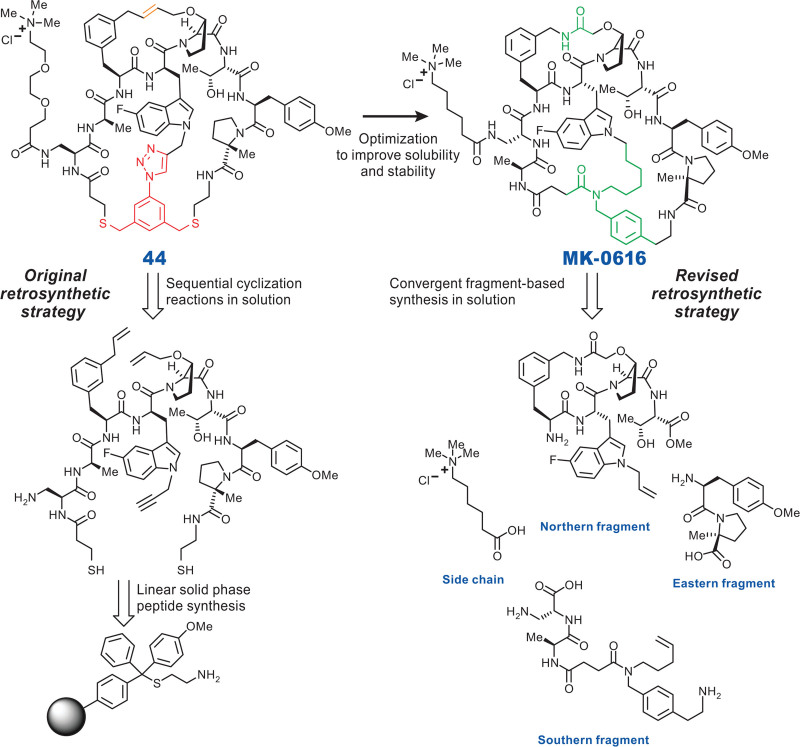
Redesigned synthesis and key features of MK-0616. Critical modifications of 44 are replacement of the sulfide-based linker and central triazole (red to teal) and changing the northern olefin to an amide crosslinker (orange to teal).
Figure 3.
Figure 3.
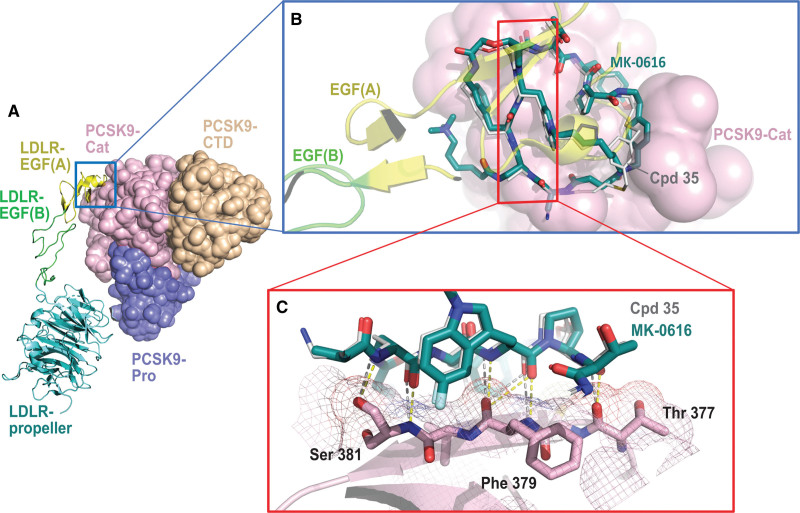
MK-0616-PCSK9 (proprotein convertase subtilisin/kexin type 9) complex. A, Interaction of PCSK9 catalytic domain and prodomain with the LDLR epidermal growth factor and β-propeller domains, respectively, from PDB ID: 3P5B. B, Modeling MK-0616 from related crystal structures (PDB IDs: 6XID, 6XIE, 75SG, and 75SH), suggests MK-0616 (deep teal) interacts with a flat surface on the PCSK9 catalytic domain (pink surface), interrupting the interaction with the EGF(A) domain (transparent yellow) of LDLR. Compound 35 (PDB ID: 7S5H), a closely related analog of Compound 44,, is shown in white sticks, overlaid with MK-0616 to illustrate the binding site similarity. C, MK-0616 and Compound 35, can form key hydrogen bonds with T377, F379, and S381 of PCSK9-Cat domain. Cpd 35 indicates Compound 35; EGF, epidermal growth factor; LDLR-EGF, LDL receptor-EGF; PCSK9-Cat, PCSK9-catalytic doman; PCSK9-CTD, PCSK9-C-terminal domain; Phe 379, phenylalanine 379; Ser 381, serine 381; and Thr 377, threonine 377.
Figure 4.
Figure 4.
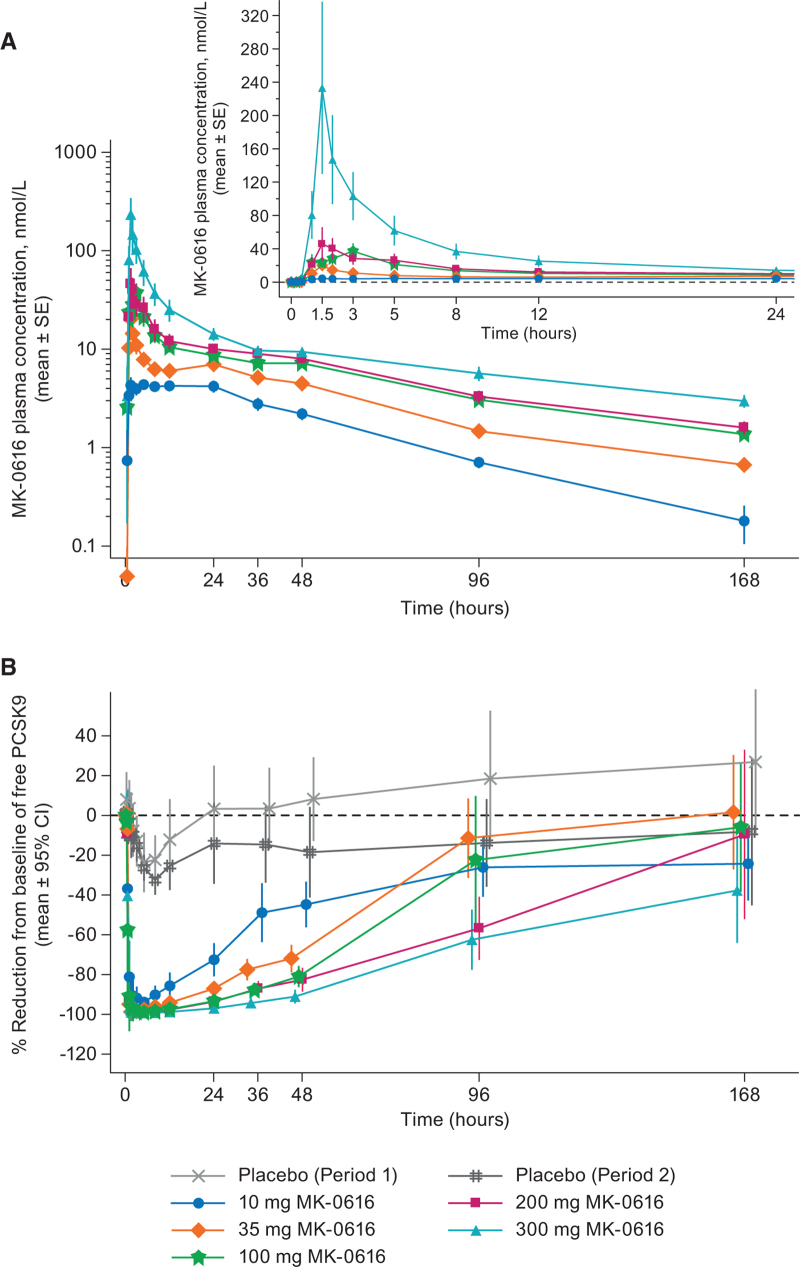
Single-dose pharmacokinetics and pharmacodynamics of MK-0616. A, Mean ± SE plasma concentration-time profiles of MK-0616 (inset shows the data plotted on a semi-logarithmic scale) and (B) mean ± SE percentage of baseline free plasma PCSK9 (proprotein convertase subtilisin/kexin type 9)-time profiles following single oral doses of 10, 35, 100, 200, and 300 mg MK-0616 in Labrasol as indicated and, in (B), placebo Period 1 and placebo Period 2 as indicated. There were n=9 healthy participants per MK-0616 dose level and n=3 healthy participants in each placebo group. Randomized participants given placebo, or 10, 35, or 100 mg MK-0616 (Period 1) were re-randomized for treatment with placebo, 200, or 300 mg MK-0616 (Period 2), therefore a placebo group is shown for each period. Per the pre-specified statistical analysis of free PCSK9, as described in the Clinical Study Methods, the hypothesis that a dose of MK-0616 will result in a true geometric mean PCSK9 reduction from baseline of greater than 80% was supported for all doses of MK-0616 (10, 35, 100, 200, 300 mg; posterior probability >99%).
Figure 5.
Figure 5.
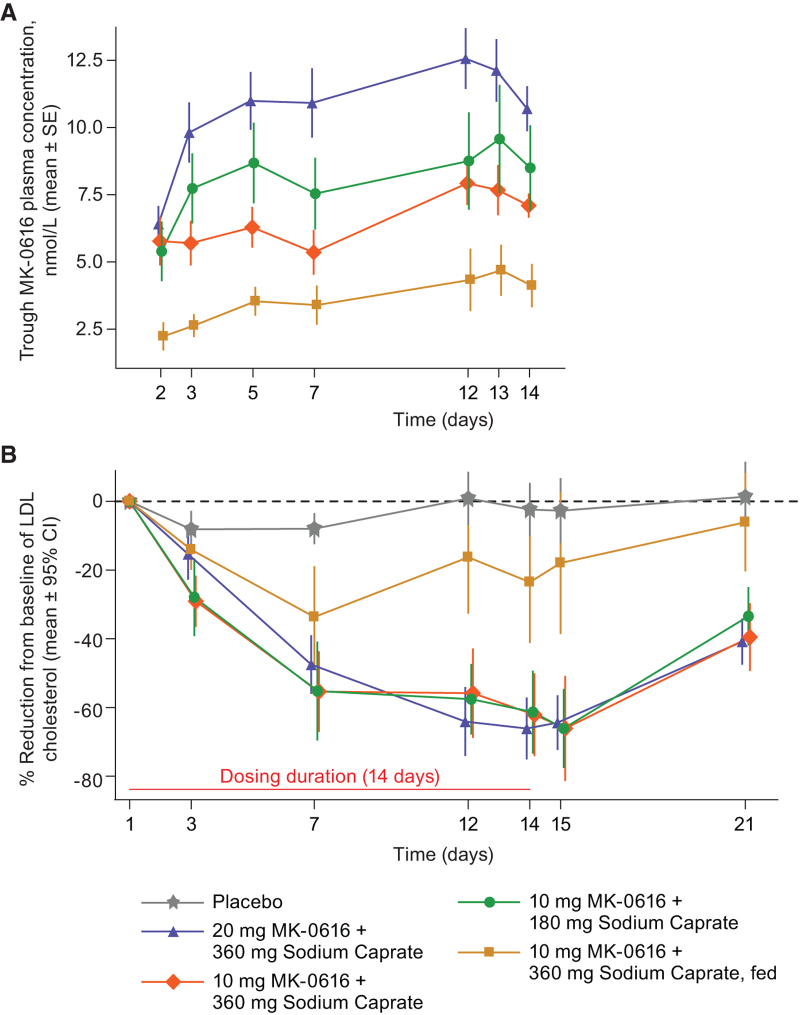
Multiple-dose pharmacokinetics and pharmacodynamics of MK-0616. A, Mean ± SE trough plasma concentration-time profiles of MK-0616 and (B) geometric mean percentage (95% CI) of baseline LDL-C-time profiles during and after multiple, oral doses (once daily for 14 days) of MK-0616 at 20 mg (n=9 [pharmacokinetics], n=8 [pharmacodynamics] participants) or 10 mg (n=8) under fasting conditions, or 10 mg administered 30 minutes post-meal (n=6 [pharmacokinetics], n=5 [pharmacodynamics]) as indicated, and, in (B), placebo (n=9) as indicated. Per the pre-specified statistical analysis of LDL-C, as described in the Clinical Study Methods, the hypothesis that the true geometric mean LDL-C reduction from baseline was greater than 50% was supported for all doses of MK-0616 (posterior probability >50%), except for the dose administered under fed conditions (posterior probability <1%).

References

    1. Kaur H. Overview of Monoclonal Antibodies. in Monoclonal Antibodies, Kaur H, Reusch D, eds. Academic Press, 2021:1–29. doi: 10.1016/C2019-0-03217-7
    1. Fosgerau K, Hoffmann T. Peptide therapeutics: current status and future directions. Drug Discov Today. 2015;20:122–128. doi: 10.1016/j.drudis.2014.10.003 - PubMed
    1. Drucker DJ. Advances in oral peptide therapeutics. Nat Rev Drug Discov. 2020;19:277–289. doi: 10.1038/s41573-019-0053-0 - PubMed
    1. Josephson K, Ricardo A, Szostak JW. mRNA display: from basic principles to macrocycle drug discovery. Drug Discov Today. 2014;19:388–399. doi: 10.1016/j.drudis.2013.10.011 - PubMed
    1. Jaradat DMM. Thirteen decades of peptide synthesis: key developments in solid phase peptide synthesis and amide bond formation utilized in peptide ligation. Amino Acids. 2018;50:39–68. doi: 10.1007/s00726-017-2516-0 - PubMed

Publication types