


Goals and goal perceptions in patients with advanced stage lung cancer: a mixed methods study
- PMID: 37126099
- PMCID: PMC10150146
- DOI: 10.1007/s00520-023-07745-z
Goals and goal perceptions in patients with advanced stage lung cancer: a mixed methods study
Abstract
Purpose: Goals provide insight into what is important to an individual. We describe the development and application of a mixed methods approach to elicit goals and perceptions about goals in patients with advanced cancer.
Methods: Patients receiving first-line treatment for advanced lung cancer participated in semi-structured interviews about their goals. Participants self-generated goals, then selected and ranked their three most important goals and provided Likert scale ratings of goal-related perceptions (e.g., attainability, locus of control). Independent raters coded goals into content domains. One month later, participants reported perceived progress toward goals and facilitators of and barriers to progress.
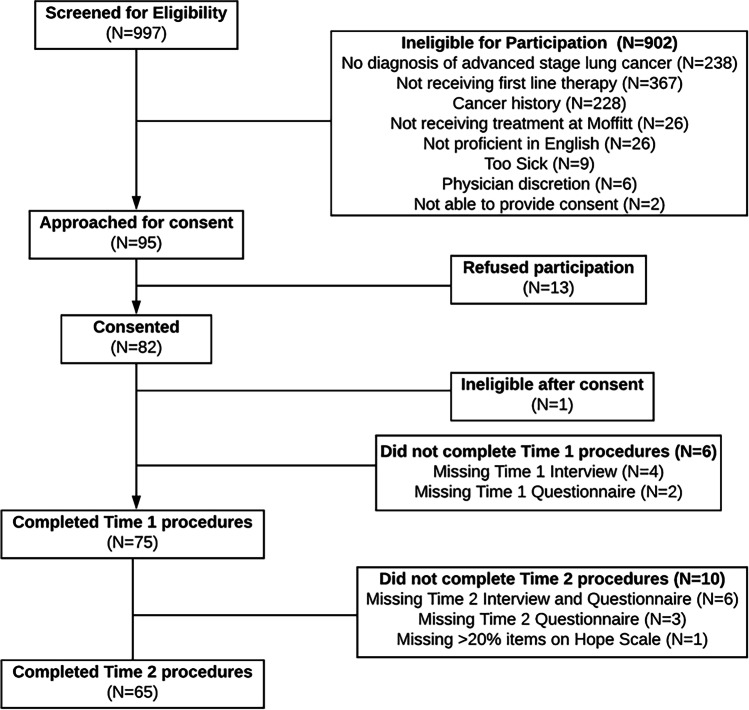
Results: Participants (N = 75, Mage = 64.5 years, 59% female) identified goals across eight domains: social/role/relationship, everyday/practical, leisure/pleasure, psychological/existential/spiritual, major life changes or achievements, cancer treatment response/disease outcomes, palliative outcomes, and behavioral health improvement. Of all goals identified (N = 352), 72% of patients had at least one social/role/relationship goal, 68% had a leisure/pleasure goal, and 29% had a cancer treatment response goal. On average, participants considered their goals to be attainable, perceived a high degree of control over reaching goals, anticipated making "some" progress in the short term, and perceived a high likelihood of reaching goals in the future. Facilitators of progress included mental fortitude, feeling physically well, and social support. Barriers included cancer-related side effects, practical challenges, and COVID-19.
Conclusions: A majority of participant goals focused on meaningful engagement and living well. Goals were largely viewed as attainable and under participants' control. Cancer clinicians may consider how to support patients in working toward valued goals in conjunction with oncology care.
Keywords: Goals; Lung cancer; Psycho-oncology.
© 2023. The Author(s), under exclusive licence to Springer-Verlag GmbH Germany, part of Springer Nature.
Conflict of interest statement
Heather S. L. Jim reports consulting for RedHill BioPharma and Janssen Scientific Affairs. The views expressed are those of the authors and do not necessarily represent those of the National Cancer Institute. The remaining authors have no relevant financial or non-financial interests to disclose.
References
-
- American Cancer Society . Cancer Facts & Figures 2018. Atlanta: American Cancer Society; 2018.
-
- Snyder CR. Hope theory: Rainbows in the mind. Psychol Inq. 2002;13(4):249–275. doi: 10.1207/S15327965PLI1304_01. - DOI
-
- Demartini, J., Fenton, J.J., Epstein, R., Duberstein, P., Cipri, C., Tancredi, D., Xing, G., Kaesberg, P., Kravitz, R.L. (2019) Patients’ Hopes for Advanced Cancer Treatment. Journal of Pain and Symptom Management. Retrieved February 6, 2019. https://www-ncbi-nlm-nih-gov.ezproxy.lib.usf.edu/pubmed/30261227 - PMC - PubMed
MeSH terms
LinkOut - more resources
Full Text Sources
Medical
