


Evaluation of the efficacy of HEMO2life®, a marine OXYgen carrier for Organ Preservation (OxyOp2) in renal transplantation: study protocol for a multicenter randomized trial
- PMID: 37127632
- PMCID: PMC10150461
- DOI: 10.1186/s13063-023-07302-3
Evaluation of the efficacy of HEMO2life®, a marine OXYgen carrier for Organ Preservation (OxyOp2) in renal transplantation: study protocol for a multicenter randomized trial
Abstract
Background: Preventing ischemia‒reperfusion injury (IRI) is a major issue in kidney transplantation, particularly for transplant recipients receiving a kidney from extended criteria donors (ECD). The main consequence of IRI is delayed graft function (DGF). Hypoxia is one of the key factors in IRI, suggesting that the use of an oxygen carrier as an additive to preservation solution may be useful. In the OxyOp trial, we showed that the organs preserved using the oxygen carrier HEMO2life® displayed significantly less DGF. In the OxyOp2 trial, we aim to definitively test and quantify the efficacy of HEMO2life® for organ preservation in a large population of kidney grafts.
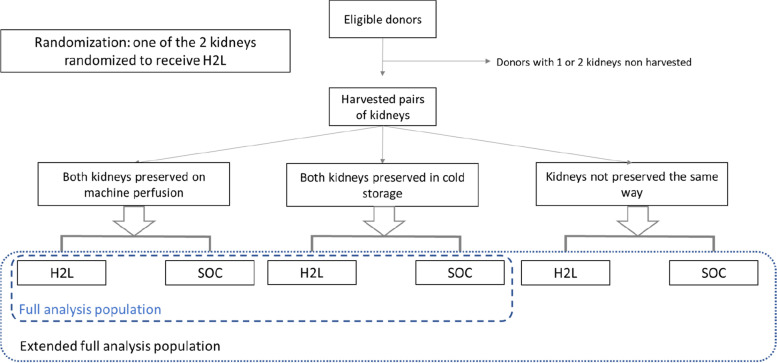
Methods: OxyOp2 is a prospective, multicenter, randomized, comparative, single-blinded, parallel-group study versus standard of care in renal transplantation. After the selection of a suitable donor according to the inclusion/exclusion criteria, both kidneys will be used in the study. Depending on the characteristics of the donor, both kidneys will be preserved either in static cold storage (standard donors) or on machine perfusion (for ECD and deceased-after-cardiac-death donors (DCD)). The kidneys resulting from one donor will be randomized: one to the standard-of-care arm (organ preserved in preservation solution routinely used according to the local practice) and the other to the active treatment arm (HEMO2life® on top of routinely used preservation solution). HEMO2life® will be used for ex vivo graft preservation at a dose of 1 g/l preservation solution. The primary outcome is the occurrence of DGF, defined as the need for renal replacement therapy during the first week after transplantation.
Discussion: The use of HEMO2life® in preservation solutions is a novel approach allowing, for the first time, the delivery of oxygen to organs. Improving graft survival by limiting ischemic lesions is a major public-health goal in the field of organ transplantation.
Trial registration: ClinicalTrials.gov, ID: NCT04181710 . registered on November 29, 2019.
Keywords: Clinical trial; Delayed Graft Function (DGF); HEMO2life®; Ischemia–Reperfusion Injury (IRI); Kidney IRI; Transplantation.
© 2023. The Author(s).
Conflict of interest statement
The authors declare the following financial interests/personal relationships that may be considered potential competing interests: Franck Zal is the founder of and holds stock in HEMARINA, the company that produces M101. Leila Demini is a collaborator of HEMARINA and does not have HEMARINA stock. Yannick Le Meur received consulting fees from HEMARINA. The other authors declare that they have no competing interests.
Figures
References
-
- « rapport_rein_2019_2021–10–14.pdf ». https://www.agence-biomedecine.fr/IMG/pdf/rapport_rein_2019_2021-10-14.pdf
Publication types
MeSH terms
Substances
Associated data
Grants and funding
LinkOut - more resources
Full Text Sources
Medical
