Review
. 2023 May 1;15(1):121.
doi: 10.1007/s40820-023-01086-6.

Fundamental Understanding and Optimization Strategies for Dual-Ion Batteries: A Review

Affiliations
Review

Fundamental Understanding and Optimization Strategies for Dual-Ion Batteries: A Review

Chong Chen et al. Nanomicro Lett. .

Abstract

There has been increasing demand for high-energy density and long-cycle life rechargeable batteries to satisfy the ever-growing requirements for next-generation energy storage systems. Among all available candidates, dual-ion batteries (DIBs) have drawn tremendous attention in the past few years from both academic and industrial battery communities because of their fascinating advantages of high working voltage, excellent safety, and environmental friendliness. However, the dynamic imbalance between the electrodes and the mismatch of traditional electrolyte systems remain elusive. To fully employ the advantages of DIBs, the overall optimization of anode materials, cathode materials, and compatible electrolyte systems is urgently needed. Here, we review the development history and the reaction mechanisms involved in DIBs. Afterward, the optimization strategies toward DIB materials and electrolytes are highlighted. In addition, their energy-related applications are also provided. Lastly, the research challenges and possible development directions of DIBs are outlined.

Keywords: Dual-ion batteries; Energy storage; Optimization strategies; Reaction mechanisms.


Figures

Fig. 1
Fig. 1
Schematic diagrams illustrating a a traditional LIB and b a dual-graphite DIB
Fig. 2
Fig. 2
Summary of the emerging optimization strategies for DIBs covered in this review
Fig. 3
Fig. 3
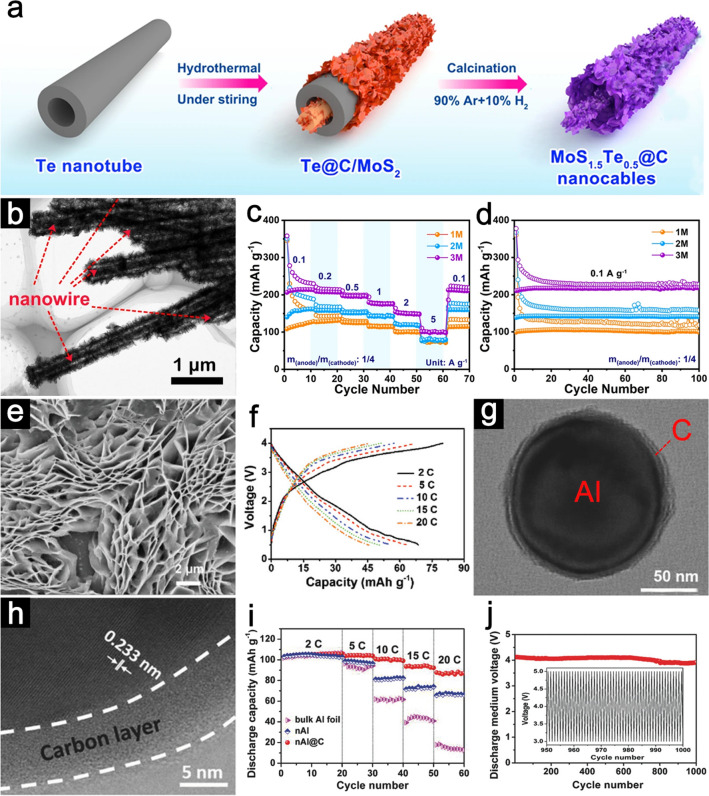
a Schematic illustration of the synthetic process for MoS1.5Te0.5@C nanocables. b TEM image of MoS1.5Te0.5@C nanocables. c Rate performance and d cycling stability of MoS1.5Te0.5@C nanocables||EG dual-ion cell. Panels (ad) reproduced with permission from Ref. [61]. Copyright 2022, Nature Publishing Group. e SEM image of pK2TP nanosheets. f GCD curves of pK2TP||EG dual-ion cell. Panels (e, f) reproduced with permission from Ref. [66]. Copyright 2020, John Wiley & Sons, Inc. g TEM image and h HRTEM image of nAl@C nanosphere. i Rate capabilities and j cycling performance of nAl@C||G DIB. Panels (g–j) reproduced with permission from Ref. [70]. Copyright 2018, John Wiley & Sons, Inc
Fig. 4
Fig. 4
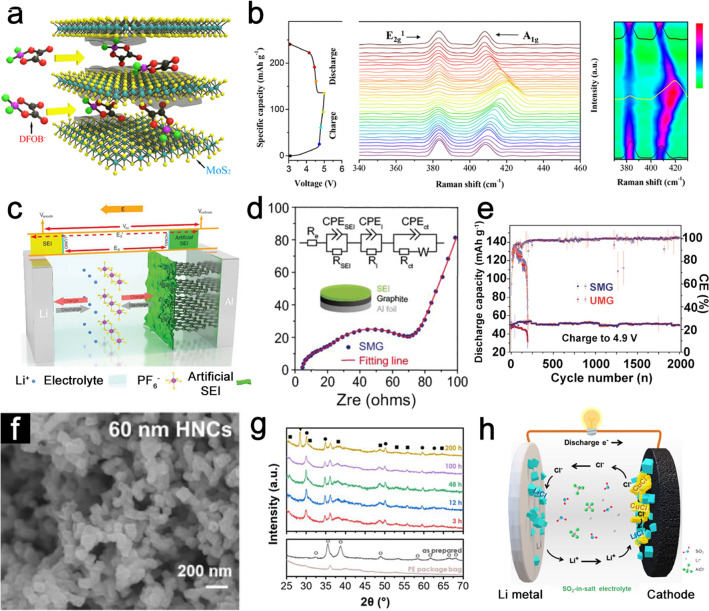
a Schematic illustration of MoS2 cathode with expanded interlayer. b In-situ Raman spectra of MoS2 cathode during charge/discharge process. Panels (a, b) reproduced with permission from Ref. [81]. Copyright 2018, John Wiley & Sons, Inc. c Schematic diagram illustration of the Li||SMG DIB. d Nyquist plot of the SMG electrode. The inset shows an equivalent circuit of the Li||SMG cell. e Cycling performance of SMG and UMG electrodes. Panels (c–e) reproduced with permission from Ref. [86]. Copyright 2020, Elsevier. f SEM image of CuO HNCs. g Ex-situ XRD patterns of CuO HNCs electrodes after 0, 3, 12, 48, 100, and 200 h immersion time in LiAlCl4⋅3SO2 electrolyte. g Schematic illustration of the Li||CuO HNCs DIB. Panels (f–h) reproduced with permission from Ref. [87]. Copyright 2021, Elsevier
Fig. 5
Fig. 5
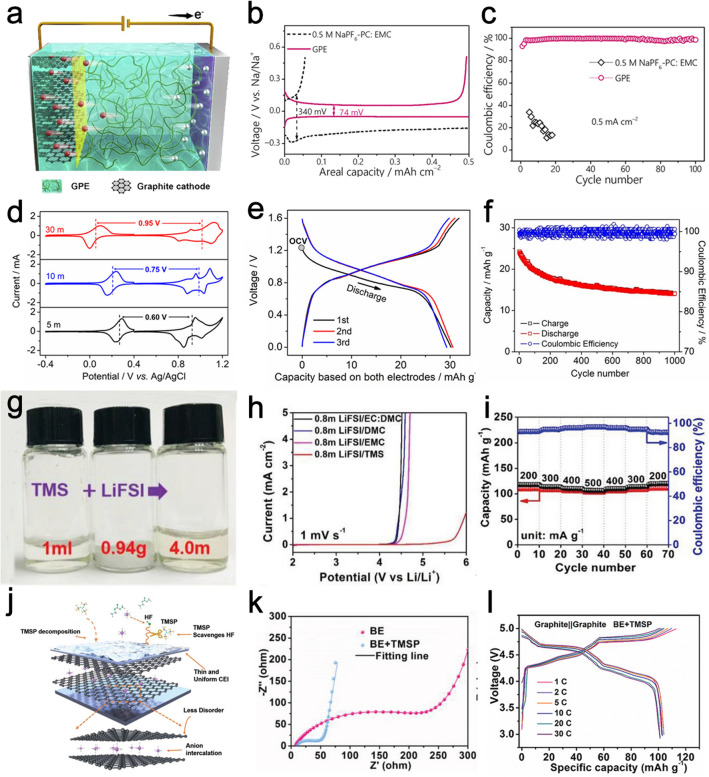
a Schematic illustration of the DIBs using GPE. b GCD profiles of Na||Cu cell using 0.5 M NaPF6-PC:EMC and GPE. c CE of Na plating-stripping in Na|0.5 M NaPF6-PC:EMC|Cu and Na|GPE|Cu cells. Panels (a–c) reproduced with permission from Ref. [99]. Copyright 2020, Elsevier. d CV curves tested in different ZnCl2 concentration electrolytes. e GCD curves and f cycling performance of Zn3[Fe(CN)6]2||Fc/C cell in 30 M ZnCl2 electrolytes. Panels (d–f) reproduced with permission from Ref. [103]. Copyright 2019, American Chemical Society. g Photographs of TMS, LiFSI, and 4.0 M LiFSI in TMS. h LSV plots under different electrolytes and f rate performance of Li||graphite DIB. Panels (g–i) reproduced with permission from Ref. [109]. Copyright 2018, John Wiley & Sons, Inc. j Schematic illustration of the unique functions of TMSP additive. k Nyquist plots of the Li||graphite cell with different electrolytes. l GCD curves of graphite||graphite in BE + TMSP. Panels (j–l) reproduced with permission from Ref. [111]. Copyright 2022, John Wiley & Sons, Inc
Fig. 6
Fig. 6
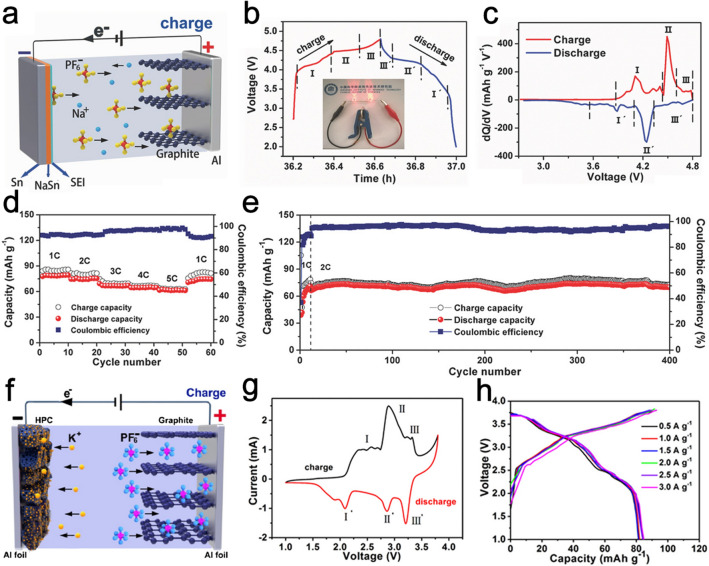
a Schematic illustration of the Na-based Sn||EG DIB cell. b GCD profile (inset is a photograph of a fully charged Sn||EG DIB to light up two LEDs in series), c CV curve, d rate capabilities, and e cycling performance of Sn||EG DIB. Panels (a–e) reproduced with permission from Ref. [121]. Copyright 2017, John Wiley & Sons, Inc. f Schematic illustration of the K-based HPC||EG DIB cell. g CV curves and h typical GCD curves of HPC||EG DIB. Panels (f–h) reproduced with permission from Ref. [122]. Copyright 2018, American Chemical Society
Fig. 7
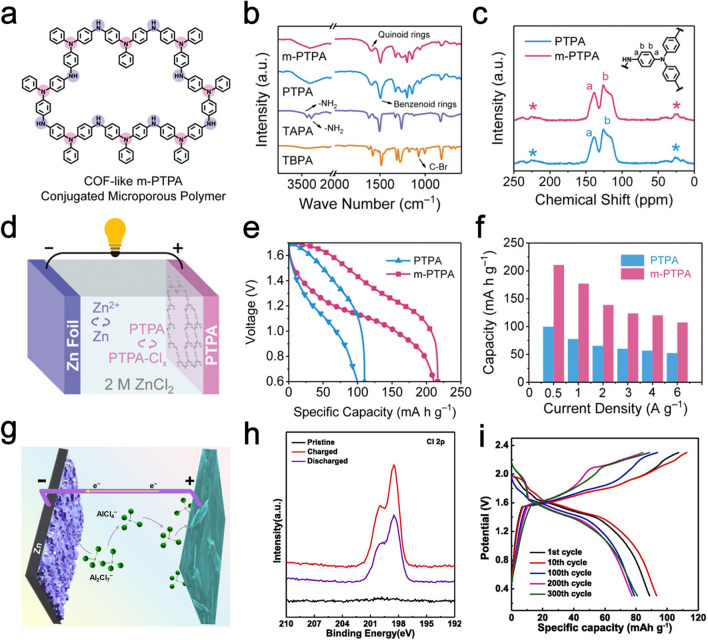
Fig. 7
a Schematic illustration of the COF-like m-PTPA structure. b FTIR spectra of m-PTPA, PTPA and monomers. c Solid-state 13C NMR spectra of m-PTPA and PTPA. d Schematic illustration of the Zn||m-PTPA DIB cell. e GCD profiles and f rate capabilities of Zn DIBs consisting of m-PTPA and PTPA cathodes. Panels (a–f) reproduced with permission from Ref. [125]. Copyright 2021, John Wiley & Sons, Inc. g Schematic illustration of the Al-based Zn||graphite DIB cell. h XPS spectra of Al 2p of FG electrode before and after cycling. i GCD profiles of Zn||graphite DIB. Panels (g–i) reproduced with permission from Ref. [127]. Copyright 2022, Elsevier

References

    1. Liu T, Liu J, Li L, Yu L, Diao J, et al. Origin of structural degradation in Li-rich layered oxide cathode. Nature. 2022;606(7913):305–312. doi: 10.1038/s41586-022-04689-y. - DOI - PubMed
    1. Liu Y, Tao X, Wang Y, Jiang C, Ma C, et al. Self-assembled monolayers direct a LiF-rich interphase toward long-life lithium metal batteries. Science. 2022;375(6582):739–745. doi: 10.1126/science.abn1818. - DOI - PubMed
    1. Lemoine K, Hemon-Ribaud A, Leblanc M, Lhoste J, Tarascon J-M, et al. Fluorinated materials as positive electrodes for Li- and Na-Ion batteries. Chem. Rev. 2022;122(18):14405. doi: 10.1021/acs.chemrev.2c00247. - DOI - PubMed
    1. Li Y, Wu F, Li Y, Liu M, Feng X, et al. Ether-based electrolytes for sodium ion batteries. Chem. Soc. Rev. 2022;51(11):4484–4536. doi: 10.1039/d1cs00948f. - DOI - PubMed
    1. Zeng Y, Gordiichuk P, Ichihara T, Zhang G, Sandoz-Rosado E, et al. Irreversible synthesis of an ultrastrong two-dimensional polymeric material. Nature. 2022;602(7895):91–95. doi: 10.1038/s41586-021-04296-3. - DOI - PubMed

LinkOut - more resources