


Prevalence, aetiology, vaccination coverage and spatio-temporal pattern among patients admitted with acute bacterial meningitis to the sentinel hospital surveillance network in Yemen, 2014-20, before and during the civil war
- PMID: 37128839
- PMCID: PMC10396411
- DOI: 10.1093/ije/dyad047
Prevalence, aetiology, vaccination coverage and spatio-temporal pattern among patients admitted with acute bacterial meningitis to the sentinel hospital surveillance network in Yemen, 2014-20, before and during the civil war
Abstract
Background: Acute bacterial meningitis (ABM) is a serious health issue in Yemen where civil war, which continues unabated, has crippled the healthcare system. We conducted a nationwide retrospective observational study in Yemeni sentinel hospitals to identify the prevalence, aetiology, vaccination coverage and spatio-temporal pattern of ABM in children aged <5 years before and during the civil war, 2014-20.
Methods: Cerebrospinal fluid samples were collected from hospitalized children and were analysed macroscopically for appearance and microscopically by Gram stain and white blood cell count. Culture and latex agglutination tests were performed. Data on the prevalence of and vaccination coverage for ABM were obtained from the Ministry of Health. Joinpoint regression was used to assess the annual percent change (APC) of ABM prevalence and vaccination coverage. Pearson's correlation was used to evaluate the association between ABM prevalence and vaccination coverage.
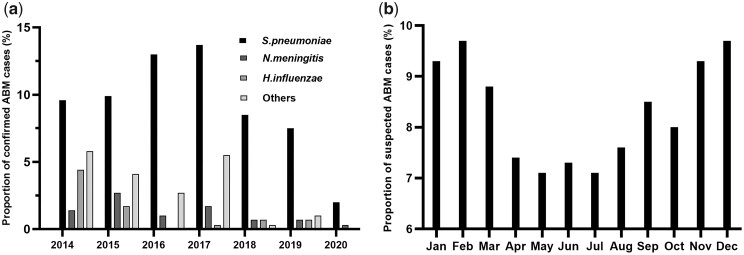
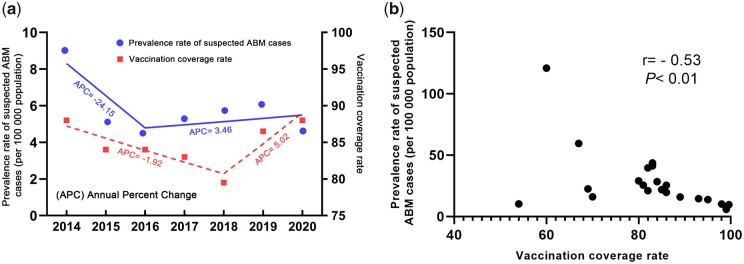
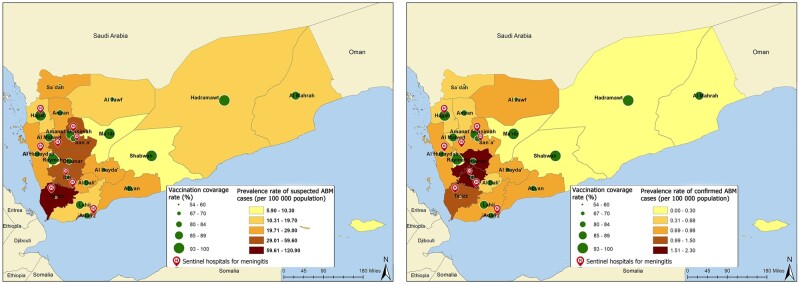
Results: In total, 11 339 hospitalized children had suspected cases of ABM (prevalence, 40.07/100 000 of the whole Yemeni population) and 2.6% (293/11 339) of suspected ABM cases were confirmed (prevalence, 1.04/100 000 of the whole Yemeni population). The dominant pathogens were Streptococcus pneumoniae, Neisseria meningitidis and Haemophilus influenzae type b (Hib). The civil war reduced the Hib and pneumococcal vaccination coverage (APC = -1.92), reaching its lowest (79.5%) in 2018. The prevalence of suspected ABM increased (APC = 3.46), reaching its maximum (6.08/100 000 of the whole Yemeni population) in 2019. The conflict inversely correlated with the ABM prevalence and vaccination coverage (Pearson correlation coefficient (r), -0.69 to -0.53). Ta'izz region, which was severely affected by the civil war, had the highest prevalence of suspected ABM (120.90/100 000 of the whole Yemeni population) and lowest vaccination coverage (60%).
Conclusions: The civil war had a negative impact on vaccination coverage and coincided with increasing prevalence of ABM in Yemen. Streptococcus pneumoniae is the dominant causative pathogen.
Keywords: Civil war; acute bacterial meningitis; aetiologic agents; prevalence; vaccination coverage.
© The Author(s) 2023. Published by Oxford University Press on behalf of the International Epidemiological Association.
Conflict of interest statement
None declared.
Figures
References
-
- Siegel JL. Acute bacterial meningitis and stroke. Neurol Neurochir Pol 2019;53:242–50. - PubMed
-
- Swanson D. Meningitis. Pediatr Rev 2015;36:514–24. quiz 25–6. - PubMed
-
- Roos KL, Tyler KL. Meningitis, encephalitis, brain abscess, and empyema. In: Hauser SL, Josephson SA (eds) Harrison’s Principles of Internal Medicine, 4th edn. New York, NY: McGraw-Hill Education, 2008, 2621–41.
