. 2023 May;22(5):1093-1127.
doi: 10.1007/s43630-023-00370-z. Epub 2023 May 2.

The response of aquatic ecosystems to the interactive effects of stratospheric ozone depletion, UV radiation, and climate change

Affiliations

The response of aquatic ecosystems to the interactive effects of stratospheric ozone depletion, UV radiation, and climate change

P J Neale et al. Photochem Photobiol Sci. 2023 May.

Abstract

Variations in stratospheric ozone and changes in the aquatic environment by climate change and human activity are modifying the exposure of aquatic ecosystems to UV radiation. These shifts in exposure have consequences for the distributions of species, biogeochemical cycles, and services provided by aquatic ecosystems. This Quadrennial Assessment presents the latest knowledge on the multi-faceted interactions between the effects of UV irradiation and climate change, and other anthropogenic activities, and how these conditions are changing aquatic ecosystems. Climate change results in variations in the depth of mixing, the thickness of ice cover, the duration of ice-free conditions and inputs of dissolved organic matter, all of which can either increase or decrease exposure to UV radiation. Anthropogenic activities release oil, UV filters in sunscreens, and microplastics into the aquatic environment that are then modified by UV radiation, frequently amplifying adverse effects on aquatic organisms and their environments. The impacts of these changes in combination with factors such as warming and ocean acidification are considered for aquatic micro-organisms, macroalgae, plants, and animals (floating, swimming, and attached). Minimising the disruptive consequences of these effects on critical services provided by the world's rivers, lakes and oceans (freshwater supply, recreation, transport, and food security) will not only require continued adherence to the Montreal Protocol but also a wider inclusion of solar UV radiation and its effects in studies and/or models of aquatic ecosystems under conditions of the future global climate.


Conflict of interest statement

The authors have no conflicts of interest.

Figures
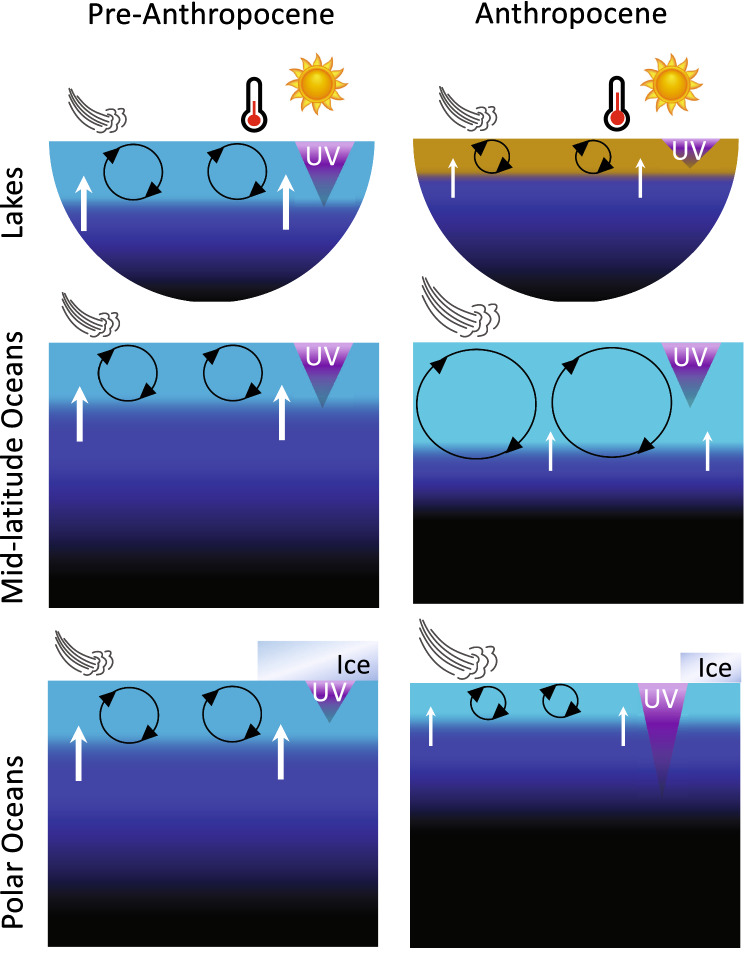
Fig. 1
Fig. 1
Schematic depiction of processes controlling exposure to UV-B radiation in aquatic ecosystems comparing before and after the “Anthropocene”, i.e. the current period of significant human impact on the Earth's ecosystems. In general, exposure to UV-B radiation is limited to the surface layer (light blue/brown), the mixing of which depends on the stratifying effect of surface warming and inputs of fresh water vs the stirring effects of surface winds and currents. Ice cover shields the polar ocean and wintertime lakes (not shown). In the Anthropocene ocean, there is more warming, more wind, and a greater mixed layer depth (MLD), while sharpening the density barrier (pycnocline, dark blue) to nutrient transport (arrows) from deep water (black). Ice melt reduces shielding and freshens the polar ocean reducing the MLD. Terrestrial run-off from rain events browns lake surface water, lowers UV-B transparency and warms surface waters due to enhanced absorption of solar radiation. Drought would have the opposite effect. The warming results in shallower mixed layers, as do weaker winds. Dimensions are not to scale
Fig. 2
Fig. 2
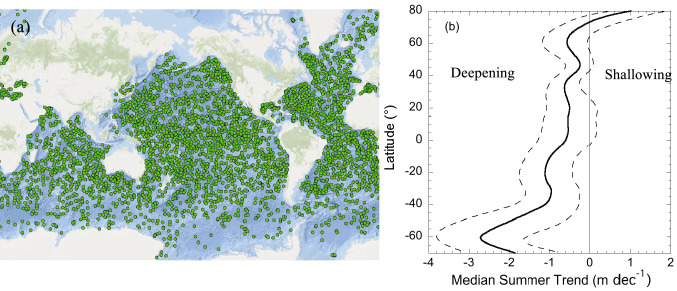
a Illustration of the locations of profiling ARGO floats on 22 March 2022 to show the density of global coverage used to observe mixed-layer depth (source ocean-ops.org) b Latitudinal variation in the trend (1970–2018) in summertime mixed layer depth, median (solid line) and 33rd and 66th percentiles (dashed lines), negative values indicate deepening, redrawn from [25]
Fig. 3
Fig. 3
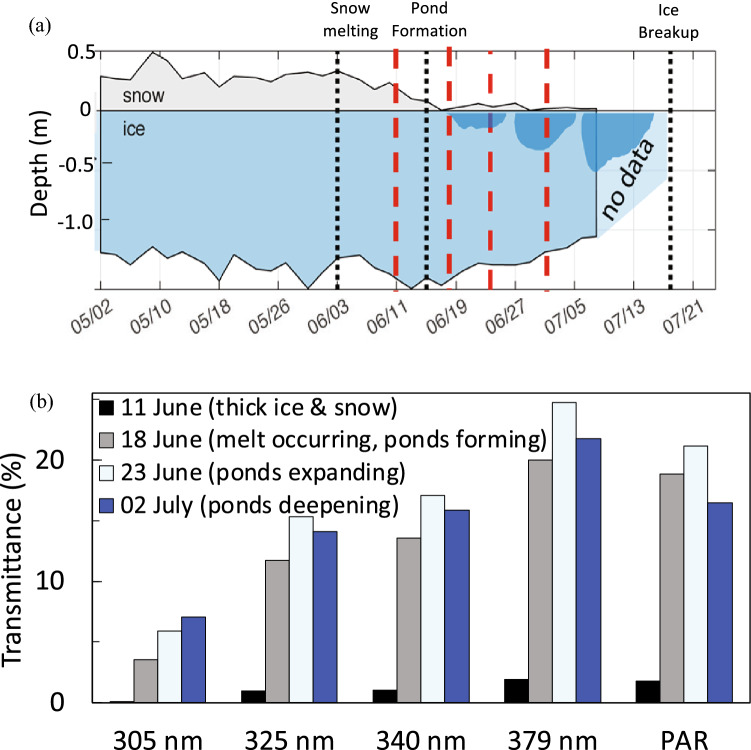
Effect of Arctic ice cover on transparency of UV radiation and PAR. a Thickness of ice, snow and pond depth through the spring, dotted black lines mark start of snow melting, start of pond development, and ice break-up. Dark blue areas indicate pond development. Red dashed lines indicate dates when the transmission was measured b Average (n > 100) transmittance to 2 m depth of UV-B, UV-A, and PAR under combined snow and ice cover (11 June), melting snow with the initiation of pond development (18 June), melting snow and shallow pond formation (23 June), and low snow and deeper pond (2 July). Adapted from [44, 45]
Fig. 4
Fig. 4
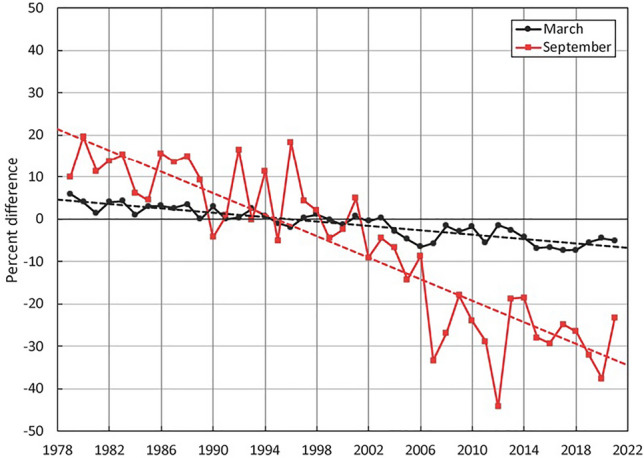
Time series of change as percent difference in maximum ice cover (black, March) and minimum ice cover (red, September) and linear trend lines (dashed) for the Arctic relative to the 1981 to 2010 average for March and September (Source: [46])
Fig. 5
Fig. 5
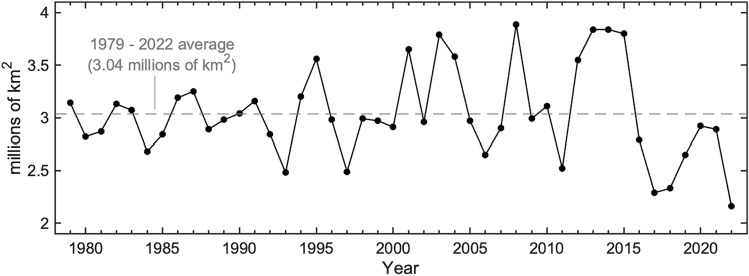
Sea ice extent around Antarctica in February (summer minimum) (data from [50])
Fig. 6
Fig. 6
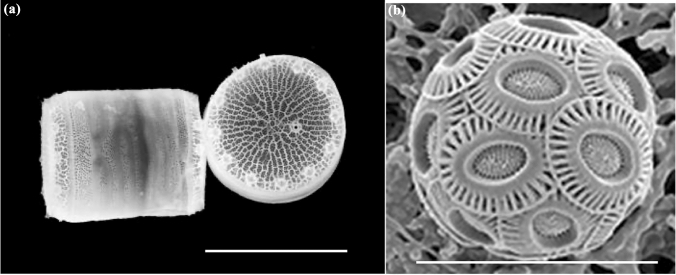
Scanning electron micrographs of different types of floating micro-algae (phytoplankton). a A cylindrical-shaped diatom in the genus Thalassiosira, scale bar 3 µm (credit Univ. Washington). b The coccolithophore Emiliania huxleyi, scale bar 20 µm (credit Kunshan Gao)
Fig. 7
Fig. 7
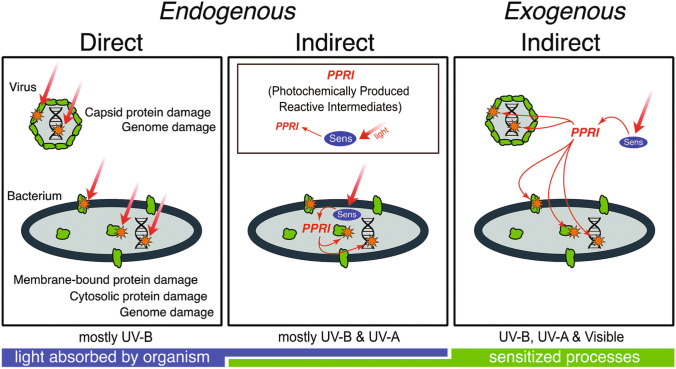
Conceptual model of inactivation mechanisms by solar radiation in viruses and bacteria. The direct mechanism involves photon absorption by viral or bacterial proteins or nucleic acids (orange stars), which triggers their photodegradation. In indirect mechanisms, the photon is absorbed by a sensitiser (Sens) present either inside (endogenous) or outside (exogenous) the pathogen. This process generates photochemically produced reactive intermediates (PPRIs) that include, among others, singlet oxygen, hydroxyl radicals, and triplet excited states that further damage the pathogen’s proteins and nucleic acids (orange stars). Green shapes represent proteins. Modified from [78]
Fig. 8
Fig. 8
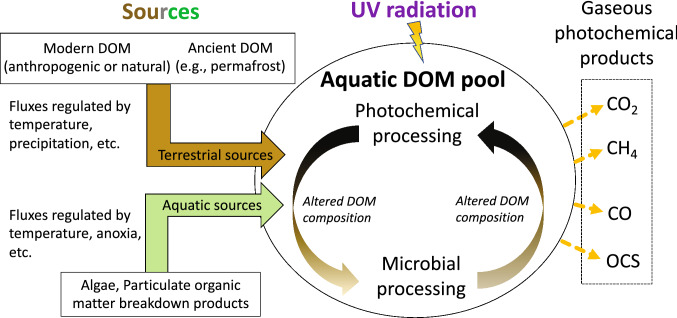
Schematic of the sources and processing of dissolved organic matter (DOM) in the aquatic environment. DOM has both terrestrial and aquatic sources, whose inputs are controlled by the rate of production and transport. Terrestrial sources include ancient DOM released during permafrost thaw. Once in the water, DOM undergoes photochemical and microbial processing, with the former usually enhancing the latter. These processes alter DOM composition and produce low molecular weight products, some of which are greenhouse gases. Products include carbon dioxide (CO2), methane (CH4), carbon monoxide (CO), and carbonyl sulphide (OCS) (photodegradation). Once in an electronically excited state, CDOM can either breakdown via direct photolysis or produce reactive species (e.g., singlet oxygen, hydroxyl radicals, triplet excited states, and hydrated electrons) that further react with both chromophoric and non-chromophoric DOM.
Fig. 9
Fig. 9
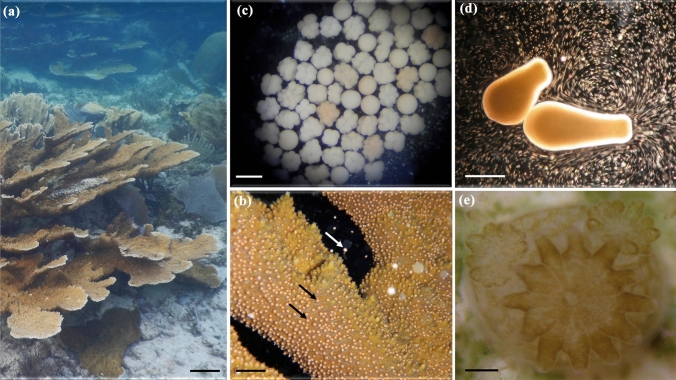
Life cycle of the Caribbean coral Acropora palmata a showing an adult colony (scale bar = 10 cm). b During summer months in the evening colonies synchronously spawn (scale bar = 2 cm) gamete bundles (seen as many pink spheres on the coral branches, two of which are indicated by black arrows) that contain eggs and sperm. The eggs are rich in lipids such that when the bundles are released (indicated by the white arrow) and rise to the surface, they break up due to wave action and fertilisation can occur between gametes of distinct colonies. c The embryos (scale bar = 600 µm) develop into d pear-shaped planula larvae (scale bar = 1 mm), both of which float at the water surface for three to five days exposed to summer-time peaks of UV radiation. Once the larvae begin to swim, they search for a suitable substrate to settle, followed by metamorphosis into e a coral primary polyp (scale bar = 1 mm), which undergoes asexual reproduction to form the colony. Photo credits: Sandra Mendoza Quiroz
Fig. 10
Fig. 10
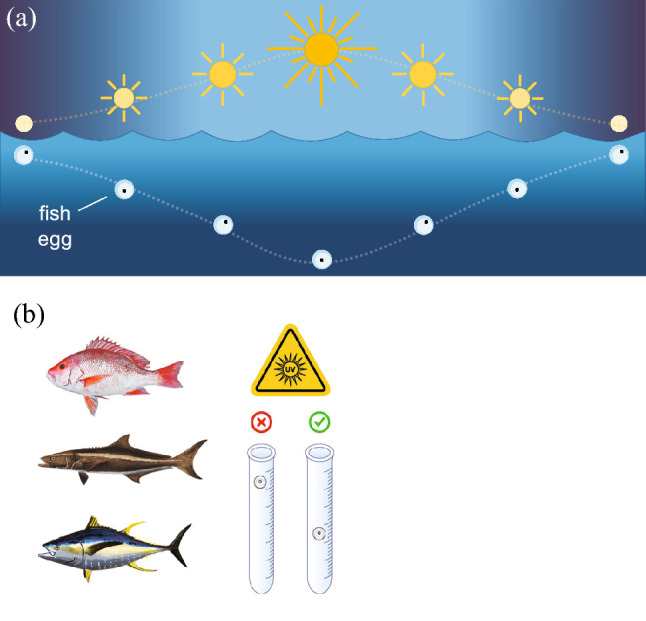
Fish have several mechanisms to avoid UV-damage. Recent laboratory studies have demonstrated that fish eggs can sink in response to UV-A irradiation. a The diel expression of this in the ocean helps to avoid potential damage from concomitant solar UV-B radiation, since eggs will sink as UV-B irradiation increases. b This mechanism is active in red snapper (Lutjanus campechanus), cobia (Rachycentron canadum), and yellowfin tuna (Thunnus albacares). On the right, a schematic of the experiment with eggs in tubes either protected from (x) or exposed to (✓) UV-A radiation (Figure redrawn from [278, 279])

References

    1. Williamson CE, Neale PJ, Hylander S, Rose KC, Figueroa FL, Robinson SA, Häder D-P, Wängberg S-Å, Worrest RC. The interactive effects of stratospheric ozone depletion, UV radiation, and climate change on aquatic ecosystems. Photochemical & Photobiological Sciences. 2019;18(3):717–746. doi: 10.1039/c8pp90062k. - DOI - PubMed
    1. Neale PJ, Williamson CE, Morris DP. Optical properties of water. In: Tockner K, Mehner T, editors. Encyclopedia of Inland Waters. 2. Elsevier; 2021. pp. 73–82.
    1. Overmans S, Agustí S. Unraveling the seasonality of UV exposure in reef waters of a rapidly warming (sub-)tropical sea. Frontiers in Marine Science. 2020;7:111. doi: 10.3389/fmars.2020.00111. - DOI
    1. Overmans S, Duarte CM, Sobrino C, Iuculano F, Álvarez-Salgado XA, Agustí S. Penetration of Ultraviolet-B radiation in oligotrophic regions of the oceans during the Malaspina 2010 expedition. Journal of Geophysical Research: Oceans. 2022;127(5):e2021JC017654. doi: 10.1029/2021jc017654. - DOI
    1. de Wit HA, Valinia S, Weyhenmeyer GA, Futter MN, Kortelainen P, Austnes K, Hessen DO, Räike A, Laudon H, Vuorenmaa J. Current browning of surface waters will be further promoted by wetter climate. Environmental Science & Technology Letters. 2016;3(12):430–435. doi: 10.1021/acs.estlett.6b00396. - DOI