. 2023 Jun 5;18(1):nsad023.
doi: 10.1093/scan/nsad023.

Mentalizing in an economic games context is associated with enhanced activation and connectivity in the left temporoparietal junction

Affiliations

Mentalizing in an economic games context is associated with enhanced activation and connectivity in the left temporoparietal junction

Li-Ang Chang et al. Soc Cogn Affect Neurosci. .

Abstract

Prior studies in Social Neuroeconomics have consistently reported activation in social cognition regions during interactive economic games, suggesting mentalizing during economic choice. Such mentalizing occurs during active participation in the game, as well as during passive observation of others' interactions. We designed a novel version of the classic false-belief task (FBT) in which participants read vignettes about interactions between agents in the ultimatum and trust games and were subsequently asked to infer the agents' beliefs. We compared activation patterns during the economic games FBT to those during the classic FBT using conjunction analyses. We find significant overlap in the left temporoparietal junction (TPJ) and dorsal medial prefrontal cortex, as well as the temporal pole (TP) during two task phases: belief formation and belief inference. Moreover, generalized Psychophysiological Interaction (gPPI) analyses show that during belief formation, the right TPJ is a target of both the left TPJ and the right TP seed regions, whereas during belief inferences all seed regions show interconnectivity with each other. These results indicate that across different task types and phases, mentalizing is associated with activation and connectivity across central nodes of the social cognition network. Importantly, this is the case for both the novel economic games and the classic FBTs.

Keywords: PPI; dmPFC; fMRI; false-belief task; mentalizing; temporoparietal junction; trust game; ultimatum game.


Conflict of interest statement

The authors declared that they had no conflict of interest with respect to their authorship or the publication of this article.

Figures
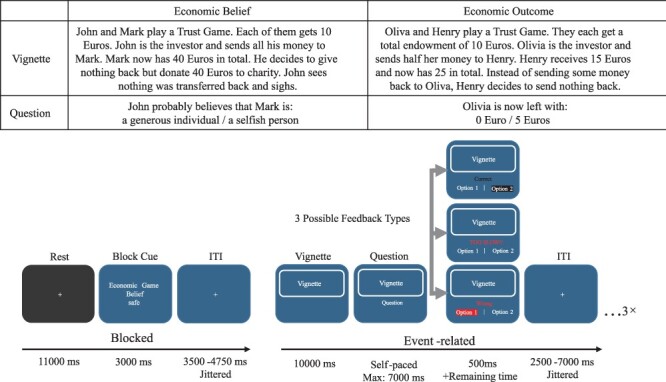
Fig. 1.
Fig. 1.
Example Economic Game Vignettes and Task Schematic. (A) A set of novel vignettes based on economic games were developed for the current experiment. The examples in (A) show economic game vignettes in the Belief (left) and the Outcome (right) conditions, together with their respective questions. (B) Trial sequence of the fMRI experiment. An initial block cue indicated the conditions that remained stable for the duration of one block of three trials, including the domain of the vignette, and whether the vignette concerns beliefs or outcomes. The vignette (see A) was shown for 10 s, after which participants were given a maximum of 7 s to answer the question. The correct answers were incentivized at a piece rate of 0.2 Euro.
Fig. 2.
Fig. 2.
Behavioral results. (A) The mean accuracy across (lines with standard error bounds) and within individuals (connected dots) of participants’ answers (percent correct) across the Domain and Outcome conditions. Accuracy reflects the proportion of correct relative to all responses. (B) The mean response times across (lines with standard error bounds) and within individuals (connected dots) for correct trials only across the Domain and Outcome conditions.
Fig. 3.
Fig. 3.
Whole-brain analysis of belief activations during the vignette period for the contrast belief > outcome in the life story domain (A) and economic game domain (B). The results show consistent activations in mentalizing regions in both tasks, particularly in the dmPFC and the left TPJ. The Results shown here were FWE-corrected at the cluster level with a cluster-forming threshold of P < 0.001.
Fig. 4.
Fig. 4.
Conjunction analysis during the vignette period. A conjunction analysis showed significant overlap between the economic games and standard FBTs in a wider network of social cognition regions, including the left TPJ, the dmPFC and the right middle temporal gyrus/temporal pole. Inlets show time courses of significant activations plotted separately for the life story and economic game domains. Time courses were extracted from voxels in the regions identified by the conjunction analysis, which were further thresholded to separate clusters in the middle temporal gyrus. The shaded area denotes the standard error of the percentage signal change.
Fig. 5.
Fig. 5.
Whole-brain analysis of belief activations during the question period for the contrast belief  > outcome in the life story domain (A) and economic game domain (B). The results show consistent activations in mentalizing regions in both tasks, particularly in the dmPFC, the bilateral TPJ and the temporal pole. The results shown here were FWE-corrected at the cluster level with a cluster-forming threshold of P < 0.001.
Fig. 6.
Fig. 6.
The conjunction analysis during the question period. A conjunction analysis showed significant overlap in a wider network of mentalizing regions, including the left TPJ, the dmPFC and the bilateral temporal pole. Inlets show time courses of significant activations plotted separately for the life story and economic game domains. Time courses were extracted from voxels in the regions identified by the conjunction analysis, which were further thresholded to separate clusters in the middle temporal gyrus. The shaded area denotes the standard error of the percentage signal change.
Fig. 7.
Fig. 7.
Functional connectivity among ROIs during the vignette and question periods. ROI-to-ROI analyses show heightened connectivity during the Belief condition relative to the Outcome condition between the left TPJ and the right TP during the vignette period (left ROI-ring display, TFCE value = 5.58, FWE-corrected P = 0.044) and extensive interconnectivity among ROIs during the question period (right ROI-ring display, TFCE value = 14.91, FWE-corrected P = 0.009).
Fig. 8.
Fig. 8.
The whole-brain gPPI analysis of belief-based effective connectivity during the vignette period. The gPPI analyses show heightened connectivity during the Belief condition relative to the Outcome condition between the left TPJ seed and the right TPJ target during the vignette period (58, −52, 30, k = 126, cluster-level FWE-corrected P = 0.0253) as well as between the right TP seed and the right TPJ target (52, −54, 26, k = 570, cluster-level FWE-corrected P < 0.0001).

References

    1. Aimone J.A., Houser D., Weber B. (2014). Neural signatures of betrayal aversion: an fMRI study of trust. Proceedings of the Royal Society B: Biological Sciences, 281(1782), 20132127. - PMC - PubMed
    1. Alós-Ferrer C., Farolfi F. (2019). Trust games and beyond. Frontiers in Neuroscience, 13, 1–14. - PMC - PubMed
    1. Amodio D.M., Frith C.D. (2006). Meeting of minds: the medial frontal cortex and social cognition. Nature Reviews Neuroscience, 7(4), 268–77. - PubMed

    1. Barr D.J. (2013). Random effects structure for testing interactions in linear mixed-effects models. Frontiers in Psychology, 4(1), 328. - PMC - PubMed
    1. Behrens T.E.J., Hunt L.T., Woolrich M.W., Rushworth M.F.S. (2008). Associative learning of social value. Nature, 456(7219), 245–9. - PMC - PubMed

Publication types