


Association of blood viscosity and device-free days among hospitalized patients with COVID-19
- PMID: 37131249
- PMCID: PMC10153022
- DOI: 10.1186/s40560-023-00665-4
Association of blood viscosity and device-free days among hospitalized patients with COVID-19
Abstract
Background: Increased estimated whole blood viscosity (eWBV) predicts higher mortality in patients hospitalized for coronavirus disease 2019 (COVID-19). This study assesses whether eWBV is an early predictor of non-fatal outcomes among patients hospitalized for acute COVID-19 infection.
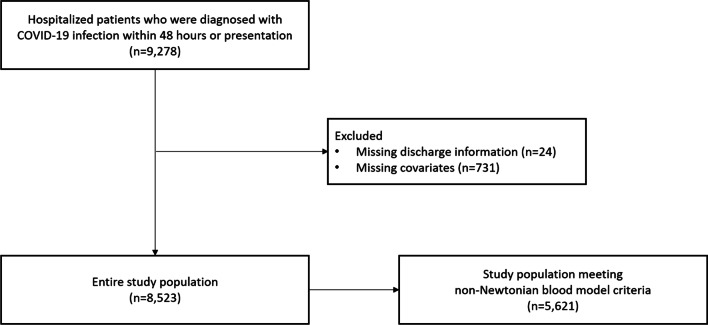
Methods: This retrospective cohort study included 9278 hospitalized COVID-19 patients diagnosed within 48 h of admission between February 27, 2020 to November 20, 2021 within the Mount Sinai Health System in New York City. Patients with missing values for major covariates, discharge information, and those who failed to meet the criteria for the non-Newtonian blood model were excluded. 5621 participants were included in the main analysis. Additional analyses were performed separately for 4352 participants who had measurements of white blood cell count, C-reactive protein and D-dimer. Participants were divided into quartiles based on estimated high-shear blood viscosity (eHSBV) and estimated low-shear blood viscosity (eLSBV). Blood viscosity was calculated using the Walburn-Schneck model. The primary outcome was evaluated as an ordinal scale indicating the number of days free of respiratory organ support through day 21, and those who died in-hospital were assigned a value of -1. Multivariate cumulative logistic regression was conducted to evaluate the association between quartiles of eWBV and events.
Results: Among 5621 participants, 3459 (61.5%) were male with mean age of 63.2 (SD 17.1) years. The linear modeling yielded an adjusted odds ratio (aOR) of 0.68 (95% CI 0.59-0.79, p value < 0.001) per 1 centipoise increase in eHSBV.
Conclusions: Among hospitalized patients with COVID-19, elevated eHSBV and eLSBV at presentation were associated with an increased need for respiratory organ support at 21 days. These findings are highly relevant, as they demonstrate the utility of eWBV in identifying hospitalized patients with acute COVID-19 infection at increased risk for non-fatal outcomes in early stages of the disease.
Keywords: Blood viscosity; Coronavirus-19; Critical care medicine; Hypoxic respiratory failure.
© 2023. The Author(s).
Conflict of interest statement
The authors declare that they do not have any competing interests.
References
-
- Marks KJ, Whitaker M, Agathis NT, Anglin O, Milucky J, Patel K, et al. Hospitalization of infants and children aged 0–4 years with laboratory-confirmed COVID-19 - COVID-NET, 14 States, March 2020-February 2022. MMWR Morb Mortal Wkly Rep. 2022;71(11):429–436. doi: 10.15585/mmwr.mm7111e2. - DOI - PMC - PubMed
LinkOut - more resources
Full Text Sources
Research Materials
