


Incentives for climate mitigation in the land use sector-the effects of payment for environmental services on environmental and socioeconomic outcomes in low- and middle-income countries: A mixed-methods systematic review
- PMID: 37131507
- PMCID: PMC8356506
- DOI: 10.1002/cl2.1045
Incentives for climate mitigation in the land use sector-the effects of payment for environmental services on environmental and socioeconomic outcomes in low- and middle-income countries: A mixed-methods systematic review
Abstract
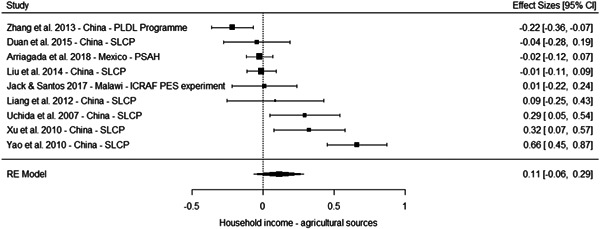
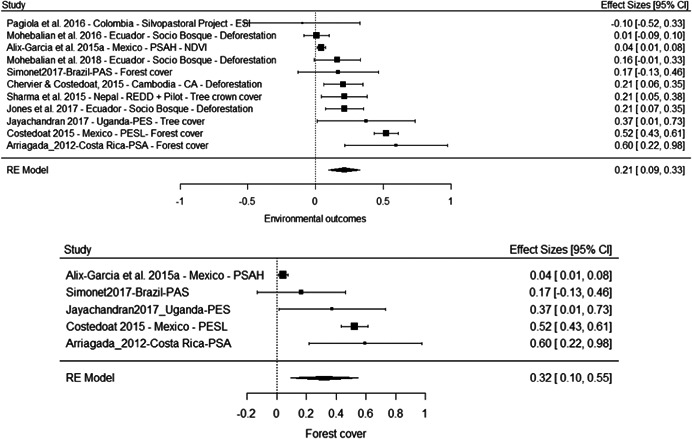
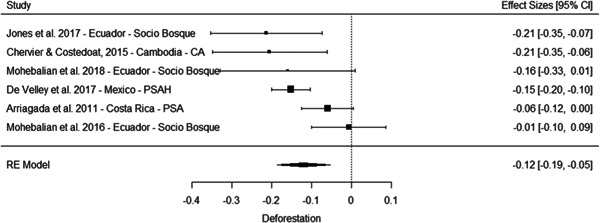
Unsustainable practices in the land use sector contribute to climate change through the release of greenhouse gases. Payment for environmental services (PESs) provide economic incentives to reduce the negative environmental impacts of land use and are a popular approach to mitigate climate change in low- and middle-income countries. Some PES programmes also aim to improve socioeconomic outcomes and reduce poverty. This systematic review examines the effect of programmes on environmental and socioeconomic outcomes. We identified 44 quantitative impact evaluations and 60 qualitative studies of PES programmes for inclusion in the review, to assess both the effects of PES and identify context, design and implementation features that may influence PES effectiveness. The studies covered 18 programmes from 12 countries in Latin America and the Caribbean, East Asia and Pacific, South Asia and Sub-Saharan Africa. The review finds that PES may increase household income, reduce deforestation and improve forest cover, but the findings are, however, based on low and very low quality evidence from a small number of programmes and should be treated with caution. Qualitative evidence indicates that several factors influence whether PES programmes are likely to be effective in different contexts and suggests that the inclusion of strong governance structures and the effective targeting of both locations and participants may improve intervention effectiveness. Funders, implementing agencies and researchers should collaborate to develop a coordinated programme of rigorous, mixed-methods impact evaluation implemented across contexts. Until such evidence is available, PES programmes remain a high-risk strategy for climate change mitigation.
© 2019 The Authors. Campbell Systematic Reviews published by John Wiley & Sons Ltd on behalf of The Campbell Collaboration.
Figures

Update of
- Protocol doi: 10.1002/CL2.209
References
-
- Alix‐Garcia, J. , & Wolff, H. (2014). Payment for ecosystem services from forests. Annual Review of Resource Economics, 6, 361–380.
-
- Alix‐Garcia, J , Aronson, G , Radeloff, V , Ramirez‐Reyes, C , Shapiro, E , Sims, K , & Yañez‐Pagans, P , (2014) Environmental and socioeconomic impacts of Mexico's payments for ecosystem services program (3ie Impact Evaluation Report 20). New Delhi: International Initiative for Impact Evaluation (3ie)
-
- Agrawal, A. , & Angelsen, A. (2009). Using community forest management to achieve REDD+ goals. In Angelsen S., Brockhaus A., Kanninen M., Sills M., Sunderlin E., & Wertz‐Kanounnikoff W. D. (Eds.), Realising REDD: National strategy and policy options (pp. 201–211). Bogor: Center for International Forestry Research (CIFOR).
-
- Angelsen, A. (2009). Policy options to reduce deforestation. In Angelsen A., Brockhaus M., Kanninen M., Sills E., Sunderlin W. D., & Wertz‐Kanounnikoff S. (Eds.), Realising REDD+: National strategy and policy options (pp. 125–138). Bogor: Center for International Forestry Research (CIFOR).
-
- Arriagada, R. , & Perrings, C. (2009). Making Payments for Ecosystem Services Work, Ecosystem Services Economics. Nairobi: United Nations Environment Program.
Publication types
LinkOut - more resources
Full Text Sources