[Assessment of Direct (COVID-19-Related) and Collateral, Psychosocial Pandemic Consequences for Vulnerable Groups by the Example of Serious Mental Illness]
- PMID: 37137325
- PMCID: PMC10567134
- DOI: 10.1055/a-2051-7613
[Assessment of Direct (COVID-19-Related) and Collateral, Psychosocial Pandemic Consequences for Vulnerable Groups by the Example of Serious Mental Illness]
Abstract
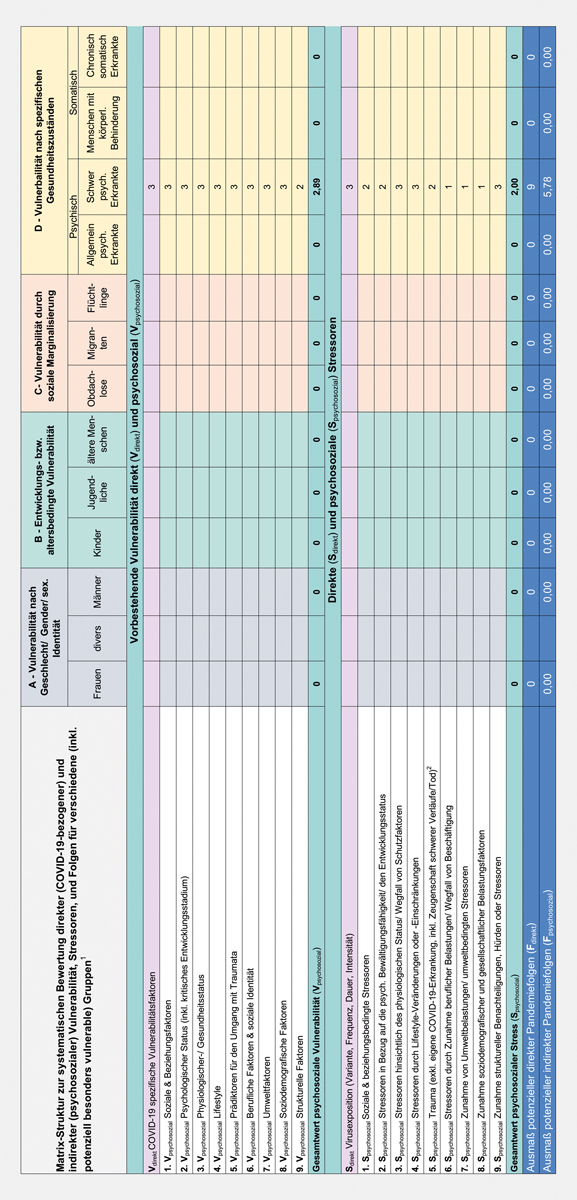
The indirect pandemic consequences could by far exceed the direct effects of SARS-CoV-2 in terms of costs, morbidity, and mortality. This essay includes a proposed method (matrix) to visualize virus-related and psychosocial risks for different populations side by side in a systematic and concise manner. COVID-19-related and psychosocial vulnerability, stressors, direct and indirect consequences are derived on a theoretical and empirical basis. An exemplary quantification of the matrix for the vulnerable group of people with severe mental illness revealed a very high risk for severe COVID-19 consequences, as well as a pronounced risk for psychosocial collateral effects. The proposed approach could be further discussed for a risk-graded pandemic management, crisis recovery, and future preparedness to adequately address psychosocial collateral effects and better identify and protect vulnerable groups in this regard.
Die indirekten Pandemiefolgen könnten die direkten Auswirkungen von SARS-CoV-2 in Bezug auf Kosten, Morbidität und Mortalität weit übersteigen. Dieses Essay beinhaltet einen Methodenvorschlag (Matrix), um virusbezogene und psychosoziale Risiken für verschiedene Bevölkerungsgruppen auf systematische und übersichtliche Weise nebeneinander sichtbar zu machen. COVID-19-bezogene und psychosoziale Vulnerabilität, Stressoren, direkte sowie indirekte Folgen werden Theorie- und evidenzbasiert hergeleitet und bestimmt. Eine exemplarische Quantifizierung der Matrix für die vulnerable Gruppe von Menschen mit schweren psychischen Erkrankungen ergab ein sehr hohes Risiko für schwere COVID-19-Folgen, sowie ein ausgeprägtes Risiko für psychosoziale Kollateraleffekte. Das vorgeschlagene Vorgehen könnte für ein risikogestuftes Pandemiemanagement, die Krisenaufarbeitung, und zukünftige Preparedness weiter diskutiert werden, um psychosoziale Kollateraleffekte angemessen zu berücksichtigen und diesbezüglich gefährdete Gruppen besser zu identifizieren und zu schützen.
The Author(s). This is an open access article published by Thieme under the terms of the Creative Commons Attribution-NonDerivative-NonCommercial-License, permitting copying and reproduction so long as the original work is given appropriate credit. Contents may not be used for commercial purposes, or adapted, remixed, transformed or built upon. (https://creativecommons.org/licenses/by-nc-nd/4.0/).
Conflict of interest statement
Die Autorinnen/Autoren geben an, dass kein Interessenkonflikt besteht.
Figures
References
-
- Gibson B, Schneider J, Talamonti D et al. The impact of inequality on mental health outcomes during the COVID-19 pandemic: a systematic review. Can Psychol Can. 2021;62:101–126.
-
- Kuran CH A, Morsut C, Kruke B I et al. Vulnerability and vulnerable groups from an intersectionality perspective. Int J Disaster Risk Reduct. 2020 doi: 10.1016/j.ijdrr.2020.101826. - DOI
-
- World Health Organization . Regional Office for Europe. Action required to address the impacts of the COVID-19 pandemic on mental health and service delivery systems in the WHO European Region: recommendations from the European Technical Advisory Group on the mental health impacts of COVID-19. WHO. 2021. https://apps.who.int/iris/handle/10665/342932 https://apps.who.int/iris/handle/10665/342932
Publication types
MeSH terms
LinkOut - more resources
Full Text Sources
Medical
Miscellaneous