


Disruption in Blood Pressure Control With the COVID-19 Pandemic: The PCORnet Blood Pressure Control Laboratory
- PMID: 37137641
- PMCID: PMC9874044
- DOI: 10.1016/j.mayocp.2022.12.024
Disruption in Blood Pressure Control With the COVID-19 Pandemic: The PCORnet Blood Pressure Control Laboratory
Abstract
Objective: To explore trends in blood pressure (BP) control before and during the COVID-19 pandemic.
Patients and methods: Health systems participating in the National Patient-Centered Clinical Research Network (PCORnet) Blood Pressure Control Laboratory Surveillance System responded to data queries, producing 9 BP control metrics. Averages of the BP control metrics (weighted by numbers of observations in each health system) were calculated and compared between two 1-year measurement periods (January 1, 2019, through December 31, 2019, and January 1, 2020, through December 31, 2020).
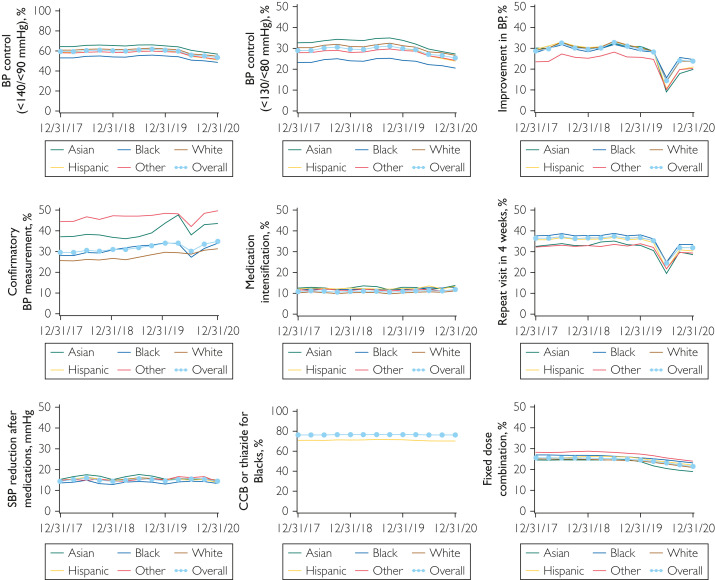
Results: Among 1,770,547 hypertensive persons in 2019, BP control to <140/<90 mm Hg varied across 24 health systems (range, 46%-74%). Reduced BP control occurred in most health systems with onset of the COVID-19 pandemic; the weighted average BP control was 60.5% in 2019 and 53.3% in 2020. Reductions were also evident for BP control to <130/<80 mm Hg (29.9% in 2019 and 25.4% in 2020) and improvement in BP (reduction of 10 mm Hg in systolic BP or achievement of systolic BP <140 mm Hg; 29.7% in 2019 and 23.8% in 2020). Two BP control process metrics exhibited pandemic-associated disruption: repeat visit in 4 weeks after a visit with uncontrolled hypertension (36.7% in 2019 and 31.7% in 2020) and prescription of fixed-dose combination medications among those with 2 or more drug classes (24.6% in 2019 and 21.5% in 2020).
Conclusion: BP control decreased substantially during the COVID-19 pandemic, with a corresponding reduction in follow-up health care visits among persons with uncontrolled hypertension. It is unclear whether the observed decline in BP control during the pandemic will contribute to future cardiovascular events.
Copyright © 2023 Mayo Foundation for Medical Education and Research. Published by Elsevier Inc. All rights reserved.
Conflict of interest statement
Mr Maeztu receives consulting fees and support for attending meetings and/or travel from and participates in a data safety monitoring board or advisory board for the University of California at San Francisco and is a Citizen Scientist for the University of Florida. Drs Wozniak and Rakotz are employees of the American Medical Association. Dr Sanchez is an employee of the American Heart Association and has received funding from the Department of Health and Human Services. Dr S Smith has received funding from the National Heart, Lung and Blood Institute, Patient-Centered Outcomes and Research Institute and served on the board of the Consortium for Southeastern Healthcare Quality. Dr Ahmad has received grant support from Amgen and Boehringer Ingelheim and consulting fees from Pfizer. Dr Liu has received grants from the National Institute of Diabetes and Digestive and Kidney Diseases (grant R01DK116986), the National Science Foundation (grant 2014554), and the National Center for Advancing Translational Sciences (grant UL1TR002366) and support for attending meetings and/or travel from the National Institutes of Health and the National Science Foundation. Dr McClay has received grant support from PCORI, the National Institutes of Health, and National Institute of General Medical Sciences and served as co-chair of the HL7 Clinical Interoperability Council. The PCORI funding partially supported salaries (Drs Chamberlain, Cooper-DeHoff, Fontil, Todd, Carton, O’Brien, and Pletcher and Mss Shaw, Smith, and Faulkner Modrow) or consulting income (Mr Maeztu). The other authors report no competing interests.
Figures

Comment in
-
Poorly Controlled Blood Pressure: The Virus and the Elephant.Mayo Clin Proc. 2023 May;98(5):644-646. doi: 10.1016/j.mayocp.2023.03.016. Mayo Clin Proc. 2023. PMID: 37137636 Free PMC article. No abstract available.
-
Probability of Reduced Follow-up Health Care Visits for Controlled Hypertensive Patients.Mayo Clin Proc. 2023 Jun;98(6):948-949. doi: 10.1016/j.mayocp.2023.04.004. Mayo Clin Proc. 2023. PMID: 37270275 Free PMC article. No abstract available.
-
In Reply: Probability of Reduced Follow-up Health Care Visits for Controlled Hypertensive Patients.Mayo Clin Proc. 2023 Jun;98(6):949. doi: 10.1016/j.mayocp.2023.04.005. Mayo Clin Proc. 2023. PMID: 37270276 Free PMC article. No abstract available.
