


Why so slangry (sleepy and angry)? Shorter sleep duration and lower sleep efficiency predict worse next-day mood in adolescents
- PMID: 37138384
- PMCID: PMC10524335
- DOI: 10.1002/jad.12182
Why so slangry (sleepy and angry)? Shorter sleep duration and lower sleep efficiency predict worse next-day mood in adolescents
Abstract
Purpose: The goal of this study was to evaluate the relationships of actigraphic nighttime sleep duration and quality with next-day mood among urban adolescents using a micro-longitudinal design.
Methods: A subsample (N = 525) of participants from the Fragile Families & Child Wellbeing Study (mean age: 15.4 years; 53% female; 42% Black non-Hispanic, 24% Hispanic/Latino, 19% White non-Hispanic) in the United States between 2014 and 2016 concurrently wore a wrist actigraphic sleep monitor and rated their daily mood in electronic diaries for about 1 week. Multilevel models tested the within-person temporal associations of nightly sleep duration and sleep maintenance efficiency with next-day reports of happiness, anger, and loneliness. The models also tested the between-person associations of sleep variables and mood. Models adjusted for sociodemographic and household characteristics, weekend, and school year.
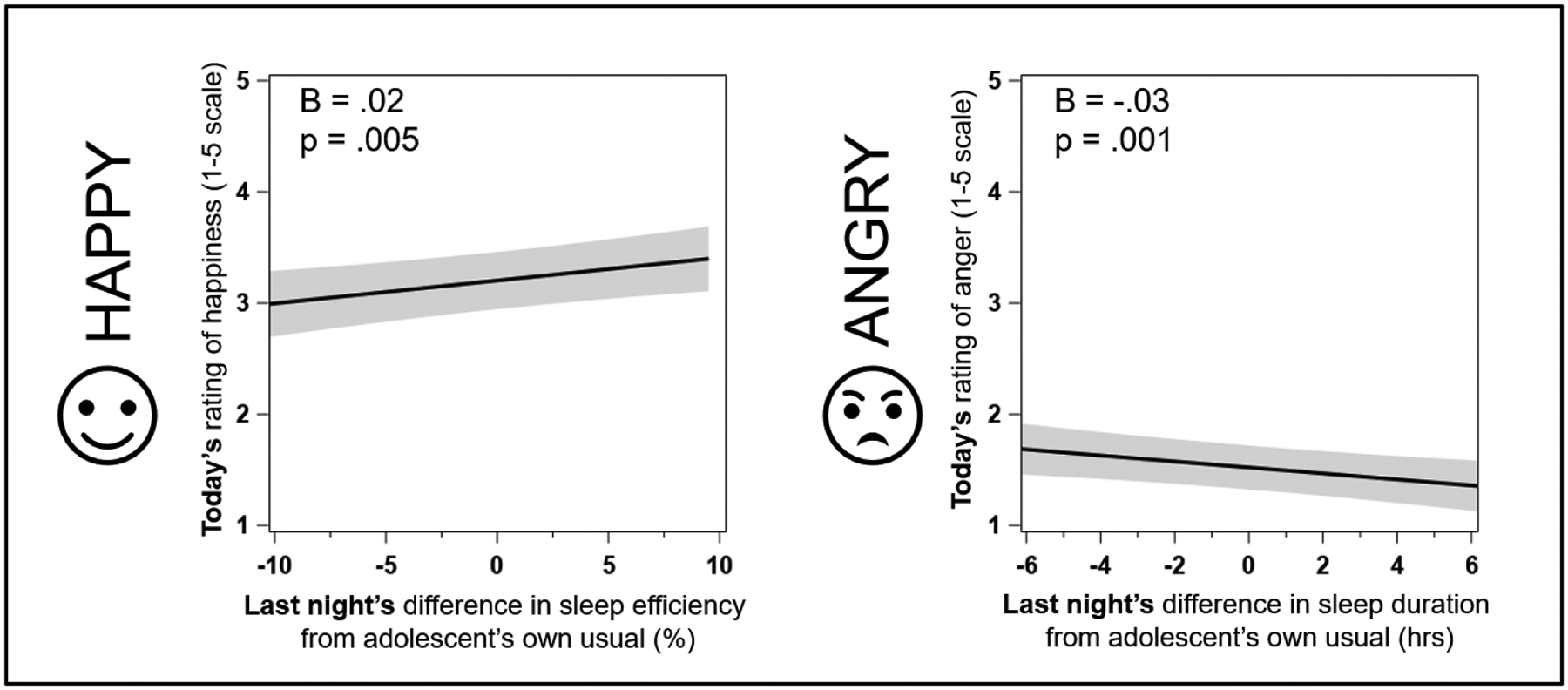
Results: After nights when adolescents obtained longer sleep duration than their usual, they reported lower ratings of anger (B = -.03, p < .01) the next day. After nights when adolescents had higher sleep maintenance efficiency than their usual, they reported higher ratings of happiness (B = .02, p < .01) the next day. Adolescents who had longer average sleep duration reported lower ratings of anger (B = -.08, p < .01) and loneliness (B = -.08, p < .01) compared to others. There was no within-person association of sleep duration or efficiency with loneliness. Sleep duration was not associated with happiness between adolescents, and sleep maintenance efficiency was not associated with any mood measure between adolescents.
Conclusions: Improvements to nightly sleep may help increase happiness and decrease anger the following day in adolescents. Promoting sleep health is recommended to improve mood.
Keywords: actigraphy; adolescents; daily diary; mood; sleep.
© 2023 The Authors. Journal of Adolescence published by Wiley Periodicals LLC on behalf of Foundation for Professionals in Services to Adolescents.
Conflict of interest statement
Outside of the current work, Dr. Orfeu M. Buxton discloses that he received subcontract grants to Penn State from Proactive Life (formerly Mobile Sleep Technologies), doing business as SleepSpace (National Science Foundation grant #1622766 and NIH/National Institute on Aging Small Business Innovation Research Program R43AG056250, R44 AG056250), received honoraria/travel support for lectures from Boston University, Boston College, Tufts School of Dental Medicine, New York University, University of Miami, University of South Florida, University of Utah, University of Arizona, Harvard Chan School of Public Health, Eric H. Angle Society of Orthodontists, and Allstate, consulting fees for SleepNumber, and receives an honorarium for his role as the Editor in Chief of the journal Sleep Health. Dr. Lauren Hale discloses that she received consulting fees from New York University, Auburn University and Baylor University, received an honorarium for a lecture from Spring Health, Willis Towers Watson, received an honorarium for her role as Founding Editor-in-Chief of the journal Sleep Health, and serves as the chair of the National Sleep Foundation. Dr. Anne-Marie Chang discloses that, outside of the current work, she received a grant through Penn State from Kunasan Inc, and received an honorarium/travel support from University of Miami. The other authors have no disclosures relevant to the current study.
Figures
References
-
- Bitsko RH, Holbrook JR, Ghandour RM, Blumberg SJ, Visser SN, Perou R, & Walkup JT (2018). Epidemiology and Impact of Health Care Provider-Diagnosed Anxiety and Depression Among US Children. Journal of Developmental and Behavioral Pediatrics, 39(5), 395–403. 10.1097/DBP.0000000000000571 - DOI - PMC - PubMed
Publication types
MeSH terms
Grants and funding
LinkOut - more resources
Full Text Sources
Medical