Review
. 2023 Apr;13(4):1438-1466.
doi: 10.1016/j.apsb.2022.12.019. Epub 2023 Feb 2.

The regulatory mechanisms and inhibitors of isocitrate dehydrogenase 1 in cancer

Affiliations
Review

The regulatory mechanisms and inhibitors of isocitrate dehydrogenase 1 in cancer

Yang Liu et al. Acta Pharm Sin B. 2023 Apr.

Abstract

Reprogramming of energy metabolism is one of the basic characteristics of cancer and has been proved to be an important cancer treatment strategy. Isocitrate dehydrogenases (IDHs) are a class of key proteins in energy metabolism, including IDH1, IDH2, and IDH3, which are involved in the oxidative decarboxylation of isocitrate to yield α-ketoglutarate (α-KG). Mutants of IDH1 or IDH2 can produce d-2-hydroxyglutarate (D-2HG) with α-KG as the substrate, and then mediate the occurrence and development of cancer. At present, no IDH3 mutation has been reported. The results of pan-cancer research showed that IDH1 has a higher mutation frequency and involves more cancer types than IDH2, implying IDH1 as a promising anti-cancer target. Therefore, in this review, we summarized the regulatory mechanisms of IDH1 on cancer from four aspects: metabolic reprogramming, epigenetics, immune microenvironment, and phenotypic changes, which will provide guidance for the understanding of IDH1 and exploring leading-edge targeted treatment strategies. In addition, we also reviewed available IDH1 inhibitors so far. The detailed clinical trial results and diverse structures of preclinical candidates illustrated here will provide a deep insight into the research for the treatment of IDH1-related cancers.

Keywords: Cancer; D-2HG; Epigenetics; IDH1; IDH1 inhibitors; Immune microenvironment; Metabolic reprogramming; Regulatory mechanisms.


Conflict of interest statement

All the authors declared that they have no conflicts of interest.

Figures

Image 1
Graphical abstract
Figure 1
Figure 1
Hallmarks of cancer from 2000 to 2022. Original hallmarks are the initially identified cancer feature; emerging hallmarks are the features that have not been determined in the corresponding period and need further research and confirmation; enabling characteristics are the features that have been proposed in the corresponding period; colored circular arrows represent the time when the cancer hallmarks were presented; “…” represents the time when new cancer characteristics may be proposed in the future.
Figure 2
Figure 2
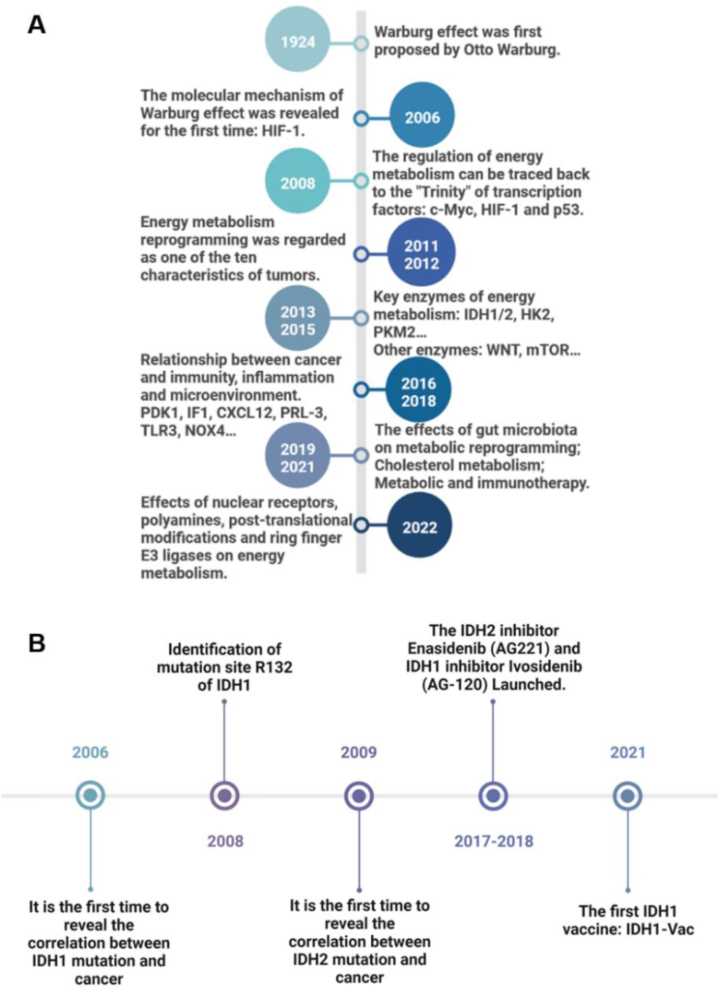
Research timeline of cancer energy metabolism reprogramming and IDH1/2. (A) Milestone events of cancer energy metabolism reprogramming from 1924 to 2022. (B) Milestone events of IDH1/2 research from 2006 to 2021. The description of key events is on the opposite side of the time.
Figure 3
Figure 3
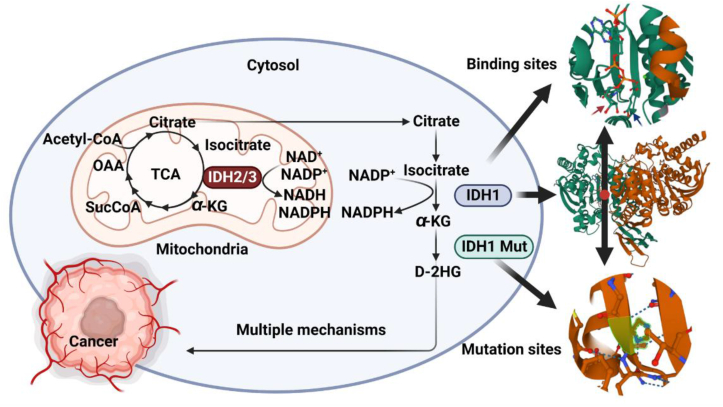
The selected function and structure of IDH1. The structure of IDH1WT (PDB ID: 4KZO). The up circular picture is a magnified view of the binding site of IDH1WT. The red arrow points to NADPH, and the blue arrow points to α-KG, green sphere is the divalent metal ion. The down circular picture is the enlarged view of the most common mutation site of IDH1WT. IDH1R132H is the most common mutation. IDH1 is composed of two subunits, heterozygous mutation (one subunit is mutated, and the other subunit is not mutated) of IDH1 can catalyze α-KG to yield D-2HG. Succinyl-coenzyme A (SucCoA); oxaloacetate (OAA); coenzyme A (CoA).
Figure 4
Figure 4
Amino acid sequence, mutation site, and mutation-related disease of IDH1. The human IDH1 is composed of 414 amino acids. In this figure, rectangles of different colors are used to show the structural characteristics of IDH1. The black rectangle marks the mutation site of IDH1, and the table below shows the disease corresponding to the mutation. Acute myeloid leukemia (AML); adenoid cystic carcinoma (AdCC); astrocytoma (A); breast neoplasm (BN); enchondromatosis (E); lymphoma (L); glioblastoma (GBM); glioblastoma multiforme (GM); glioma susceptibility 1 (GLM1); hepatocellular carcinoma (HCC); lung adenocarcinoma (LUAD); malignant melanoma of skin (CMM); medulloblastoma (MDB); metaphyseal chondromatosis (MC); multiple myeloma (MM); myelodysplastic syndrome (MDS); neoplasm of brain (NB); neoplasm of the large intestine (NLI); oligodendroglioma (ODGM); prostate adenocarcinoma (PAAD). The above information cited from the Uniport Database. Update [2020]. URL: https://www.uniprot.org/uniprotkb/O75874/feature-viewer.
Figure 5
Figure 5
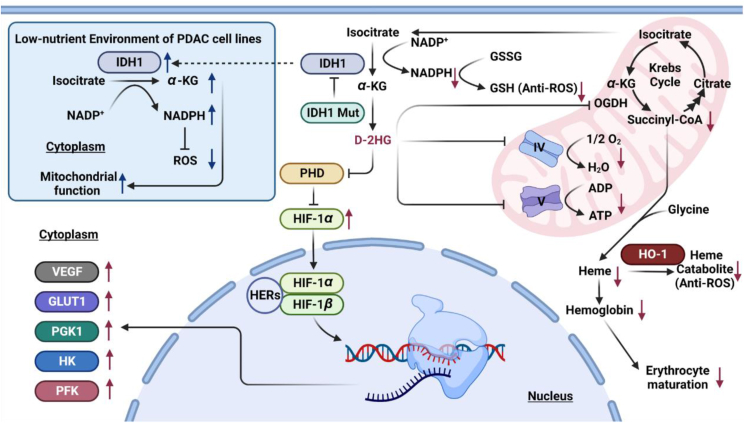
IDH1-mediated metabolic reprogramming. In general, IDH1 mutation increases the level of D-2HG and the expression of cancer-promoting proteins through the HIF-1α signal pathway. In addition, IDH1 mutation also inhibits the synthesis of ATP, results in a decline in antioxidant capacity, and causes erythroid cell maturation disorder via the inhibition of α-KG dehydrogenase. In the low-nutritional stated PDAC cells, the levels of IDH1 and NADPH increased, enhancing the mitochondrial function to maintain the growth of cancer cells. The black arrow means the promotion effects. The black T-shaped arrow means inhibition effects. The red arrow means the final effect caused by IDH1 mutations. The blue arrow means the change of IDH1 level in the low-nutritional stated PDAC cells and the resulting final effect. Vascular endothelial growth factor (VEGF), hexokinase (HK), glucose transporter-1 (GLUT1), phosphofructokinase (PFK), phosphoglycerate kinase 1 (PGK1), prolyl-hydroxylase (PHD), hypoxia inducible factors-1α (HIF-1α), hypoxia-responsive elements (HERs), heme oxygenase-1 (HO-1), reactive oxygen species (ROS), glutathione (GSH).
Figure 6
Figure 6
Effect of IDH1 on Epigenetics. IDH1 mutation causes the level of D-2HG to increase, which in turn promotes the hypermethylation of DNA and histones, and eventually induces cancer. The black arrow means the promotion effects. The black T-shaped arrow means inhibition effects. The black dotted arrow means the time sequence. “Me” means methylation. Receptor-interacting protein 3 (RIP3), DNA methyltransferase 1 (DNMT1), TET oncogene family member 2 (TET2), 5-methylcytosine (5mC), 5-hydroxymethylcytosine (5hmC), JmjC domain containing histone demethylase (JHDM), zinc finger E-box binding homeobox 1 (ZEB1), epithelial–mesenchymal transition (EMT).
Figure 7
Figure 7
Effect of IDH1 mutation on cancer immune microenvironment. IDH1 mutation will cause the cancer microenvironment to be in a state of immunosuppression. The black arrow means the promotion effects. The black T-shaped arrow means inhibition effects. The red arrow means the final effects caused by IDH1 mutation. Signal transducer and activator of transcription 1 (STAT1), CXC chemokine ligand-10 (CXCL10), solute carrier family 13 member 3 (SLC13A3), phospholipase C gamma (PLC-γ), nuclear translocation of activated T cell nuclear factor (NFAT), tryptophan-2,3-dioxygenase (TDO), l-tryptophan (L-Trp), aryl hydrocarbon receptor (AhR), kynurine (Kyn), interleukin 10 (IL-10), cluster of differentiation 86 (CD86), cluster of differentiation 80 (CD80), major histocompatibility complex II (MHCII), programmed cell death-ligand 1 (PD-L1), natural killer cell group 2D (NKG2D), NKG2D ligand (NKG2DL), natural killer (NK).
Figure 8
Figure 8
The effect of IDH1 on cancer phenotype and its molecular mechanism. The black arrow means the promotion effects. The black T-shaped arrow means inhibition effects. “+” means synergistic effect. The colors of targets represent the influence on IDH1WT and IDH1 (upstream), or the influence on cancer cell phenotype (downstream). Prostate apoptosis response-4 (Par-4), B-cell lymphoma-2 (Bcl-2), B-cell lymphoma-XL (Bcl-XL), myeloid cell leukemia 1 (Mcl-1), adenosine 5′-monophosphate-activated protein kinase (AMPK), mechanistic target of rapamycin (mTOR), C/EBP homologous protein (CHOP), c-Jun N-terminal kinase (JNK), poly ADP-ribose polymerase (PARP), paired box 5 (PAX5), phosphoinositide 3-kinase (PI3K), protein kinase B (AKT).
Figure 9
Figure 9
Structures of IDH1 inhibitor in the clinical trial stage. Assay type and activity data are displayed on the right side of the compound's structure.
Figure 10
Figure 10
Combined application of IDH1 inhibitors and other target drugs in the clinical research. Different IDH1 inhibitors are listed on the left side of the heatmap. Targets of drug combination are located below the heat map. The color depth represents the number of clinical experiments.

References

    1. Hanahan D., Weinberg R.A. The hallmarks of cancer. Cell. 2000;100:57–70. - PubMed
    1. Hanahan D., Weinberg R.A. Hallmarks of cancer: the next generation. Cell. 2011;144:646–674. - PubMed
    1. Hanahan D. Hallmarks of cancer: new dimensions. Cancer Discov. 2022;12:31–46. - PubMed
    1. Vander Heiden M.G., Cantley L.C., Thompson C.B. Understanding the Warburg effect: the metabolic requirements of cell proliferation. Science. 2009;324:1029–1033. - PMC - PubMed
    1. DeBerardinis R.J., Chandel N.S. We need to talk about the Warburg effect. Nat Metab. 2020;2:127–129. - PubMed

LinkOut - more resources