


Frailty transitions and prevalence in an ageing population: longitudinal analysis of primary care data from an open cohort of adults aged 50 and over in England, 2006-2017
- PMID: 37140052
- PMCID: PMC10158172
- DOI: 10.1093/ageing/afad058
Frailty transitions and prevalence in an ageing population: longitudinal analysis of primary care data from an open cohort of adults aged 50 and over in England, 2006-2017
Abstract
Introduction: frailty is common in older adults and is associated with increased health and social care use. Longitudinal information is needed on population-level incidence, prevalence and frailty progression to plan services to meet future population needs.
Methods: retrospective open cohort study using electronic health records of adults aged ≥50 from primary care in England, 2006-2017. Frailty was calculated annually using the electronic Frailty Index (eFI). Multistate models estimated transition rates between each frailty category, adjusting for sociodemographic characteristics. Prevalence overall for each eFI category (fit, mild, moderate and severe) was calculated.
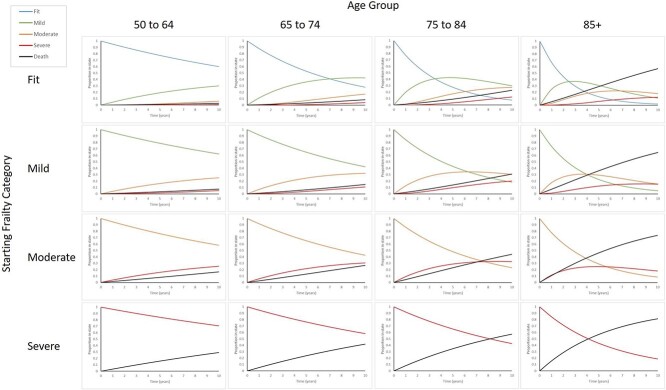
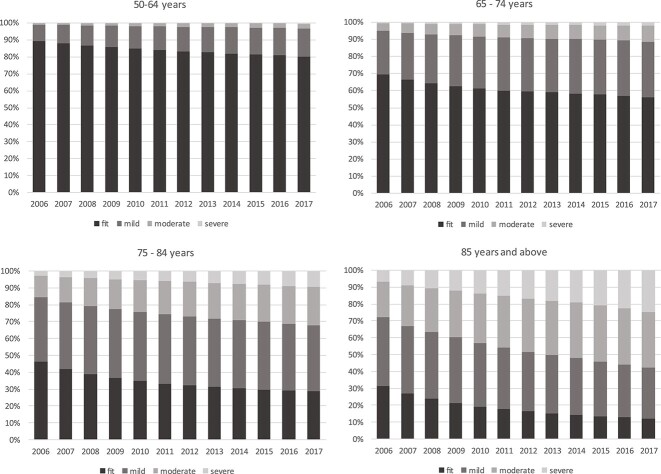
Results: the cohort included 2,171,497 patients and 15,514,734 person-years. Frailty prevalence increased from 26.5 (2006) to 38.9% (2017). The average age of frailty onset was 69; however, 10.8% of people aged 50-64 were already frail in 2006. Estimated transitions from fit to any level of frailty were 48/1,000 person-years aged 50-64, 130/1,000 person-years aged 65-74, 214/1,000 person-years aged 75-84 and 380/1,000 person-years aged ≥ 85. Transitions were independently associated with older age, higher deprivation, female sex, Asian ethnicity and urban dwelling. Mean time spent in each frailty category decreased with age, with the longest period spent in severe frailty at all ages.
Conclusions: frailty is prevalent in adults aged ≥50 and time spent in successive frailty states is longer as frailty progresses, resulting in extended healthcare burden. Larger population numbers and fewer transitions in adults aged 50-64 present an opportunity for earlier identification and intervention. A large increase in frailty over 12 years highlights the urgency of informed service planning in ageing populations.
Keywords: ageing population; frailty; incidence; older people; prevalence; transitions.
© The Author(s) 2023. Published by Oxford University Press on behalf of the British Geriatrics Society. All rights reserved. For permissions, please email: journals.permissions@oup.com.
Conflict of interest statement
None.
Figures
References
-
- Oliver D, Foot C, Humphries R. Making our Health and Care Systems Fit for an Ageing Population. London, UK: King’s Fund, 2014.
-
- British Geriatrics Society . Fit for Frailty. Part 1. London, UK: British Geriatrics Society, 2014.
-
- British Geriatrics Society . Fit for Frailty. Part 2. London, UK: British Geriatrics Society, 2015.
