


doi: 10.1177/00333549231170044.
Epub 2023 May 4.
Development of a Standardized, Laboratory Result-Based Hepatitis C Virus Clearance Cascade for Public Health Jurisdictions
Affiliations
- PMID: 37140162
- PMCID: PMC10851908
- DOI: 10.1177/00333549231170044
Item in Clipboard
Development of a Standardized, Laboratory Result-Based Hepatitis C Virus Clearance Cascade for Public Health Jurisdictions
Public Health Rep.
2024 Mar-Apr.
No abstract available
Keywords: continuity of patient care; data systems; hepatitis C; population health; public health surveillance.
Conflict of interest statement
Declaration of Conflicting InterestsThe authors declared no potential conflicts of interest with respect to the research, authorship, and/or publication of this article.
Figures
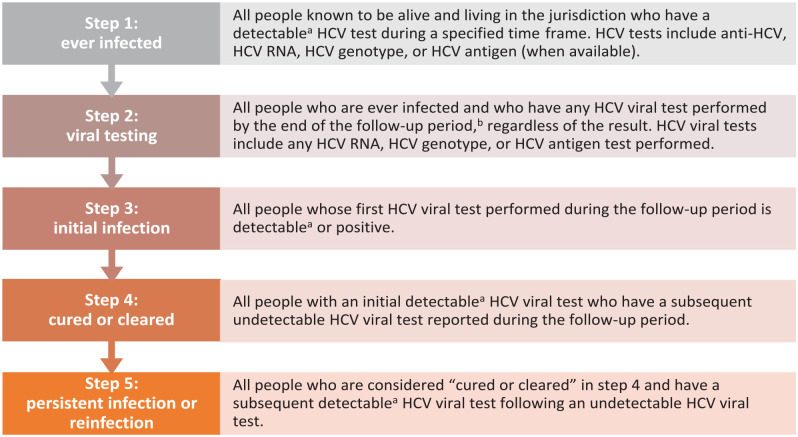
Definitions for laboratory result–based hepatitis C virus (HCV) clearance cascade. Abbreviation: anti-HCV, HCV antibody. a A detectable HCV viral test includes laboratory results that are detectable but below the limit of quantification. b The follow-up period begins at the start of the time frame and extends 1 year beyond the time frame specified in step 1. This provides at least 1 additional year for people to have confirmatory viral testing, establish care, initiate and complete treatment (often 8-12 weeks), and complete posttreatment testing, which usually occurs 12 weeks after treatment completion.

Standardized hepatitis C virus (HCV) clearance cascade for public health departments. Measures A, C, and D outlined in black represent data-to-care opportunities.
References
-
- US Department of Health and Human Services. Viral hepatitis: national strategic plan for the United States: a roadmap to elimination, 2021-2025. 2020. Accessed March 8, 2022. https://www.hhs.gov/sites/default/files/Viral-Hepatitis-National-Strateg...
-
- Sizemore LA, Wingate H, Black J, Wester CN. Tennessee’s 2017 hepatitis C virus continuum of cure. Abstract presented at: Council of State and Territorial Epidemiologists Annual Conference; June 4, 2019; Raleigh, North Carolina. Accessed March 29, 2022. https://cste.confex.com/cste/2019/meetingapp.cgi/Paper/11007
MeSH terms
LinkOut - more resources
Full Text Sources
Medical
