Meta-Analysis
. 2023 Oct;164(4):892-912.
doi: 10.1016/j.chest.2023.04.036. Epub 2023 May 2.

Lower vs Higher Fluid Volumes in Adult Patients With Sepsis: An Updated Systematic Review With Meta-Analysis and Trial Sequential Analysis

Affiliations
Meta-Analysis

Lower vs Higher Fluid Volumes in Adult Patients With Sepsis: An Updated Systematic Review With Meta-Analysis and Trial Sequential Analysis

Praleene Sivapalan et al. Chest. 2023 Oct.

Abstract

Background: IV fluids are recommended for adults with sepsis. However, the optimal strategy for IV fluid management in sepsis is unknown, and clinical equipoise exists.

Research question: Do lower vs higher fluid volumes improve patient-important outcomes in adult patients with sepsis?

Study design and methods: We updated a systematic review with meta-analysis and trial sequential analysis of randomized clinical trials assessing lower vs higher IV fluid volumes in adult patients with sepsis. The coprimary outcomes were all-cause mortality, serious adverse events, and health-related quality of life. We followed the recommendations from the Cochrane Handbook and used the Grading of Recommendations Assessment, Development and Evaluation approach. Primary conclusions were based on trials with low risk of bias if available.

Results: We included 13 trials (N = 4,006) with four trials (n = 3,385) added to this update. The meta-analysis of all-cause mortality in eight trials with low risk of bias showed a relative risk of 0.99 (97% CI, 0.89-1.10; moderate certainty evidence). Six trials with predefined definitions of serious adverse events showed a relative risk of 0.95 (97% CI, 0.83-1.07; low certainty evidence). Health-related quality of life was not reported.

Interpretation: Among adult patients with sepsis, lower IV fluid volumes probably result in little to no difference in all-cause mortality compared with higher IV fluid volumes, but the interpretation is limited by imprecision in the estimate, which does not exclude potential benefit or harm. Similarly, the evidence suggests lower IV fluid volumes result in little to no difference in serious adverse events. No trials reported on health-related quality of life.

Trial registration: PROSPERO; No.: CRD42022312572; URL: https://www.crd.york.ac.uk/prospero/.

Keywords: fluid therapy; intensive care; sepsis; septic shock.


Figures

None
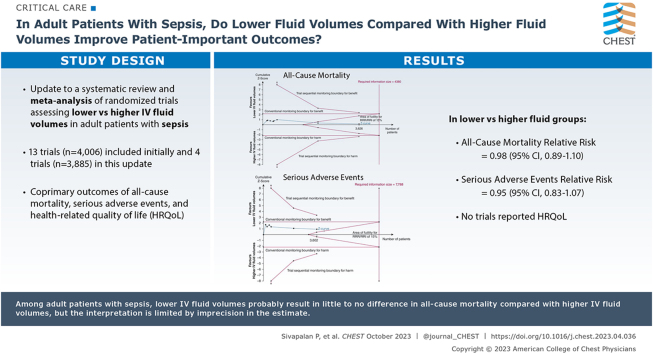
Graphical abstract
Figure 1
Figure 1
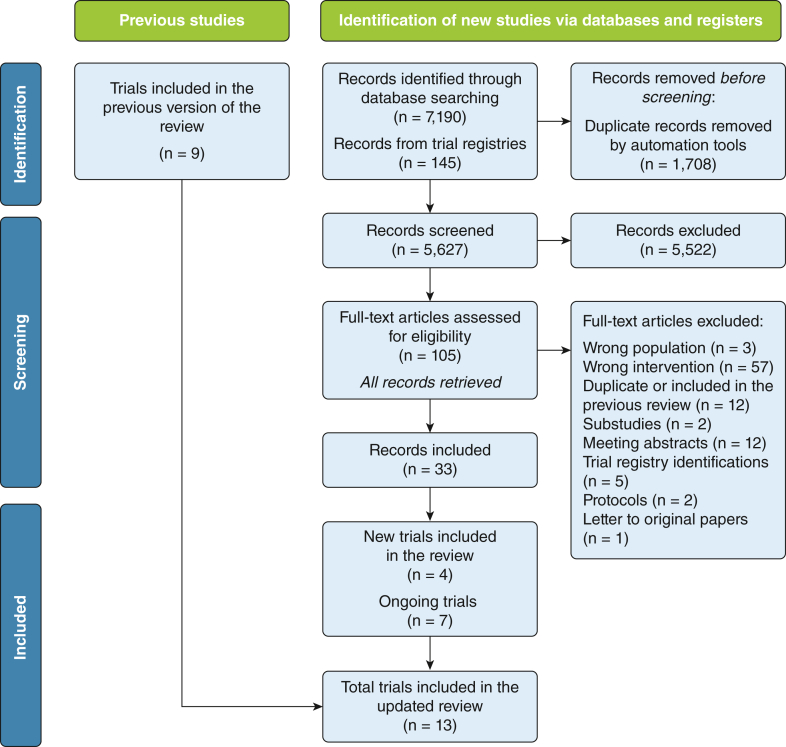
Trial flowchart.
Figure 2
Figure 2
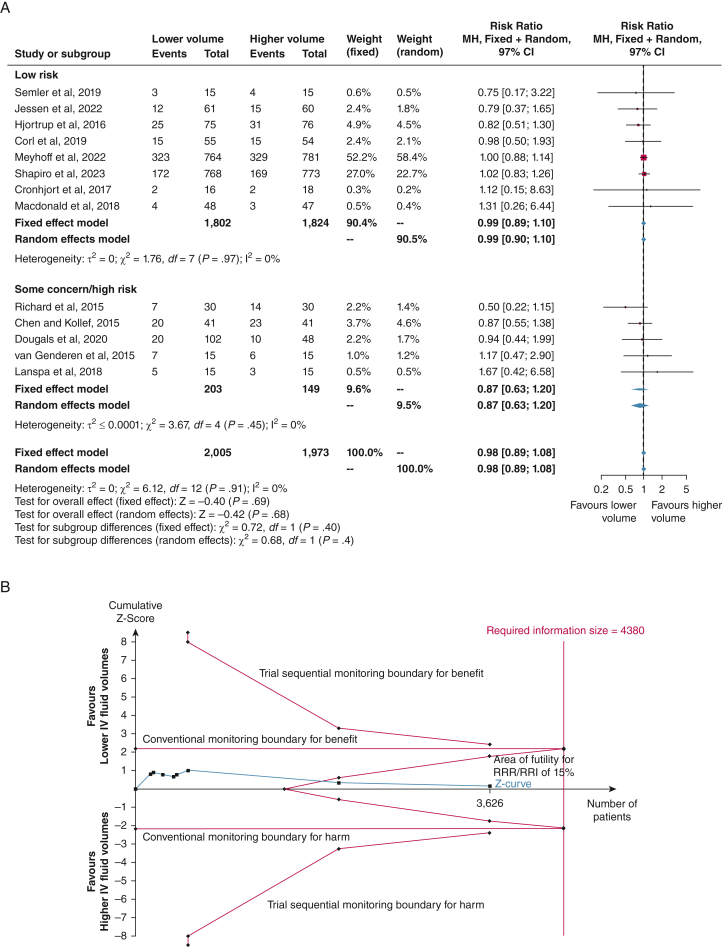
A-B, All-cause mortality. A, Meta-analysis of all-cause mortality in eight trials with low risk of bias (RoB) and five some concern/high concern RoB trials. The conventional meta-analysis of low RoB trials showed no statistically significant difference on mortality with lower vs higher fluid volumes (fixed effect model; relative risk, 0.99; 97% CI, 0.89-1.10; P = .69; I2 = 0%). B, Trial sequential analysis (TSA) for all-cause mortality in eight low RoB trials. We used a control event proportion of 31.1%, α of 3.3% (two-sided), β of 10% (power 90%), and an a priori relative risk reduction of 15% in the analysis. The TSA-adjusted CI in the fixed effect model was 0.89 to 1.11 with a diversity D2 of 0%. The blue cumulative z curve crossed the area of futility. Therefore, the TSA is conclusive, and a relative risk reduction of 15% is unlikely. A total of 83% (n = 3,626) of the required information size of 4,380 patients was accrued. MH = Mantel-Haaenszel; RRI = relative risk increase; RRR = relative risk reduction.
Figure 3
Figure 3
A, B, Subgroup analyses of coprimary outcomes. A, Relative risks with 97% CIs are shown for the all-cause mortality with lower vs higher IV fluid volumes among all the patients and the five predefined subgroups and one post hoc subgroup on the Sepsis-3 definition vs other definitions. B, Relative risks with 97% CIs for SAEs with lower vs higher IV fluid volumes among all the patients and three predefined subgroups. SAE = serious adverse event.
Figure 4
Figure 4
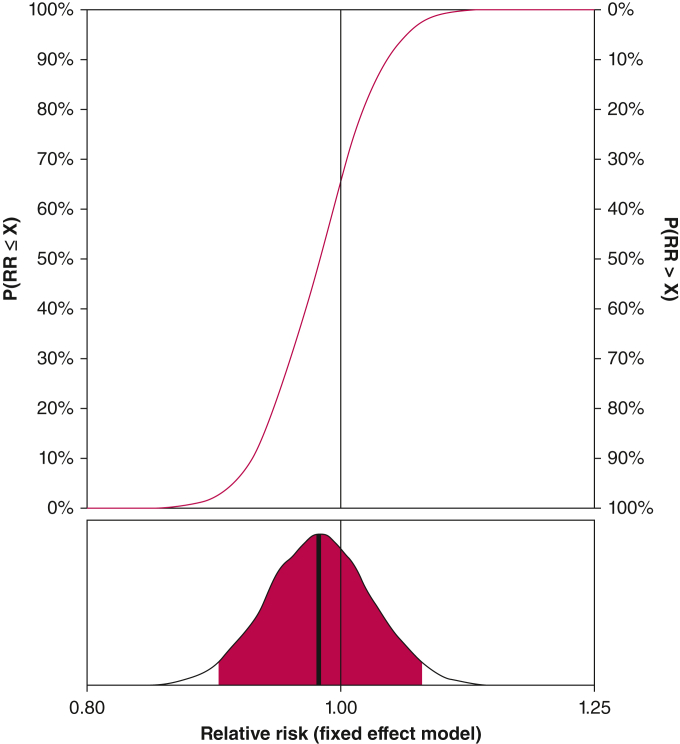
Bayesian analysis of all-cause mortality. Full posterior probability distribution for the treatment effect on all-cause mortality from the Bayesian analysis in a fixed effect model. We used a normally distributed weakly informative prior centered on no difference for the treatment effect (mean ± SD, 0 ± 1). Sensitivity analyses using different priors are reported in e-Appendix 6. The plot displays the relative difference (RR). An RR < 1 favors lower fluid volumes, whereas an RR > 1 favors higher fluid volumes. The upper subplot displays the cumulative posterior distribution, and therefore displays the probabilities (vertical axes) of various effect sizes (horizontal axis). The lower subplots display the entire posterior distribution, with the bold, vertical line indicating the median value (used as the point estimate) and the area highlighted in red indicating the percentile-based 95% credible interval. The vertical black line represents exactly no difference. The probability of any benefit (ie, RR < 1.00) with lower IV fluid volumes was 66.1%, whereas the probability of effect sizes smaller than an RR reduction of 15% (or the opposite RR increase) with lower IV fluid volumes was > 99.9%. The probability of an RR reduction of at least 15% was 0.1%, whereas the probability of the corresponding RR increase (ie, RR ≥ 1.18) was < 0.1%. RR = risk ratio
Figure 5
Figure 5
A, B, Serious adverse events. A, Meta-analysis of the highest proportion of serious adverse events (as defined in the original trial) in six trials, all with some concerns in the risk of bias adjudication. The conventional meta-analysis demonstrated no statistically significant difference in serious adverse events with lower vs higher fluid volumes (fixed effect model; relative risk, 0.95; 95% CI, 0.83-1.07; I2 = 0%). B, Trial sequential analysis (TSA) of the highest proportion of serious adverse events in six trials. We used a control event proportion of 20.1%, α of 3.3% (two-sided), β of 10% (power 90%), and an a priori relative risk reduction of 15% in the analysis. The TSA-adjusted CI in the fixed effect model was 0.78 to 1.15, with a diversity D2 of 0%. The blue cumulative z curve did not cross the conventional monitoring boundaries for benefit, harm, or futility; the TSA is therefore inconclusive. A total of 46% (n = 3,602) of the required information size of 7,788 patients was accrued. MH = Mantel-Haaenszel; RRI = relative risk increase; RRR = relative risk reduction

Comment in

References

    1. Evans L., Rhodes A., Alhazzani W., et al. Surviving Sepsis Campaign: international guidelines for management of sepsis and septic shock 2021. Intensive Care Med. 2021;47(11):1181–1247. - PMC - PubMed
    1. Boyd J.H., Forbes J., Nakada T.A., Walley K.R., Russell J.A. Fluid resuscitation in septic shock: a positive fluid balance and elevated central venous pressure are associated with increased mortality. Crit Care Med. 2011;39(2):259–265. - PubMed
    1. Murphy C.V., Schramm G.E., Doherty J.A., et al. The importance of fluid management in acute lung injury secondary to septic shock. Chest. 2009;136(1):102–109. - PubMed
    1. Acheampong A., Vincent J.L. A positive fluid balance is an independent prognostic factor in patients with sepsis. Crit Care. 2015;19(1):1–7. - PMC - PubMed
    1. Smith S.H., Perner A. Higher vs. lower fluid volume for septic shock: clinical characteristics and outcome in unselected patients in a prospective, multicenter cohort. Crit Care. 2012;16(3):R76. - PMC - PubMed

Publication types