


Comment
doi: 10.1038/s41422-023-00814-2.
Sensing unsaturated fatty acids: insights from GPR120 signaling
Affiliations
- PMID: 37142674
- PMCID: PMC10474016
- DOI: 10.1038/s41422-023-00814-2
Item in Clipboard
Comment
Sensing unsaturated fatty acids: insights from GPR120 signaling
Cell Res.
2023 Sep.
No abstract available
Figures
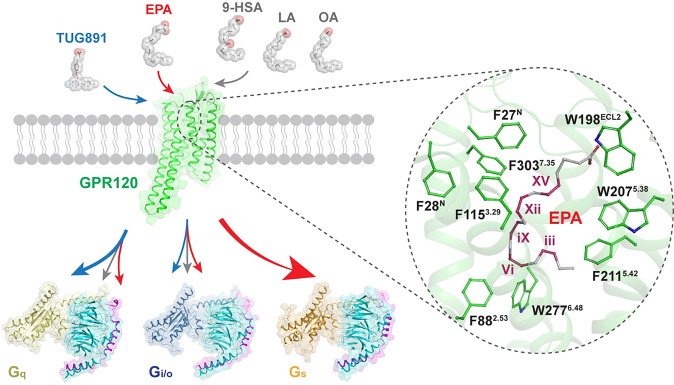
GPR120 agonists (TUG891, EPA, 9-HSA, LA, and OA) are shown in both stick and sphere models and colored in gray. GPR120 (PDB: 8G59), Gq heterotrimer (PDB: 8G59), Gi/o heterotrimer (PDB: 8ID8), and Gs heterotrimer (PDB: 7XTC) are shown in both ribbon and surface models. GPR120, Gq, Gi/o, Gs, Gβ and Gγ are colored in green, yellow, sky blue, orange, cyan and magenta, respectively. Signaling pathways induced by TUG891, EPA, and other FAs (9-HSA, LA, and OA) are indicated by blue, red, and gray arrows, respectively. As an example, the interactions between EPA and GPR120 in the orthosteric binding pocket are shown in the inset panel. EPA and nine aromatic residues involved in the recognition of the unsaturated bonds in FAs are shown in the ball and stick model, and colored in gray and green, respectively. Specifically, the double bonds in EPA are colored in deep purple. All the oxygen and nitrogen atoms are colored in red and blue, respectively.
Comment on
-
Unsaturated bond recognition leads to biased signal in a fatty acid receptor.Science. 2023 Apr 7;380(6640):eadd6220. doi: 10.1126/science.add6220. Epub 2023 Apr 7. Science. 2023. PMID: 36862765
References
Publication types
MeSH terms
Substances
Grants and funding
LinkOut - more resources
Full Text Sources
