. 2023 May 4;24(1):236.
doi: 10.1186/s12864-023-09316-2.

Transcriptome analysis of thermomorphogenesis in ovules and during early seed development in Brassica napus

Affiliations

Transcriptome analysis of thermomorphogenesis in ovules and during early seed development in Brassica napus

Veronika Jedličková et al. BMC Genomics. .

Abstract

Background: Plant sexual reproduction is highly sensitive to elevated ambient temperatures, impacting seed development and production. We previously phenotyped this effect on three rapeseed cultivars (DH12075, Topas DH4079, and Westar). This work describes the transcriptional response associated with the phenotypic changes induced by heat stress during early seed development in Brassica napus.

Results: We compared the differential transcriptional response in unfertilized ovules and seeds bearing embryos at 8-cell and globular developmental stages of the three cultivars exposed to high temperatures. We identified that all tissues and cultivars shared a common transcriptional response with the upregulation of genes linked to heat stress, protein folding and binding to heat shock proteins, and the downregulation of cell metabolism. The comparative analysis identified an enrichment for a response to reactive oxygen species (ROS) in the heat-tolerant cultivar Topas, correlating with the phenotypic changes. The highest heat-induced transcriptional response in Topas seeds was detected for genes encoding various peroxidases, temperature-induced lipocalin (TIL1), or protein SAG21/LEA5. On the contrary, the transcriptional response in the two heat-sensitive cultivars, DH12075 and Westar, was characterized by heat-induced cellular damages with the upregulation of genes involved in the photosynthesis and plant hormone signaling pathways. Particularly, the TIFY/JAZ genes involved in jasmonate signaling were induced by stress, specifically in ovules of heat-sensitive cultivars. Using a weighted gene co-expression network analysis (WGCNA), we identified key modules and hub genes involved in the heat stress response in studied tissues of either heat-tolerant or sensitive cultivars.

Conclusions: Our transcriptional analysis complements a previous phenotyping analysis by characterizing the growth response to elevated temperatures during early seed development and reveals the molecular mechanisms underlying the phenotypic response. The results demonstrated that response to ROS, seed photosynthesis, and hormonal regulation might be the critical factors for stress tolerance in oilseed rape.

Keywords: Brassica napus; Embryo; Ovule; Seed; Thermomorphogenesis; Transcriptomics.


Conflict of interest statement

The authors declare no competing interests.

Figures
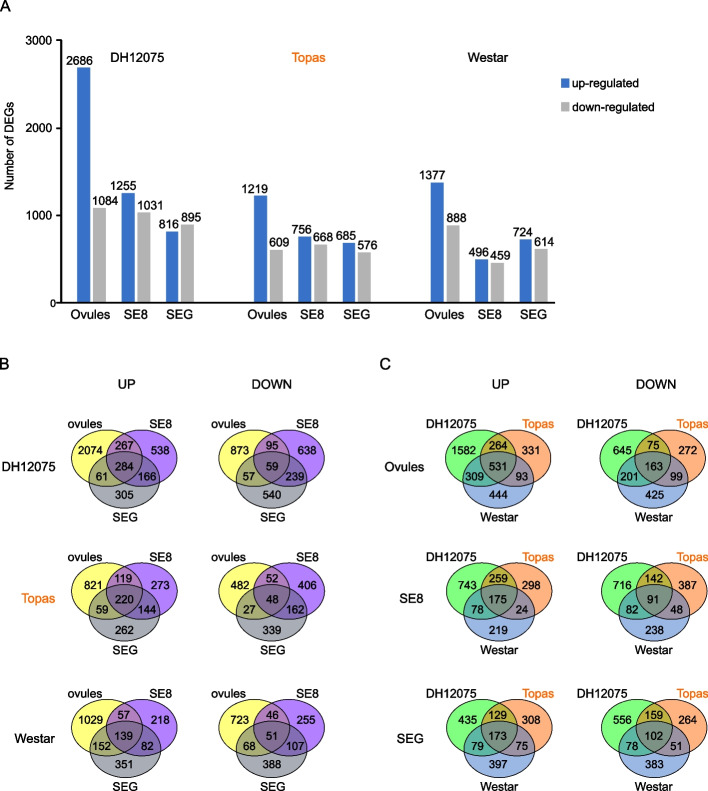
Fig. 1
Fig. 1
Transcriptional response of three rapeseed cultivars (DH12075, Topas, Westar) in ovules and developing seeds under heat stress. A Number of DEGs between control temperature and heat stress in all studied tissues and cultivars. B-C Venn diagrams of up-regulated and down-regulated DEGs under heat stress in ovules and seeds bearing embryos at the 8-cell stage (SE8) and seeds containing globular embryos (SEG). The heat-tolerant cultivar Topas is highlighted in orange
Fig. 2
Fig. 2
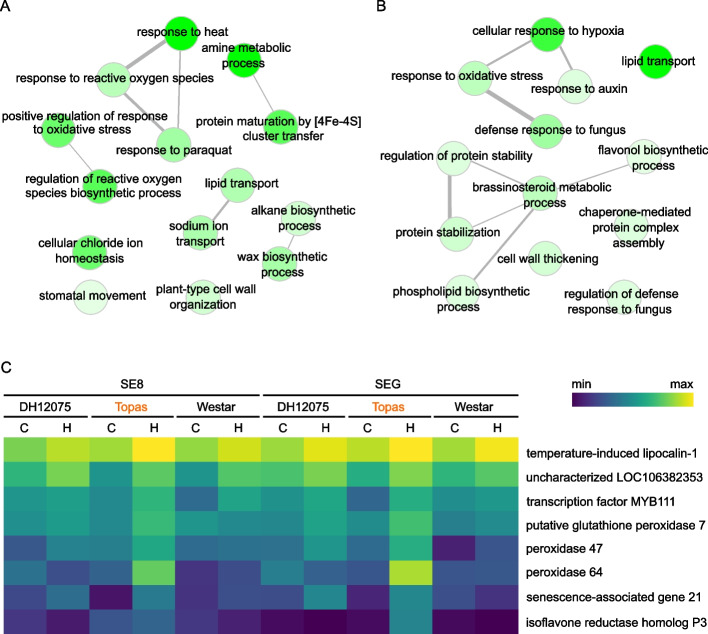
Specific response to the heat stress in seeds of tolerant cultivar Topas. A-B Gene ontology (GO) term enrichment analysis of DEGs in SE8 (A) and SEG (B) in the biological process category. Cytoscape networks were generated by REVIGO to reduce redundant GO terms. Color intensity represents the significance of enrichment (darker color = lower p-value). For details, see Additional file 5. C Transcriptional profiling of selected genes connected to reactive oxygen species (ROS) response and flavonol pathways. C, control conditions; H, high-temperature conditions
Fig. 3
Fig. 3
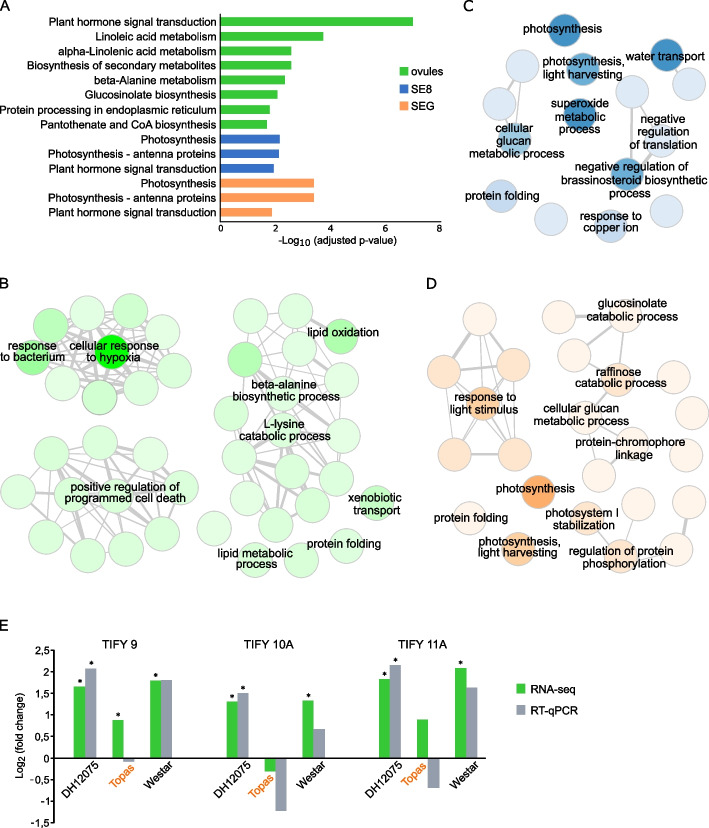
Specific heat stress response in ovules and seeds of sensitive cultivars DH12075 and Westar. A Significantly enriched KEGG pathways [20] in ovules (green), SE8 (blue), and SEG (orange). B-D Significantly enriched GO terms in the biological process category in ovules (B), SE8 (C), and SEG D. Cytoscape networks were generated by REVIGO to reduce redundant GO terms. The key terms are indicated in each network. Color intensity represents the significance of enrichment (darker color = lower p-value). For details, see Additional file 5. ETIFY expression in ovules by RNA-seq data (green) and RT-qPCR (grey). The heat-tolerant cultivar (Topas) is highlighted in orange. *, significant difference (p < 0.05) between control and high temperature
Fig. 4
Fig. 4
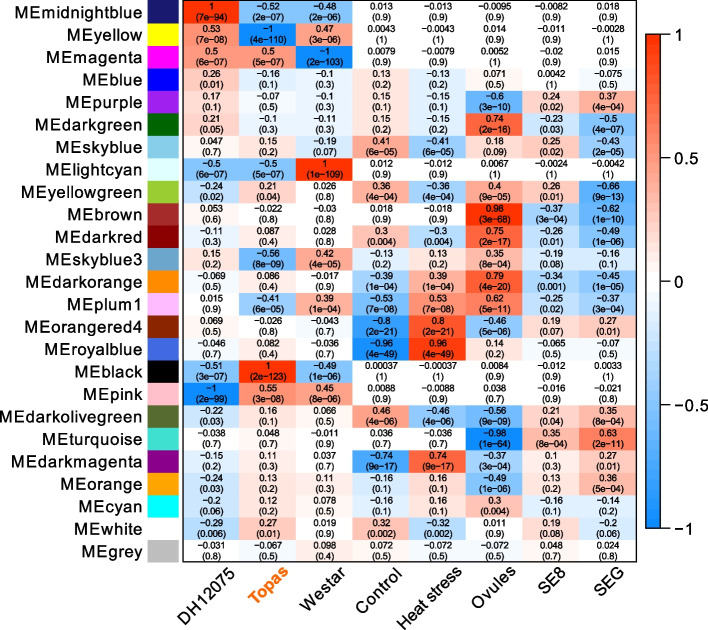
Module-trait relationship heatmap for different traits and gene modules provided by weighted gene co-expression network analysis (WGCNA). The value in the box indicates the correlation coefficient between the module and the trait, followed by the corresponding p-value (in brackets). The boxes are colored based on the correlation of the module with the trait: red is a strong positive correlation, while blue is a strong negative correlation. The heat-tolerant cultivar (Topas) is highlighted in orange
Fig. 5
Fig. 5
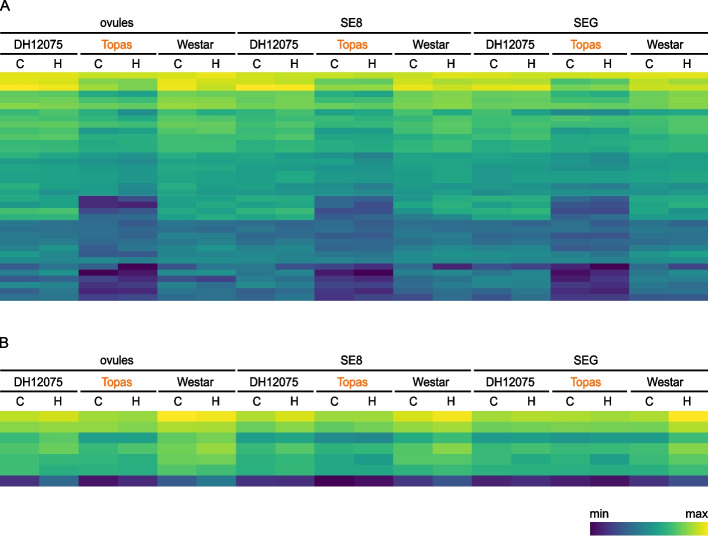
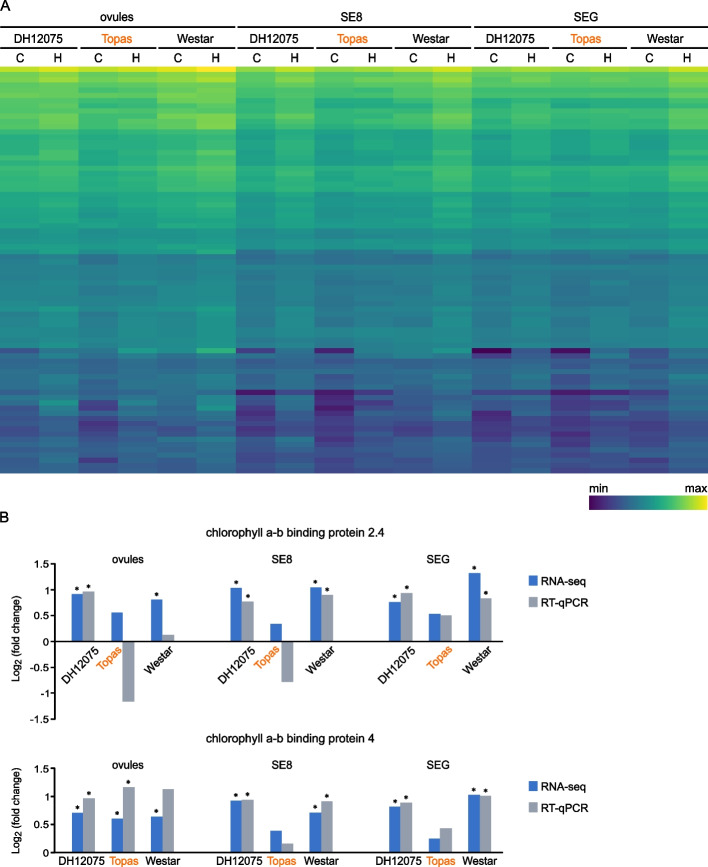
Transcriptional profiling of photosynthesis-related genes co-expressed in (A) yellow and (B) skyblue3 modules. Genes are associated with GO terms “photosynthesis” (GO:0015979) and “photosystem II” (GO:0009523) for the yellow module, and “photosynthesis” (GO:0015979) and “photosystem I” (GO:0009522) for skyblue3 module. The heat-tolerant cultivar Topas is highlighted in orange. C, control conditions; H, high-temperature conditions
Fig. 6
Fig. 6
The expression profiles of the genes associated with the plum1 module. A Transcriptional profiling of all genes co-expressed in the plum1 module. B Expression by RNA-seq data (blue) and RT-qPCR analysis (grey) of two top hub genes of the plum1 module. The heat-tolerant cultivar Topas is highlighted in orange. *, significant difference (p < 0.05) between control and high temperature

References

    1. Luo Q. Temperature thresholds and crop production: a review. Clim Change. 2011;109:583–598. doi: 10.1007/s10584-011-0028-6. - DOI
    1. Chaturvedi P, Wiese AJ, Ghatak A, Drábková LZ, Weckwerth W, Honys D. Heat stress response mechanisms in pollen development. New Phytol. 2021;231:571–585. doi: 10.1111/nph.17380. - DOI - PMC - PubMed
    1. Zhang C, Li G, Chen T, Feng B, Fu W, Yan J, et al. Heat stress induces spikelet sterility in rice at anthesis through inhibition of pollen tube elongation interfering with auxin homeostasis in pollinated pistils. Rice. 2018;11:14. doi: 10.1186/s12284-018-0206-5. - DOI - PMC - PubMed
    1. Mesihovic A, Iannacone R, Firon N, Fragkostefanakis S. Heat stress regimes for the investigation of pollen thermotolerance in crop plants. Plant Reprod. 2016;29:93–105. doi: 10.1007/s00497-016-0281-y. - DOI - PubMed
    1. Young LW, Wilen RW, Bonham-Smith PC. High temperature stress of Brassica napus during flowering reduces micro- and megagametophyte fertility, induces fruit abortion, and disrupts seed production. J Exp Bot. 2004;55:485–495. doi: 10.1093/jxb/erh038. - DOI - PubMed

Substances

LinkOut - more resources