


Moderating effects of uric acid and sex on cognition and psychiatric symptoms in asymmetric Parkinson's disease
- PMID: 37143121
- PMCID: PMC10157998
- DOI: 10.1186/s13293-023-00510-1
Moderating effects of uric acid and sex on cognition and psychiatric symptoms in asymmetric Parkinson's disease
Abstract
Background: Non-motor symptoms are an important early feature of Parkinson's disease (PD), encompassing a variety of cognitive and psychiatric symptoms that seem to manifest differently depending on motor symptom asymmetry. Different factors, such as uric acid (UA) and sex, seem to influence cognitive and psychiatric expression in PD, however their interplay remains to be better understood.
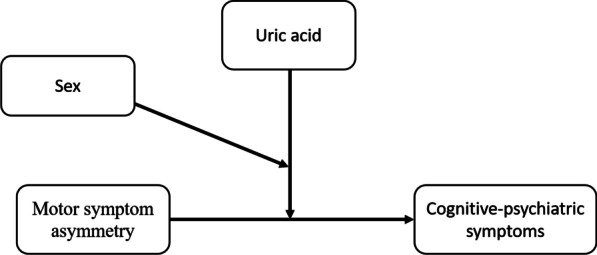
Methods: Participants taking part in the Parkinson's Progression Marker Initiative were studied based on the side of motor symptom asymmetry and sex. Three-way interaction modeling was used to examine the moderating effects of sex and UA on cognitive functions and psychiatric symptoms.
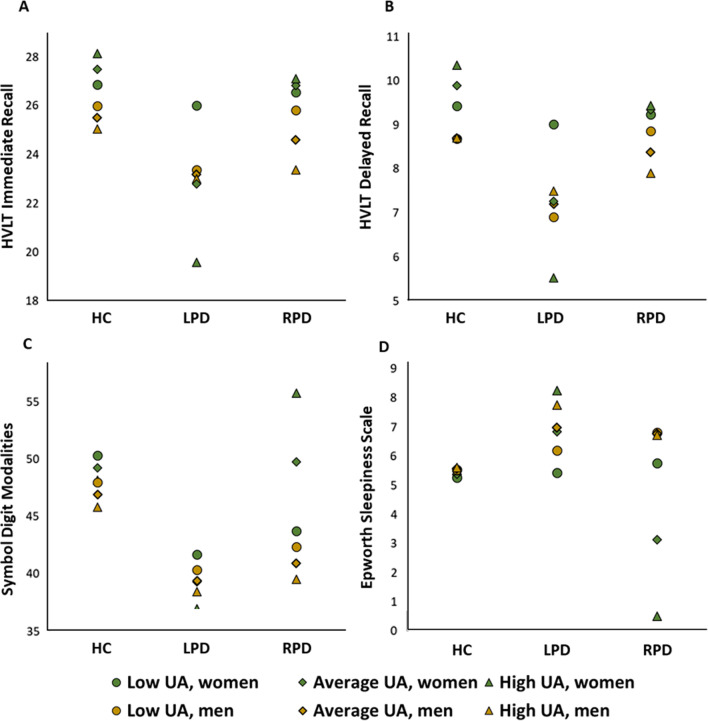
Results: Significant three-way interactions were highlighted at 1-year follow-up between motor symptom asymmetry, UA and sex for immediate and long-term memory in female patients exhibiting predominantly left-sided motor symptoms, and for processing speed and sleepiness in female patients exhibiting predominantly right-sided motor symptoms. No significant interactions were observed for male patients. Moreover, female patients exhibiting predominantly right-sided motor symptoms demonstrated lower serum UA concentrations and had overall better outcomes, while male patients with predominantly right-sided motor symptoms demonstrated particularly poor outcomes.
Conclusions: These findings suggest that in the earliest stages of the disease, UA and sex moderate cognitive functions and psychiatric symptoms differently depending on motor asymmetry, holding important clinical implications for symptom management in patients.
Keywords: Cognition; Motor symptom asymmetry; Parkinson’s disease; Psychiatric symptoms; Three-way interaction models; Uric acid.
Plain language summary
Parkinson’s disease is characterized by motor symptoms that usually manifest in an asymmetrical fashion. Given this motor symptom asymmetry, it is possible to distinguish patients that exhibit predominantly right-sided motor symptoms from those that exhibit predominantly left-sided motor symptoms. Patients also often develop non-motor symptoms, such as cognitive and psychiatric complaints. Recent studies have found that non-motor symptoms can manifest differently depending on motor symptom asymmetry. Furthermore, different factors, such as uric acid, a natural antioxidant in the human body, and the patient’s sex seem to influence cognitive and psychiatric manifestations, however their interplay remains to be better understood. The present study aimed to examine the interactions between motor symptom asymmetry, serum uric acid and patient’s sex on the manifestation of cognitive and psychiatric symptoms. Using regression models, it was found that at 1 year from diagnosis, uric acid and sex moderated cognitive and psychiatric symptoms differently according to motor symptom asymmetry. Indeed, female patients with predominantly left-sided motor symptoms had better memory performances with lower concentrations of serum uric acid, whereas female patients with predominantly right-sided symptoms presented better psychomotor speed and less sleepiness with higher concentrations of uric acid. Moreover, female patients with predominantly right-sided motor symptoms had overall better outcomes, while male patients with predominantly right-sided motor symptoms demonstrated particularly poor clinical outcomes. These findings suggest that in the earliest stages of the disease, uric acid and sex moderate cognitive and psychiatric symptoms differently depending on motor asymmetry, holding important clinical implications for symptom management in patients.
© 2023. The Author(s).
Conflict of interest statement
The authors declare that they have no competing interests.
Figures
References
-
- Agosta S, Magnago D, Galante E, Ferraro F, Magherini A, di Giacopo R, Miceli G, Battelli L. Lateralized cognitive functions in Parkinson’s patients: a behavioral approach for the early detection of sustained attention deficits. Brain Res. 2020;1726:146486. doi: 10.1016/j.brainres.2019.146486. - DOI - PubMed
Publication types
MeSH terms
Substances
LinkOut - more resources
Full Text Sources
Medical
