. 2023 May 4;42(1):112.
doi: 10.1186/s13046-023-02687-0.

Targeting homologous recombination deficiency in uterine leiomyosarcoma

Affiliations

Targeting homologous recombination deficiency in uterine leiomyosarcoma

Genevieve Dall et al. J Exp Clin Cancer Res. .

Abstract

Background: Uterine leiomyosarcoma (uLMS) is a rare and aggressive gynaecological malignancy, with individuals with advanced uLMS having a five-year survival of < 10%. Mutations in the homologous recombination (HR) DNA repair pathway have been observed in ~ 10% of uLMS cases, with reports of some individuals benefiting from poly (ADP-ribose) polymerase (PARP) inhibitor (PARPi) therapy, which targets this DNA repair defect. In this report, we screened individuals with uLMS, accrued nationally, for mutations in the HR repair pathway and explored new approaches to therapeutic targeting.

Methods: A cohort of 58 individuals with uLMS were screened for HR Deficiency (HRD) using whole genome sequencing (WGS), whole exome sequencing (WES) or NGS panel testing. Individuals identified to have HRD uLMS were offered PARPi therapy and clinical outcome details collected. Patient-derived xenografts (PDX) were generated for therapeutic targeting.

Results: All 13 uLMS samples analysed by WGS had a dominant COSMIC mutational signature 3; 11 of these had high genome-wide loss of heterozygosity (LOH) (> 0.2) but only two samples had a CHORD score > 50%, one of which had a homozygous pathogenic alteration in an HR gene (deletion in BRCA2). A further three samples harboured homozygous HRD alterations (all deletions in BRCA2), detected by WES or panel sequencing, with 5/58 (9%) individuals having HRD uLMS. All five individuals gained access to PARPi therapy. Two of three individuals with mature clinical follow up achieved a complete response or durable partial response (PR) with the subsequent addition of platinum to PARPi upon minor progression during initial PR on PARPi. Corresponding PDX responses were most rapid, complete and sustained with the PARP1-specific PARPi, AZD5305, compared with either olaparib alone or olaparib plus cisplatin, even in a paired sample of a BRCA2-deleted PDX, derived following PARPi therapy in the patient, which had developed PARPi-resistance mutations in PRKDC, encoding DNA-PKcs.

Conclusions: Our work demonstrates the value of identifying HRD for therapeutic targeting by PARPi and platinum in individuals with the aggressive rare malignancy, uLMS and suggests that individuals with HRD uLMS should be included in trials of PARP1-specific PARPi.

Keywords: Homologous recombination deficiency; PARP inhibitors; Patient-derived xenografts; Rare cancers; Uterine leiomyosarcoma.


Conflict of interest statement

CLS declares Advisory Boards for AstraZeneca, Clovis Oncology, Roche, Eisai Inc, Sierra Oncology, Takeda, MSD and Grant/Research support from AstraZeneca, Clovis Oncology, Eisai Inc, Sierra Oncology, Boehringer Ingelheim, Roche and Beigene. Other authors declare no conflicts of interest.

Figures
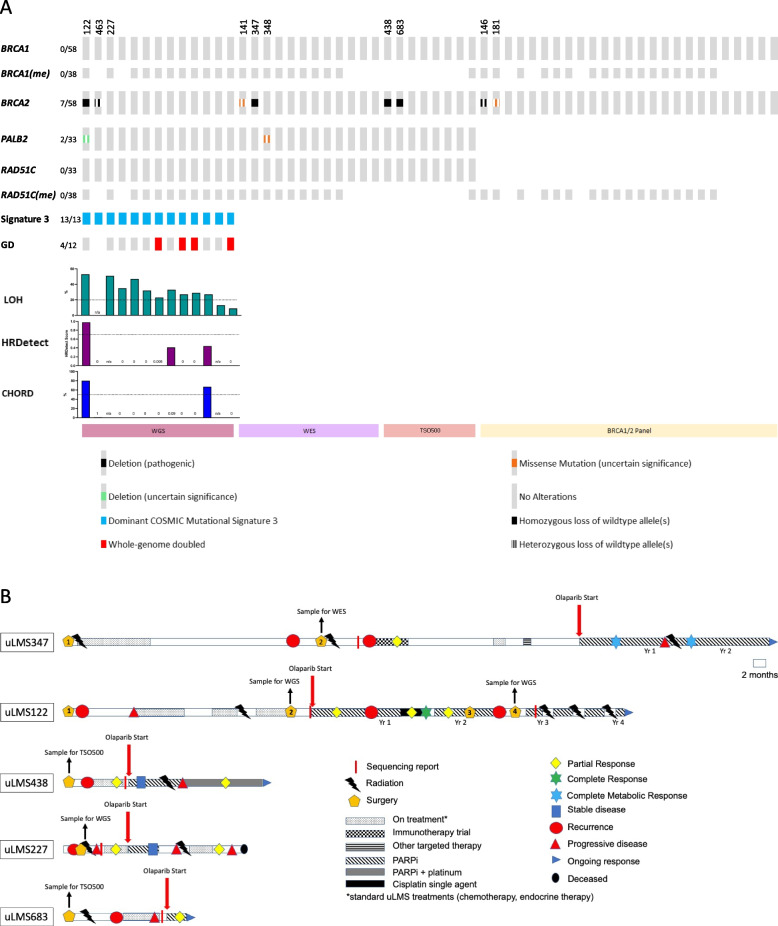
Fig. 1
Fig. 1
Molecular summary of HRD screening and clinical journey of the five HRD uLMS identified. A Summary of results from screening 58 uLMS samples via either whole genome sequencing (WGS), whole exome sequencing (WES), TruSight Oncology 500 (TSO500) panel testing or BRCA1/2 panel sequencing. Genome doubling (GD), percentage loss of heterozygosity (LOH) and results of MS-HRM methylation analysis of BRCA1 and RAD51C promoters (denoted as BRCA1(me) and RAD51C(me), respectively) also shown. HRDetect scores and CHORD percentage readouts from UoM pipeline are as shown. Blanks indicate test was not run (for BRCA1(me) and RAD51C(me)), the tumour purity was not high enough to provide accurate scores or that the type of analysis used cannot report on the parameter. uLMS numbers refer to specific uLMS cases described in the text. B Timeline of uLMS patients who, based on HRD screening, received PARPi (olaparib) ± platinum therapy as part of their treatment history. Time of sample collection, type of molecular test, time of molecular reporting, and commencement of PARPi therapy are shown along with other types of therapy received and tumour responses where available
Fig. 2
Fig. 2
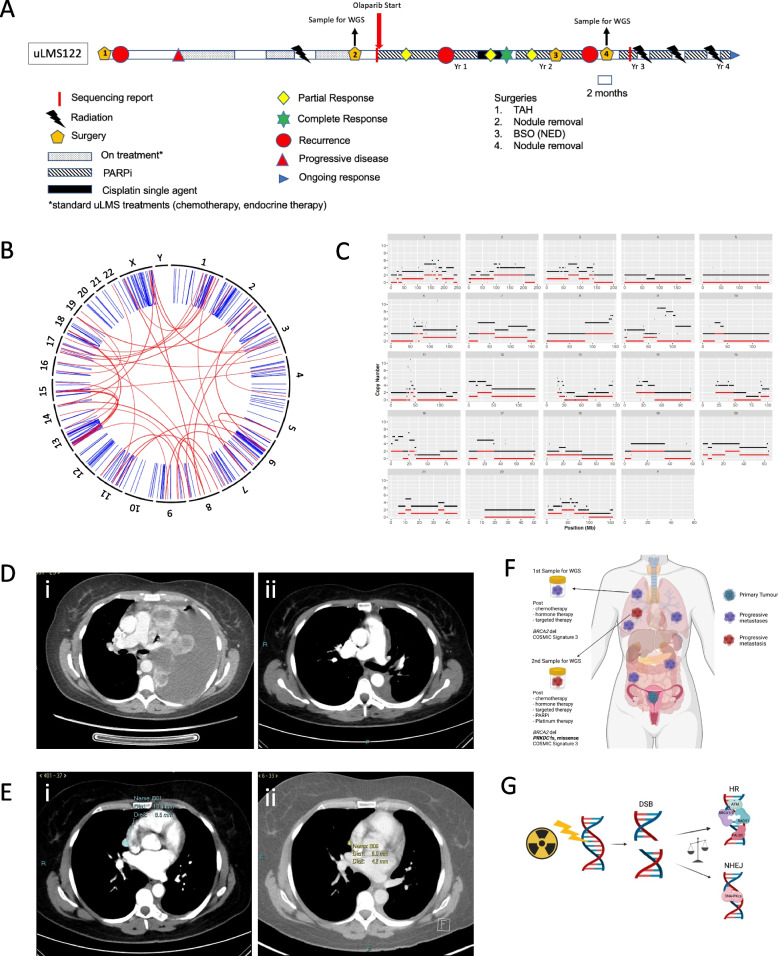
Patient with BRCA2-deleted, COSMIC signature 3 uLMS responded to PARPi. A Timeline of uLMS122 patient history (TAH = Total abdominal hysterectomy, BSO = Bilateral Salpingo-oophorectomy, NED = no evidence of disease). Repeated from Fig. 1B for ease of reference. B Structural variants plot generated from WGS data of first patient sample showing intra-chromosomal rearrangements. C Copy number profile generated from the first patient sample where total copy number is shown in black and minor copy number in red. Red at 0 indicates loss of heterozygosity. D Computerised tomography images of patient lungs at the point of recruitment to the SFRCP (i) and after 3 months of receiving olaparib (ii). E computerised tomography images of the patient lungs indicating a small recurrence (mediastinal nodule, blue cross) following the initial PARPi therapy (i) and following cisplatin plus PARPi. F Schematic of tumour samples analysed by WGS, with second sample showing additional PRKDC mutations (del = deletion, fs = frameshift). G Schematic depicting repair of DNA double stranded breaks (DSB) by either homologous recombination (HR) or Non-homologous end-joining (NHEJ), in which DNA PKcs plays a pivotal role
Fig. 3
Fig. 3
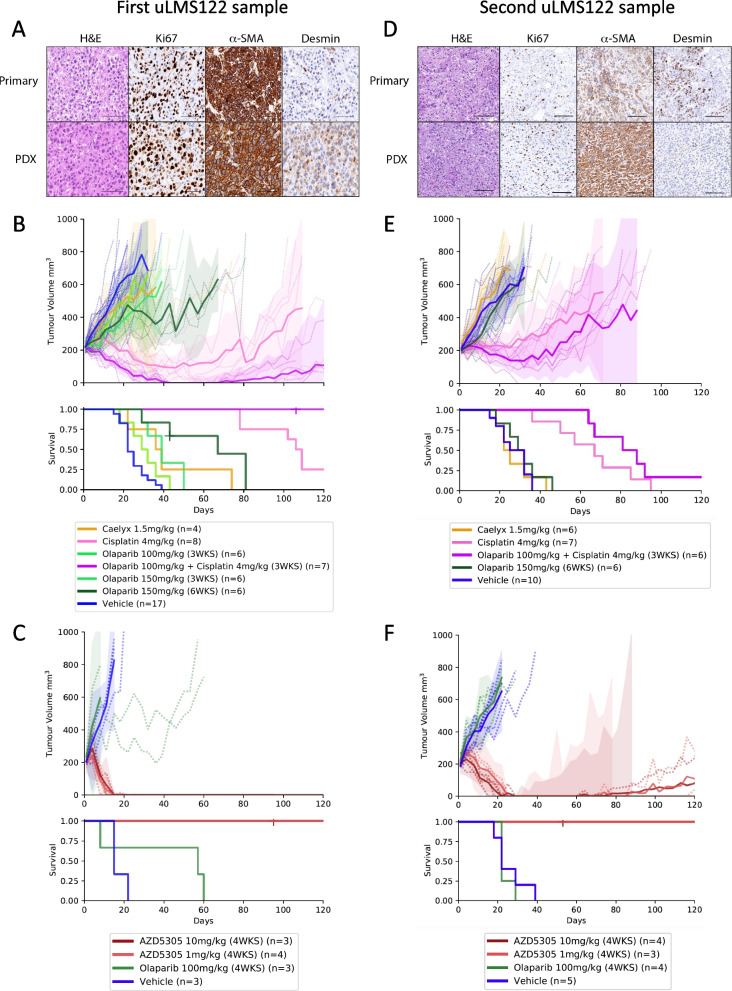
Two patient derived xenografts (PDX) generated from HRD uLMS tumour responsive to platinum therapy. A Immunohistochemistry panel showing concordant protein expression between first primary patient sample and PDX. H&E = Haematoxylin and Eosin, α-SMA = alpha smooth muscle actin. Scale bars represent 100 μm. B PDX tumour growth curves and survival in response to vehicle, standard therapy caelyx (pegylated doxorubicin; 1.5 mg/kg day 1, 8 and 18), olaparib (100 mg/kg or 150 mg/kg, daily Monday to Friday, 3 or 6 weeks), cisplatin (4 mg/kg day 1, 8 and 18) and the combination of olaparib (100 mg/kg daily Monday to Friday 3 weeks) and cisplatin (4 mg/kg day 1, 8 and 18). Data is shown as mean (solid lines, and individual tumours in dotted lines) with shaded areas representing 95% confidence intervals. C PDX tumour growth curves and survival in response to daily treatment for 4 weeks with vehicle, olaparib (100 mg/kg) or AZD5305 (1 mg/kg or 10 mg/kg). D Immunohistochemistry panel showing second PARPi resistant primary patient sample and PDX. H&E = Haematoxylin and Eosin, α-SMA = alpha smooth muscle actin. Scale bars represent 200 μm. E PDX tumour growth curves and survival in response to vehicle, caelyx (pegylated doxorubicin; 1.5 mg/kg day 1, 8 and 18), olaparib (150 mg/kg, daily Monday to Friday, 6 weeks) and cisplatin (4 mg/kg day 1, 8 and 18). Data is shown as mean with shaded areas representing 95% confidence intervals. F PDX tumour growth curves and survival in response to daily treatment for 4 weeks with vehicle, olaparib (100 mg/kg) or AZD5305 (1 mg/kg or 10 mg/kg)
Fig. 4
Fig. 4
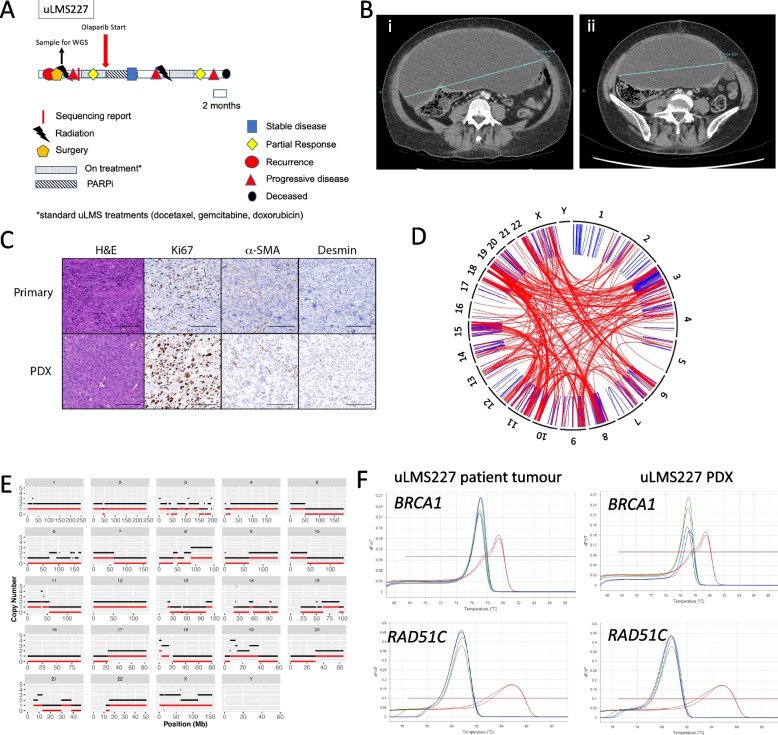
Patient with HRD uLMS with no HR pathway gene mutations response to PARPi. A Timeline of uLMS227 patient history. Repeated from Fig. 1B for ease of reference. B computerised tomography images of the patient abdomen prior to (i) and 3 months after initiation of PARPi therapy (ii). C Immunohistochemistry panel showing concordant protein expression between primary patient sample and PDX. H&E = Haematoxylin and Eosin, α-SMA = alpha smooth muscle actin. Scale bars represent 200 μm. D Structural variants plot generated from WGS data of the uLMS227 PDX sample showing intra-chromosomal rearrangements. E Copy number profile generated from the uLMS227 PDX sample where total CN is shown in black and minor CN in red. F Methylation analysis of the BRCA1 and RAD51C promoters. Red lines indicate a 100% methylated control, blue lines indicated 0% methylated control and the green line represents the uLMS227 sample (both patient and PDX sample)
Fig. 5
Fig. 5
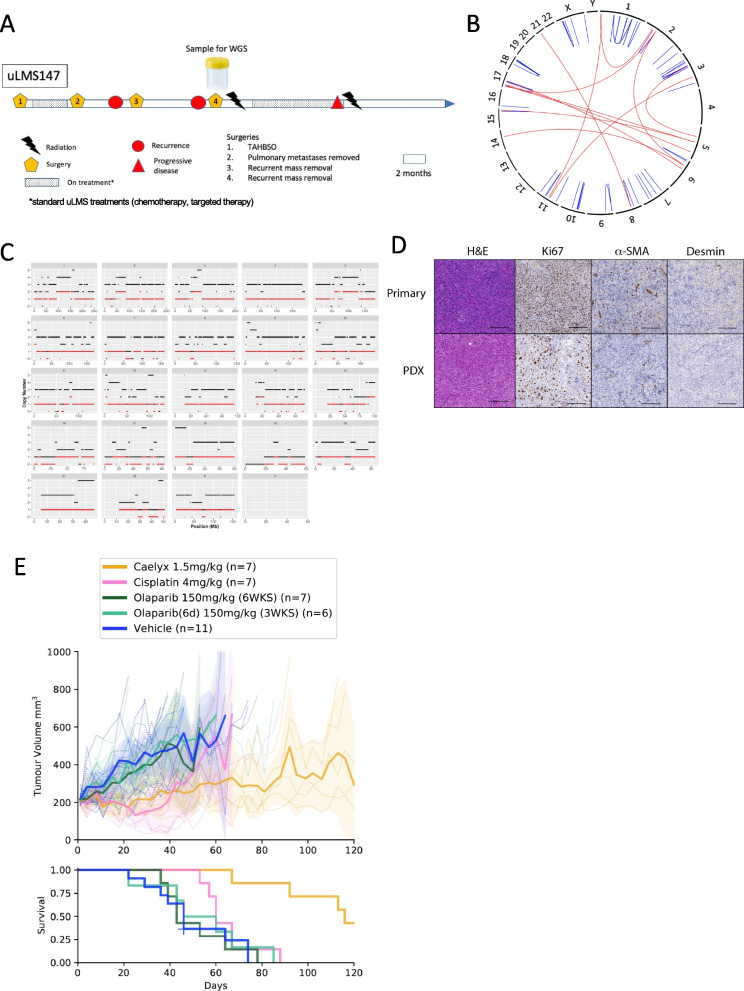
HRP uLMS PDX does not respond to PARPi. A Timeline of uLMS147 patient history. B CIRCOS plot generated from patient WGS data showing intra-chromosomal rearrangements, and (C) Copy number profile, where total CN is shown in black and minor CN in red. D Immunohistochemistry panel showing concordant protein expression between primary patient sample and PDX. H&E = Haematoxylin and Eosin, α-SMA = alpha smooth muscle actin. Scale bars represent 200 μm. E PDX tumour growth curves and survival on treatment with vehicle, caelyx (pegylated doxorubicin; 1.5 mg/kg 1, 8 and 18), olaparib (150 mg/kg, daily Monday to Friday or Monday to Sat, 6 weeks) and cisplatin (4 mg/kg day 1, 8 and 18). Data is shown as mean with shaded areas representing 95% confidence intervals

References

    1. Brohl AS, Li L, Andikyan V, Običan SG, Cioffi A, Hao K, et al. Age-stratified risk of unexpected uterine sarcoma following surgery for presumed benign leiomyoma. Oncologist. 2015;20(4):433–439. doi: 10.1634/theoncologist.2014-0361. - DOI - PMC - PubMed
    1. Kapp DS, Shin JY, Chan JK. Prognostic factors and survival in 1396 patients with uterine leiomyosarcomas: emphasis on impact of lymphadenectomy and oophorectomy. Cancer. 2008;112(4):820–830. doi: 10.1002/cncr.23245. - DOI - PubMed
    1. Hosh M, Antar S, Nazzal A, Warda M, Gibreel A, Refky B. Uterine Sarcoma: Analysis of 13,089 Cases Based on Surveillance, Epidemiology, and End Results Database. Int J Gynecol Cancer. 2016;26(6):1098–1104. doi: 10.1097/IGC.0000000000000720. - DOI - PubMed
    1. Tirumani SH, Deaver P, Shinagare AB, Tirumani H, Hornick JL, George S, et al. Metastatic pattern of uterine leiomyosarcoma: retrospective analysis of the predictors and outcome in 113 patients. J Gynecol Oncol. 2014;25(4):306–312. doi: 10.3802/jgo.2014.25.4.306. - DOI - PMC - PubMed
    1. Ricci S, Stone RL, Fader AN. Uterine leiomyosarcoma: Epidemiology, contemporary treatment strategies and the impact of uterine morcellation. Gynecol Oncol. 2017;145(1):208–216. doi: 10.1016/j.ygyno.2017.02.019. - DOI - PubMed