Review
. 2023 Apr 18:14:1178337.
doi: 10.3389/fimmu.2023.1178337. eCollection 2023.

The generation, activation, and polarization of monocyte-derived macrophages in human malignancies

Affiliations
Review

The generation, activation, and polarization of monocyte-derived macrophages in human malignancies

Paul Chaintreuil et al. Front Immunol. .

Abstract

Macrophages are immune cells that originate from embryogenesis or from the differentiation of monocytes. They can adopt numerous phenotypes depending on their origin, tissue distribution and in response to different stimuli and tissue environment. Thus, in vivo, macrophages are endowed with a continuum of phenotypes that are rarely strictly pro-inflammatory or anti-inflammatory and exhibit a broad expression profile that sweeps over the whole polarization spectrum. Schematically, three main macrophage subpopulations coexist in human tissues: naïve macrophages also called M0, pro-inflammatory macrophages referred as M1 macrophages, and anti-inflammatory macrophages also known as M2 macrophages. Naïve macrophages display phagocytic functions, recognize pathogenic agents, and rapidly undergo polarization towards pro or anti-inflammatory macrophages to acquire their full panel of functions. Pro-inflammatory macrophages are widely involved in inflammatory response, during which they exert anti-microbial and anti-tumoral functions. By contrast, anti-inflammatory macrophages are implicated in the resolution of inflammation, the phagocytosis of cell debris and tissue reparation following injuries. Macrophages also play important deleterious or beneficial roles in the initiation and progression of different pathophysiological settings including solid and hematopoietic cancers. A better understanding of the molecular mechanisms involved in the generation, activation and polarization of macrophages is a prerequisite for the development of new therapeutic strategies to modulate macrophages functions in pathological situations.

Keywords: CSF-1; LAM; TAM; differentiation; monocyte-derived macrophages; polarization; targeting macrophages.


Conflict of interest statement

The authors declare that the research was conducted in the absence of any commercial or financial relationships that could be construed as a potential conflict of interest.

Figures
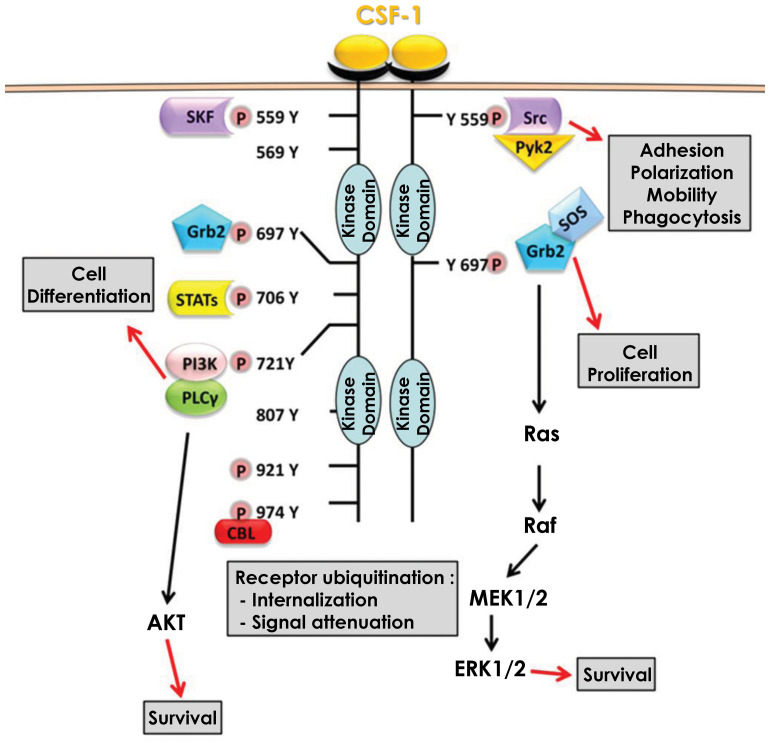
Figure 1
Figure 1
Signaling pathways downstream of CSF1R. Binding of CSF-1 to its receptor CSF1R leads to dimerization and subsequent auto-phosphorylation of several tyrosine residues in the intracellular domain. These phosphorylation reactions are then responsible for the activation of multiple signaling pathways that promote cell differentiation and monocyte survival.
Figure 2
Figure 2
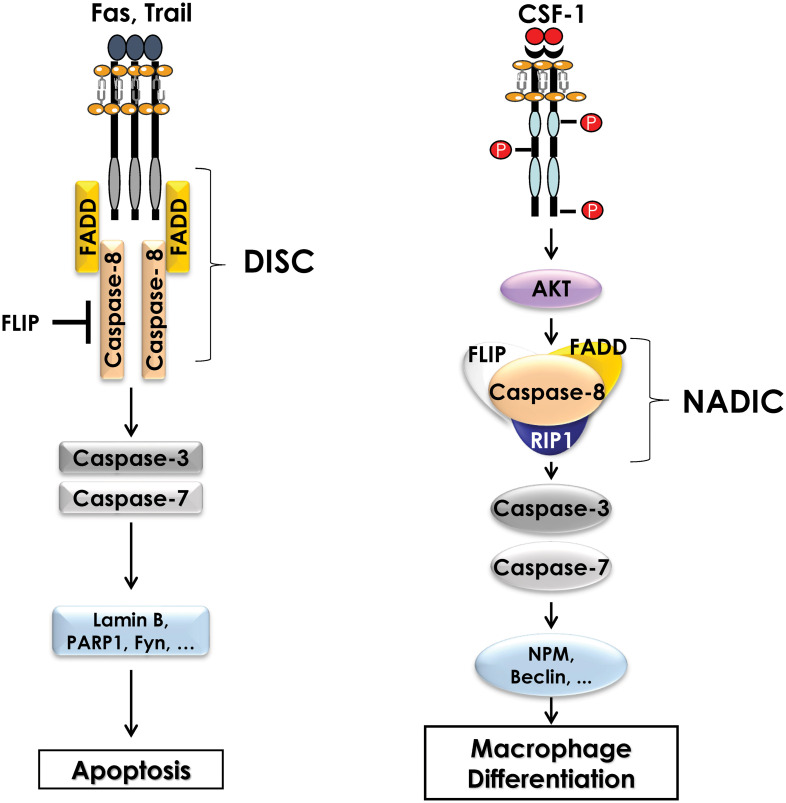
Comparison of the Death Inducing Signaling Complex (DISC) and the complex formed during differentiation of monocytes (NADIC). During induction of extrinsic apoptosis, caspase-8 interacts with a death receptor (FAS, TRAIL) and FADD to form the DISC (Death-inducing signaling complex) at the cell membrane. The FLIP protein may also be present in the DISC to inhibit caspase-8 activity. Activation of caspase-8 leads to the cleavage of caspases-3 and -7 and then to the cleavage of numerous substrate proteins, ultimately inducing apoptosis of the cell. During the differentiation of monocytes into macrophages, CSF1R triggering leads to the activation of the AKT pathway, which is involved in the formation of an intracellular multimolecular complex including caspase-8, FLIP, FADD and RIP1 called non-apoptotic differentiation-inducing complex (NADIC). Within this complex, caspase-8 is activated and then cleaves caspases-3 and -7 to allow the cleavage of substrate proteins that are required for differentiation of monocytes into macrophages.
Figure 3
Figure 3
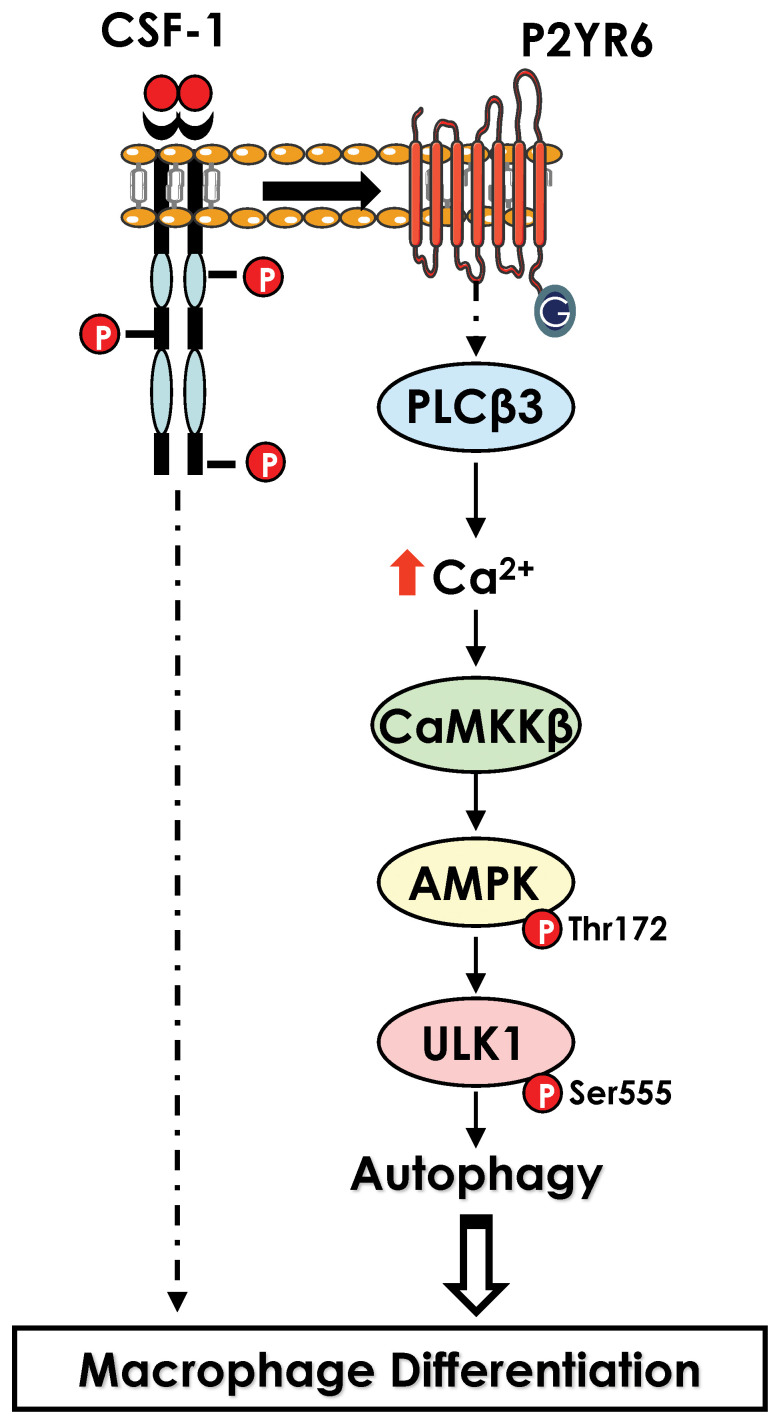
Activation of autophagy during macrophage differentiation. Activation of CSF1R leads to an increase in level of the purinergic receptor P2RY6 at the surface of differentiating monocytes. P2RY6 triggers PLCβ activation, increase in calcium level and a cascade of kinase activation CAMKK2>ULK1 that culminate in the induction of autophagy.
Figure 4
Figure 4
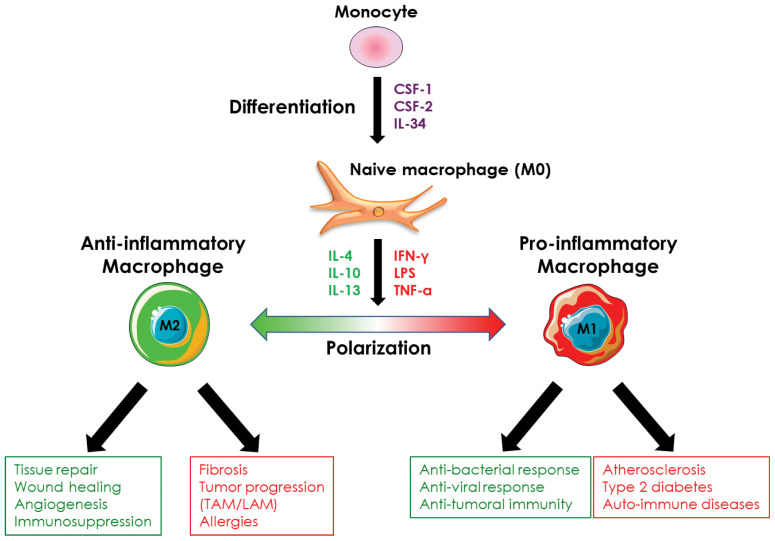
Macrophage polarization. Monocyte-derived-macrophages can be polarized ex vivo and in vivo into pro- or anti-inflammatory macrophages in response to different stimuli. Pro-inflammatory macrophages are involved in the anti-microbial and anti-tumor response and are implicated in the evolution of several pathologies such as atherosclerosis or type 2 diabetes. Anti-inflammatory macrophages exhibit an immunosuppressive activity, are involved in tissue repair, and promote angiogenesis. They are also involved in the evolution of various pathologies including fibrosis and tumor progression.
Figure 5
Figure 5
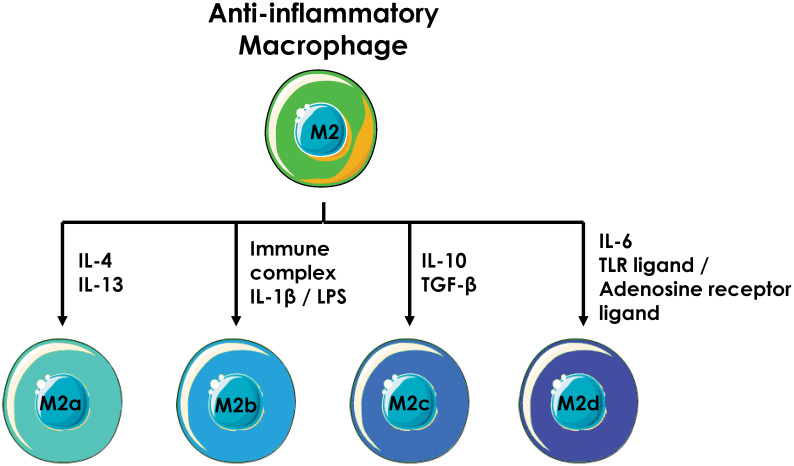
Anti-inflammatory macrophage polarization. Anti-inflammatory macrophages are divided into four subpopulations, each of which is generated by different stimuli.
Figure 6
Figure 6
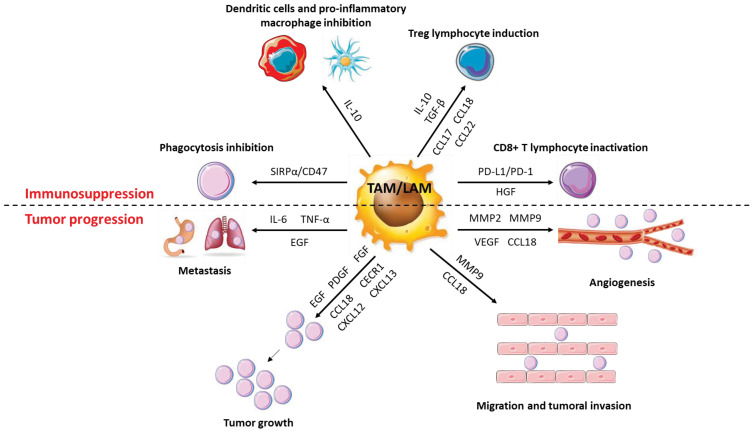
Role of macrophages in cancer progression. TAMs have a very diverse activity profile to promote cancer cells. They promote the growth and metastatic potential of cancer cells by secreting numerous molecules (cytokines, chemokines, growth factors, etc.) that act directly or indirectly on them. Thus, TAMs disrupt the anti-tumor response and promote angiogenesis, tumor growth and metastatic potential.
Figure 7
Figure 7
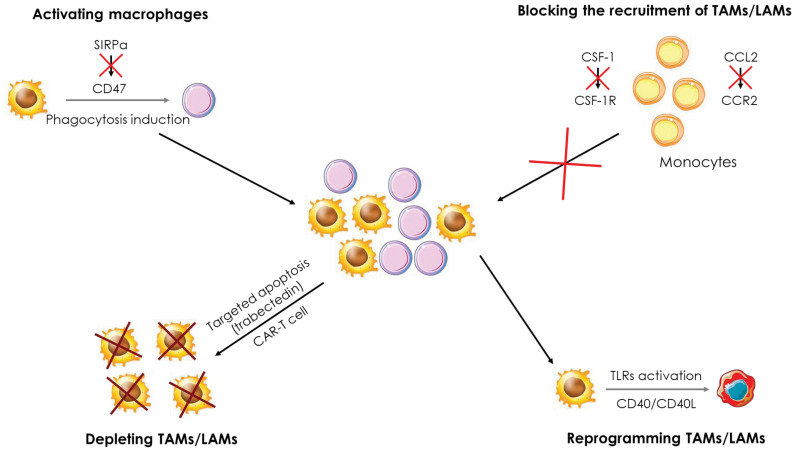
Therapeutic strategies targeting macrophages in cancer. Several therapeutic strategies targeting TAMs/LAMs are being developed to treat cancers. i) Blockade of monocyte recruitment by inhibiting the CCL2/CCR2 and CSF-1/CSFR1 axes, ii) Depletion of TAMs/LAMs using apoptosis inducers and CAR-T cells, iii) Activation of macrophages through the inhibition of the SIRPα/CD47 axis to induce phagocytosis of cancer cells and iv) reprogramming of TAMs/LAMs by activation of the CD40/CD40L axis and TLRs.

References

    1. Ziegler-Heitbrock HW, Ulevitch RJ. Cd14: Cell surface receptor and differentiation marker. Immunol Today (1993) 14(3):121–5. doi: 10.1016/0167-5699(93)90212-4 - DOI - PubMed
    1. Wong KL, Yeap WH, Tai JJ, Ong SM, Dang TM, Wong SC. The three human monocyte subsets: Implications for health and disease. Immunol Res (2012) 53(1-3):41–57. doi: 10.1007/s12026-012-8297-3 - DOI - PubMed
    1. Yona S, Kim KW, Wolf Y, Mildner A, Varol D, Breker M, et al. . Fate mapping reveals origins and dynamics of monocytes and tissue macrophages under homeostasis. Immunity (2013) 38(1):79–91. doi: 10.1016/j.immuni.2012.12.001 - DOI - PMC - PubMed
    1. Frankenberger M, Sternsdorf T, Pechumer H, Pforte A, Ziegler-Heitbrock HW. Differential cytokine expression in human blood monocyte subpopulations: A polymerase chain reaction analysis. Blood (1996) 87(1):373–7. doi: 10.1182/blood.V87.1.373.373 - DOI - PubMed
    1. Gordon S, Taylor PR. Monocyte and macrophage heterogeneity. Nat Rev Immunol (2005) 5(12):953–64. doi: 10.1038/nri1733 - DOI - PubMed

Publication types

Substances