


Severe Falciparum and Vivax Malaria on the Thailand-Myanmar Border: A Review of 1503 Cases
- PMID: 37144342
- PMCID: PMC10495127
- DOI: 10.1093/cid/ciad262
Severe Falciparum and Vivax Malaria on the Thailand-Myanmar Border: A Review of 1503 Cases
Abstract
Background: The northwestern border of Thailand is an area of low seasonal malaria transmission. Until recent successful malaria elimination activities, malaria was a major cause of disease and death. Historically the incidences of symptomatic Plasmodium falciparum and Plasmodium vivax malaria were approximately similar.
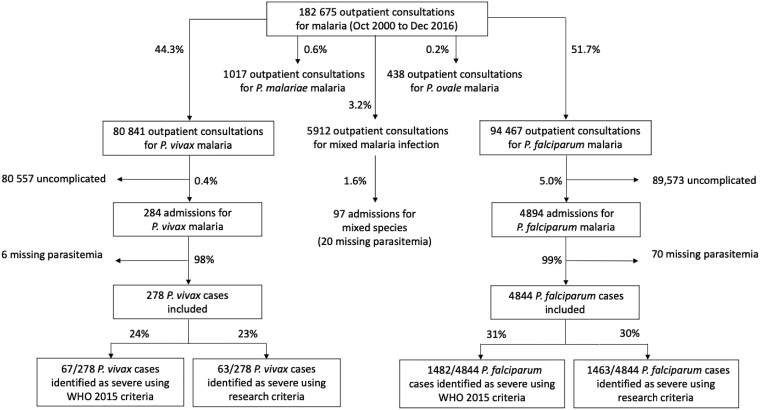
Methods: All malaria cases managed in the Shoklo Malaria Research Unit along the Thailand-Myanmar border between 2000 and 2016 were reviewed.
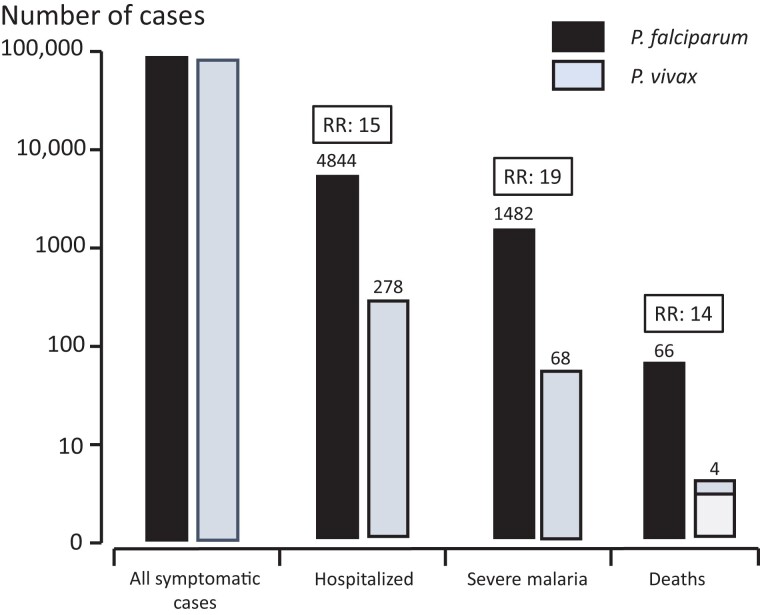
Results: There were 80 841 consultations for symptomatic P. vivax and 94 467 for symptomatic P. falciparum malaria. Overall, 4844 (5.1%) patients with P. falciparum malaria were admitted to field hospitals, of whom 66 died, compared with 278 (0.34%) with P. vivax malaria, of whom 4 died (3 had diagnoses of sepsis, so the contribution of malaria to their fatal outcomes is uncertain). Applying the 2015 World Health Organization severe malaria criteria, 68 of 80 841 P. vivax admissions (0.08%) and 1482 of 94 467 P. falciparum admissions (1.6%) were classified as severe. Overall, patients with P. falciparum malaria were 15 (95% confidence interval, 13.2-16.8) times more likely than those with P. vivax malaria to require hospital admission, 19 (14.6-23.8) times more likely to develop severe malaria, and ≥14 (5.1-38.7) times more likely to die.
Conclusions: In this area, both P. falciparum and P. vivax infections were important causes of hospitalization, but life-threatening P. vivax illness was rare.
Keywords: Plasmodium falciparum; Plasmodium vivax; epidemiology; severe malaria.
© The Author(s) 2023. Published by Oxford University Press on behalf of Infectious Diseases Society of America.
Conflict of interest statement
Potential conflicts of interest. M. Stolbrink reports a Clinical PhD fellowship from Wellcome Trust, unrelated to this manuscript or the topic. All other authors report no potential conflicts. All authors have submitted the ICMJE Form for Disclosure of Potential Conflicts of Interest. Conflicts that the editors consider relevant to the content of the manuscript have been disclosed.
Figures
References
-
- Craig CF. The classification of the malarial plasmodia. Boston Med Surg J 1909; 160:677–9.
-
- Wagner-Jauregg J. Über die einwirkung der malaria auf die progressive paralyse. Psychiatr Neurol Wochenschr 1918; 21/22:132–4.
-
- Snounou G, Pérignon JL. Malariotherapy—insanity at the service of malariology. Advances Parasitol 2013; 18:223–55. - PubMed
-
- Swellengrebel NH, De Buck A. Malaria in the Netherlands. Amsterdam,the Netherlands: Scheltema & Holkema, 1938.
-
- Kitchen SF. Symptomatology: general considerations. In: Boyd MF, ed. Malariology. Philadelphia, PA and London: W. B. Saunders, 1949:966–94.
Publication types
MeSH terms
Grants and funding
LinkOut - more resources
Full Text Sources
Medical
