


Noise Produced by Neonatal Ventilators Inside and Outside of the Incubators
- PMID: 37147103
- PMCID: PMC10676250
- DOI: 10.4187/respcare.10989
Noise Produced by Neonatal Ventilators Inside and Outside of the Incubators
Abstract
Background: Insufficient data are available about the noise produced by modern neonatal ventilators. We aimed to measure their noise under different ventilatory modes and parameters.
Methods: This was a bench study measuring the noise produced by 9 neonatal ventilators set in conventional or high-frequency oscillatory ventilation (HFOV), nasal mask-delivered CPAP with variable- or continuous-flow configuration, or bi-level positive airway pressure (considered as noninvasive ventilation [NIV]). Conventional ventilation and HFOV were tested in 2 distinct settings with moderate or higher parameters. Sound measurements were performed inside and outside an incubator mimicking the clinical setting and using a high-end meter meeting the international ISO 226:2003 standard.
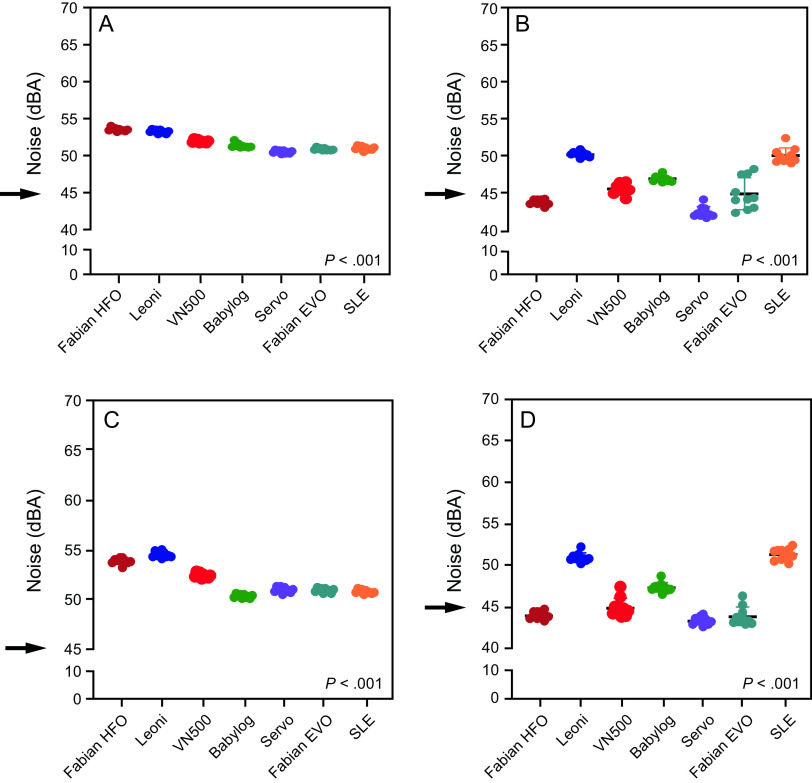
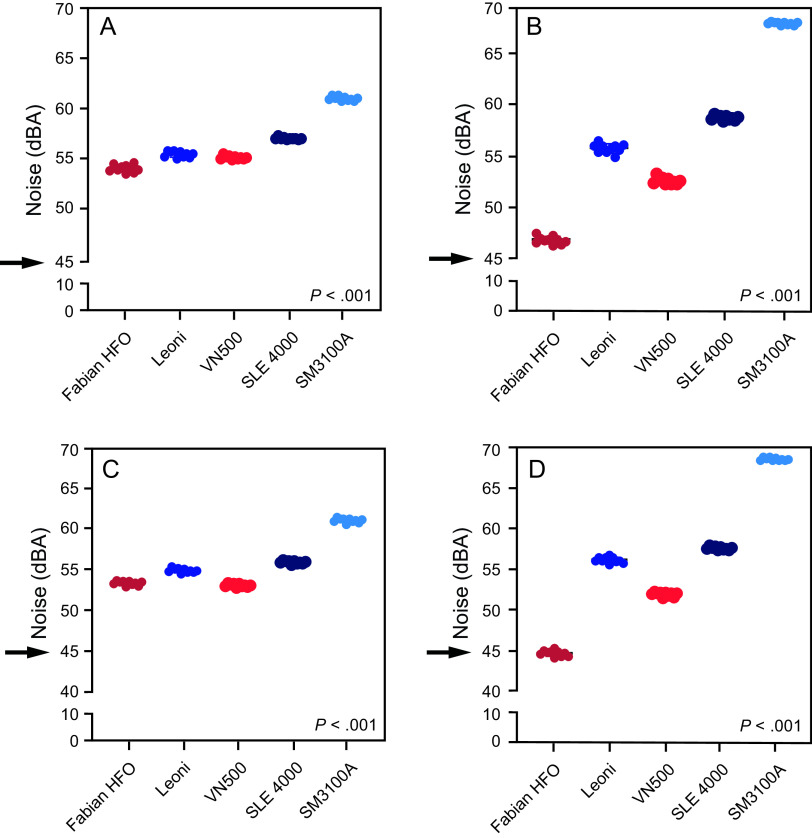
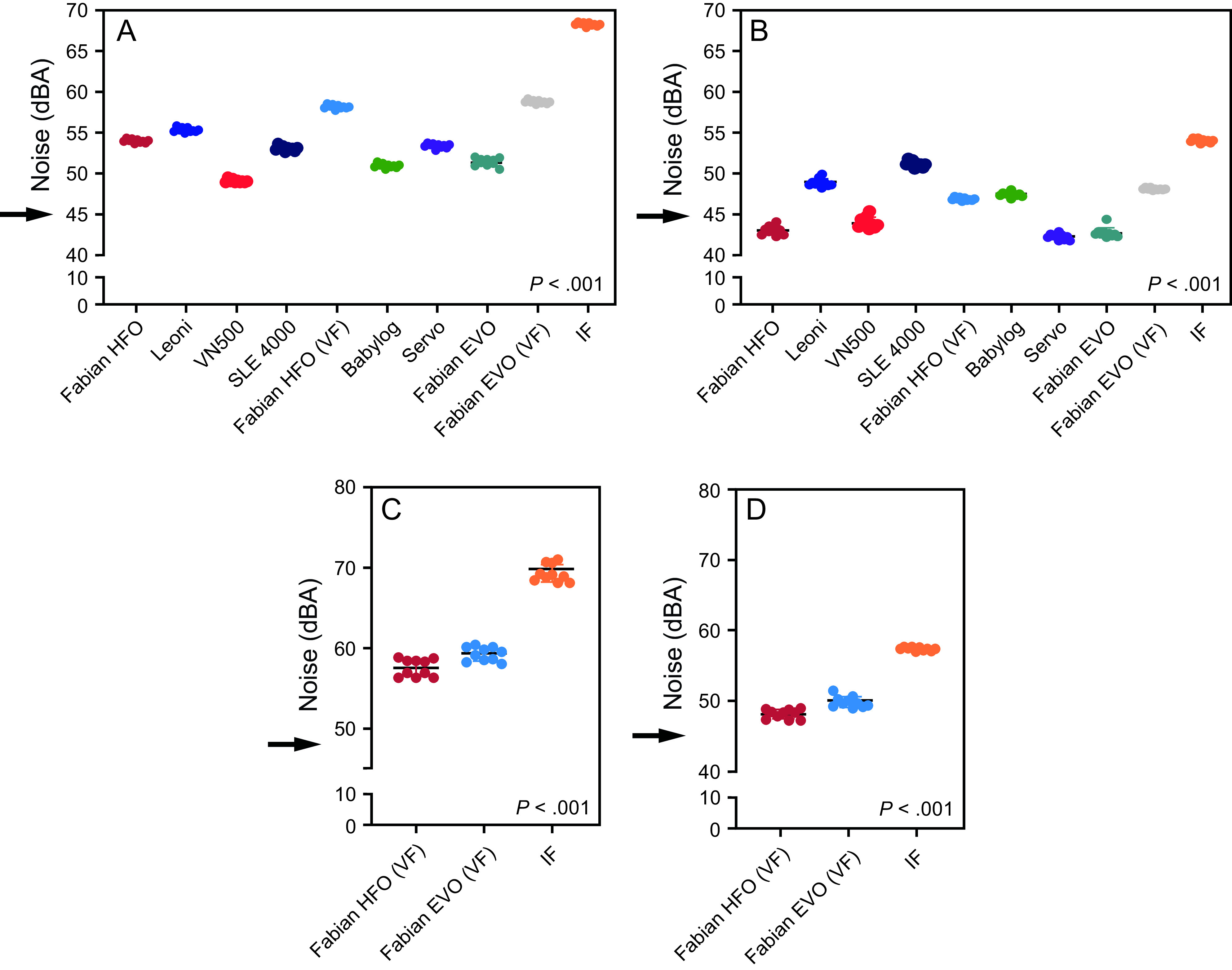
Results: Four ventilators remained below the internationally recommended safety threshold but only for measurements outside the incubator. Conventional ventilation (49.1 [3.4] dBA) and HFOV (56.3 [5.2] dBA) were the least and most noisy respiratory support technique, respectively. Noise was greater inside than outside the incubators (P < .0001) and different between the ventilators (P < .0001); better results were achieved by Servo-u and Fabian family devices for conventional ventilation; by fabian HFO for HFOV; and by Servo-u, VN500, and fabian family devices for CPAP and NIV. Noise levels were similar when using moderate or higher parameters in conventional ventilation (P = .81) and in HFOV (P = .45).
Conclusions: Modern ventilators often produce relevant noise, independent of the respiratory support modality, with acceptable noise levels being measured only outside the incubator. Better results were achieved with Servo-u, VN500, and Fabian family devices.
Keywords: NICU; neonate; respiratory support; safety; sound; ventilation.
Copyright © 2023 by Daedalus Enterprises.
Conflict of interest statement
Dr De Luca discloses relationships with Getinge and Vyaire. The remaining authors have disclosed no conflicts of interest.
Figures
References
-
- Kramer B, Joshi P, Heard C. Noise pollution levels in the pediatric intensive care unit. J Crit Care 2016;36:111-115. - PubMed
-
- Fortes-Garrido JC, Velez-Pereira AM, Gázquez M, Hidalgo-Hidalgo M, Bolívar JP. The characterization of noise levels in a neonatal intensive care unit and the implications for noise management. J Environ Health Sci Eng 2014;12(1):104.
-
- World Health Organization. Community Noise- Environmental Health Criteria Document, External Review Draft. Geneva: World Health Organizatio Publishing; 2002
-
- American Academy of Pediatrics. Committee on Environmental Health. Noise: a hazard for the fetus and newborn. Pediatrics 1997;100:724-727. - PubMed
-
- Philbin MK, Evans JB. Standards for the acoustic environment of the newborn ICU. J Perinatol 2006;26(S3):S27-S30.
MeSH terms
LinkOut - more resources
Full Text Sources
