Observational Study
. 2023 May 5;10(4):e200097.
doi: 10.1212/NXI.0000000000200097. Print 2023 Jul.

Deep Phenotyping of Neurologic Postacute Sequelae of SARS-CoV-2 Infection

Affiliations
Observational Study

Deep Phenotyping of Neurologic Postacute Sequelae of SARS-CoV-2 Infection

Yair Mina et al. Neurol Neuroimmunol Neuroinflamm. .

Abstract

Background and objectives: SARS-CoV-2 infection has been associated with a syndrome of long-term neurologic sequelae that is poorly characterized. We aimed to describe and characterize in-depth features of neurologic postacute sequelae of SARS-CoV-2 infection (neuro-PASC).

Methods: Between October 2020 and April 2021, 12 participants were seen at the NIH Clinical Center under an observational study to characterize ongoing neurologic abnormalities after SARS-CoV-2 infection. Autonomic function and CSF immunophenotypic analysis were compared with healthy volunteers (HVs) without prior SARS-CoV-2 infection tested using the same methodology.

Results: Participants were mostly female (83%), with a mean age of 45 ± 11 years. The median time of evaluation was 9 months after COVID-19 (range 3-12 months), and most (11/12, 92%) had a history of only a mild infection. The most common neuro-PASC symptoms were cognitive difficulties and fatigue, and there was evidence for mild cognitive impairment in half of the patients (MoCA score <26). The majority (83%) had a very disabling disease, with Karnofsky Performance Status ≤80. Smell testing demonstrated different degrees of microsmia in 8 participants (66%). Brain MRI scans were normal, except 1 patient with bilateral olfactory bulb hypoplasia that was likely congenital. CSF analysis showed evidence of unique intrathecal oligoclonal bands in 3 cases (25%). Immunophenotyping of CSF compared with HVs showed that patients with neuro-PASC had lower frequencies of effector memory phenotype both for CD4+ T cells (p < 0.0001) and for CD8+ T cells (p = 0.002), an increased frequency of antibody-secreting B cells (p = 0.009), and increased frequency of cells expressing immune checkpoint molecules. On autonomic testing, there was evidence for decreased baroreflex-cardiovagal gain (p = 0.009) and an increased peripheral resistance during tilt-table testing (p < 0.0001) compared with HVs, without excessive plasma catecholamine responses.

Discussion: CSF immune dysregulation and neurocirculatory abnormalities after SARS-CoV-2 infection in the setting of disabling neuro-PASC call for further evaluation to confirm these changes and explore immunomodulatory treatments in the context of clinical trials.


Conflict of interest statement

The authors report no disclosures relevant to the manuscript. Go to Neurology.org/NN for full disclosures.

Figures

Figure 1
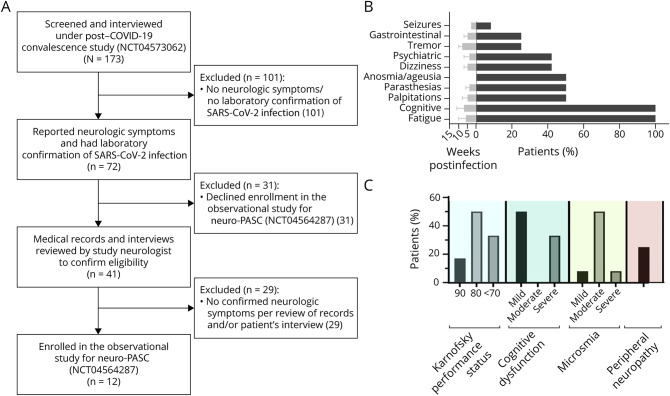
Figure 1. Flowchart for Inclusion in the Study and Symptoms and Signs of Neurologic Postacute Sequelae of SARS-CoV-2 Infection (Neuro-PASC)
(A) Flowchart describing the process of including/excluding participants for this observational study. (B) Symptoms of neuro-PASC; bars on the right represent the frequency of symptoms in the cohort (%), whereas the bars on the left represent the time of onset after SARS-CoV-2 infection (mean ± SD). (C) Neurologic findings in neuro-PASC; bars represent the frequency of signs in the cohort (%). COVID-19 = coronavirus disease 2019; NCT = National Clinical Trial.
Figure 2
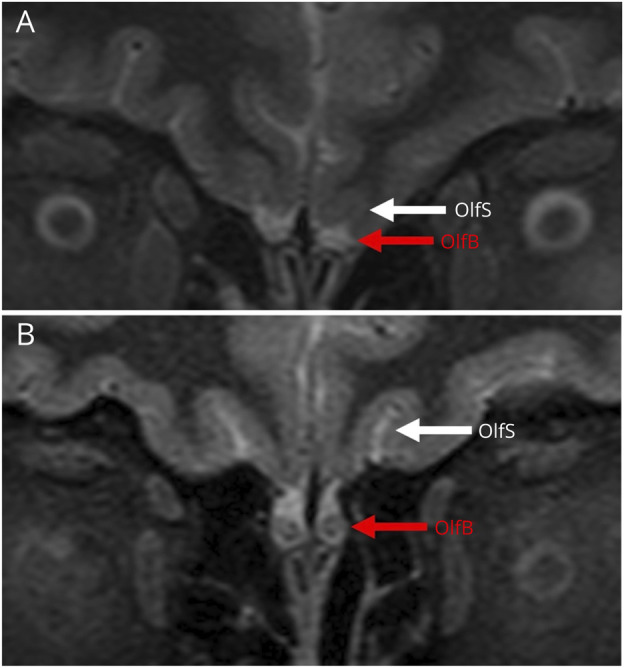
Figure 2. Bilateral Hypoplastic Olfactory Bulbs in a Patient With Neuro-PASC
These T2 images from brain scans of study participants show that although most participants (B) had a normal appearance of the olfactory bulbs (OlfB, red arrow) and olfactory sulcus (OlfS, white arrow), 1 participant, a 34-year-old woman with reported parosmia and documented moderate microsmia, had evidence for bilateral hypoplastic olfactory bulbs (A). The presence of shallow olfactory fossae and small olfactory sulci in this patient suggests that this is most likely congenital.
Figure 3
Figure 3. Main Differences Found by Immunophenotyping of Spinal Fluid Between Patients With PASC and HVs
Each dot represents 1 participant; bars represent SD from mean (top edge of rectangle). Numbers on top crossing line are p values based on the Wilcoxon 2-sample test. HVs = healthy volunteers; NK = natural killer; PASC = postacute sequelae of SARS-CoV-2; PD-L1 = programmed death ligand 1 TIGIT = T-cell immunoglobulin and ITIM domains.
Figure 4
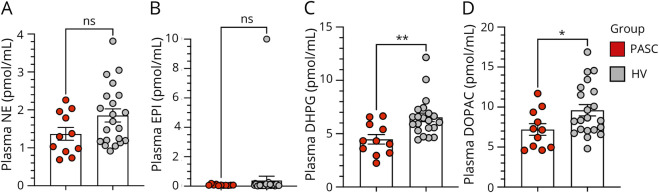
Figure 4. Plasma Levels of Catecholamines in Patients With Postacute Sequelae of SARS-CoV-2 Infection (PASC, Red) and Healthy Volunteers (HVs, Gray)
Each dot represents 1 participant; bars represent standard errors of the mean (top edge of rectangle). *p < 0.05 and **p < 0.01 by independent means t tests. (A) Plasma levels of norepinephrine (NE); (B) Plasma levels of epinephrine (EPI); (C) Plasma levels of 3,4-dihydroxyphenylglycol (DHPG); (D) Plasma levels of 3,4-dihydroxyphenylacetic acid (DOPAC). ns = not significant.
Figure 5
Figure 5. Differences in Physiologic Variables in Patients With Postacute Sequelae of SARS-CoV-2 Infection (PASC, Red) Compared With Healthy Volunteers (HVs, Gray)
Each dot represents 1 participant; bars represent standard errors of the mean (top edge of rectangle). p Values are for independent means t tests. (A) Heart rate (HR); (B) finger systolic blood pressure (BPs); (C) baroreflex-cardiovagal gain; (D) high-frequency (HF) power of heart rate variability; ns = not significant.
Figure 6
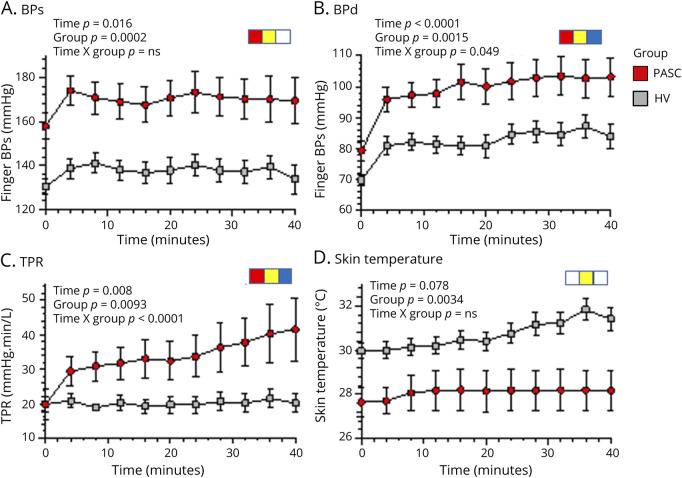
Figure 6. Differences in Physiologic Variables During Head-Up Tilt Table Testing in Patients With Postacute Sequelae of SARS-CoV-2 Infection (PASC, Red) Compared With Healthy Volunteers (HVs, Gray)
Data are from all participants. Data at each time point are presented as mean (dot) and standard error of the mean (bars). (A) Finger systolic blood pressure (BPs); (B) finger diastolic blood pressure (BPd); (C) total peripheral resistance (TPR); (D) skin temperature; red symbols indicate significant time effect, yellow symbols significant group effect, and blue symbols significant time-group interaction effect in repeated-measures analyses of variance. The PASC group had higher BPs, BPd, and TPR and lower skin temperature than did the HV group. The PASC group had larger increases in BPd and TPR during head-up tilt.

References

    1. Dong E, Du H, Gardner L. An interactive web-based dashboard to track COVID-19 in real time. Lancet Infect Dis. 2020;20(5):533-534. doi: 10.1016/S1473-3099(20)30120-1 - DOI - PMC - PubMed
    1. Hui DS, Joynt GM, Wong KT, et al. Impact of severe acute respiratory syndrome (SARS) on pulmonary function, functional capacity and quality of life in a cohort of survivors. Thorax. 2005;60(5):401-409. doi: 10.1136/thx.2004.030205 - DOI - PMC - PubMed
    1. Groff D, Sun A, Ssentongo AE, et al. Short-term and long-term rates of postacute sequelae of SARS-CoV-2 infection: a systematic review. JAMA Netw Open. 2021;4(10):e2128568. doi: 10.1001/jamanetworkopen.2021.28568 - DOI - PMC - PubMed
    1. Nath A. Long-haul COVID. Neurology. 2020;95(13):559-560. doi: 10.1212/WNL.0000000000010640 - DOI - PubMed
    1. Huang C, Huang L, Wang Y, et al. 6-month consequences of COVID-19 in patients discharged from hospital: a cohort study. Lancet. 2021;397(10270):220-232. doi: 10.1016/S0140-6736(20)32656-8 - DOI - PMC - PubMed

Publication types