


Impact of premature birth on cardiopulmonary function in later life
- PMID: 37147470
- PMCID: PMC10353970
- DOI: 10.1007/s00431-023-04952-y
Impact of premature birth on cardiopulmonary function in later life
Abstract
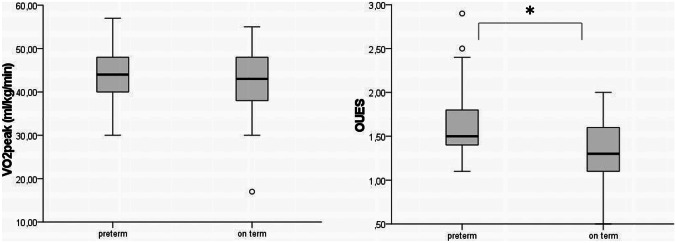
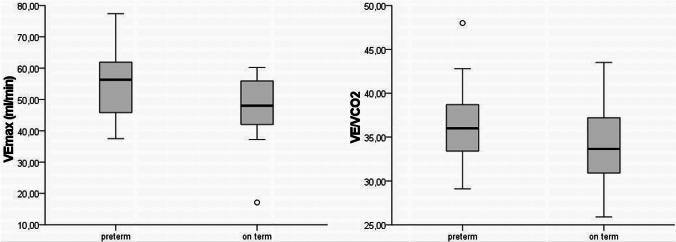
Pulmonary function is reduced in children after preterm birth. The variety of subgroups ranges from early to late preterm births. Limitations in pulmonary function can be observed even after late preterm birth without signs of bronchopulmonary dysplasia and/or history of mechanical ventilation. Whether this reduction in lung function is reflected in the cardiopulmonary capacity of these children is unclear. This study aims to investigate the impact of moderate to late premature birth on cardiopulmonary function. Cardiopulmonary exercise testing on a treadmill was performed by 33 former preterm infants between 8 and 10 years of age who were born between 32 + 0 and 36 + 6 weeks of gestation and compared with a control group of 19 children born in term of comparable age and sex. The former preterm children achieved comparable results to the term-born controls with respect to most of the cardiopulmonary exercise parameters [Formula: see text]. The only differences were in a slightly higher oxygen uptake efficiency slope [Formula: see text] and higher peak minute ventilation [Formula: see text] in the group of children born preterm. With respect to heart rate recovery [Formula: see text] and breathing efficiency [Formula: see text], there were no significant differences.
Conclusion: Children born preterm did not show limitations in cardiopulmonary function in comparison with matched controls.
What is known: • Preterm birth is associated with reduced pulmonary function in later life, this is also true for former late preterms. • As a consequence of being born premature, the lungs have not finished their important embryological development. Cardiopulmonary fitness is an important parameter for overall mortality and morbidity in children and adults and a good pulmonary function is therefore paramount.
What is new: • Children born prematurely were comparable to an age- and sex-matched control group with regards to almost all cardiopulmonary exercise variables. • A significantly higher OUES, a surrogate parameter for VO2peak was found for the group of former preterm children, most likely reflecting on more physical exercise in this group. Importantly, there were no signs of impaired cardiopulmonary function in the group of former preterm children.
Keywords: Cardiopulmonary exercise testing; Habitual exercise; Premature birth; Sports.
© 2023. The Author(s).
Conflict of interest statement
The authors declare no competing interests.
Figures
References
-
- Kajantie E, Strang-Karlsson S, Evensen KAI, Haaramo P. Adult outcomes of being born late preterm or early term - what do we know? Semin Fetal Neonatal Med. 2019;24:66–83. - PubMed
-
- Kotecha SJ, Watkins WJ, Paranjothy S, Dunstan FD, Henderson AJ, Kotecha S. Effect of late preterm birth on longitudinal lung spirometry in school age children and adolescents. Thorax. 2012;67:54–61. - PubMed
MeSH terms
LinkOut - more resources
Full Text Sources
Research Materials
