


The effects of a music enrichment program on parent-infant interactions during mealtime: A randomized controlled trial
- PMID: 37148975
- PMCID: PMC10401892
- DOI: 10.1016/j.appet.2023.106590
The effects of a music enrichment program on parent-infant interactions during mealtime: A randomized controlled trial
Abstract
Background: Parent-child interactions are linked to childhood obesity. Music enrichment programs enhance parent-child interactions and may be a strategy for early childhood obesity prevention.
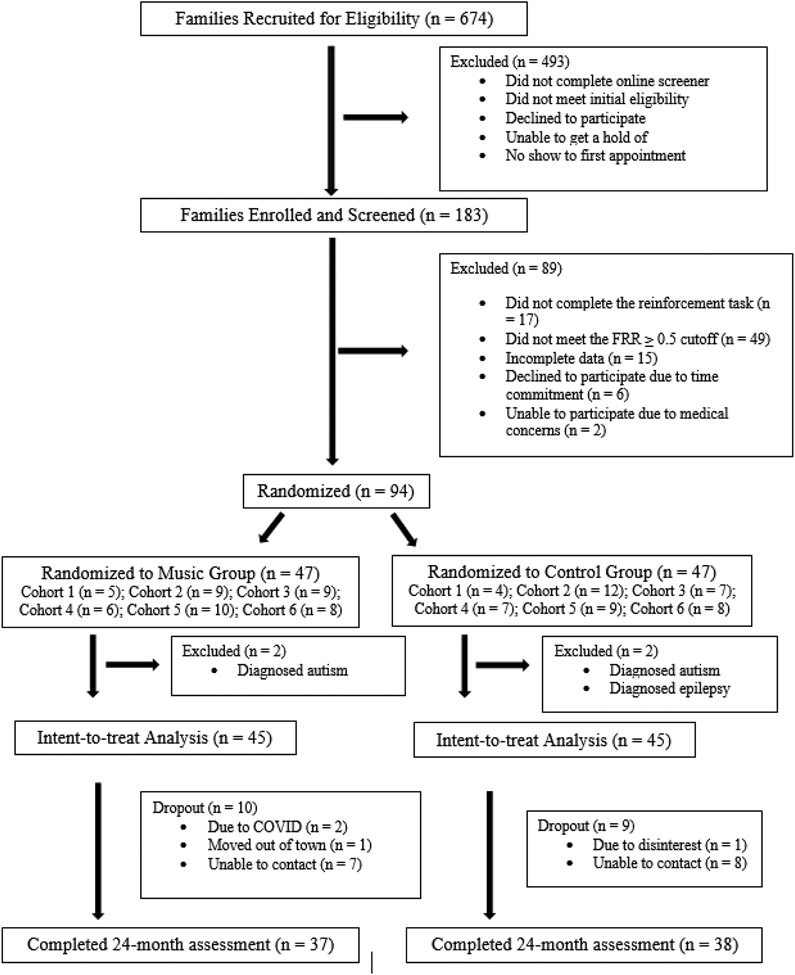
Objective: We implemented a 2-year randomized, controlled trial to assess the effects of a music enrichment program (music, n = 45) vs. active play date control (control, n = 45) on parent-child interactional quality and infant weight status.
Methods: Typically developing infants aged 9-to 15-months were enrolled with a primary caregiver in the Music Together ® or a play date program. Participants attended once per week group meetings for 12 months and once per month group meetings for an additional 12 months. Parent-child interaction was measured using the Parent Child Early Relational Assessment (PCERA) at baseline, month 6, 12, and 24. We used a modified intent-to-treat mixed model regression to test group differences in parent-child interactions and Weight for length z-score (zWFL) growth trajectories were modeled.
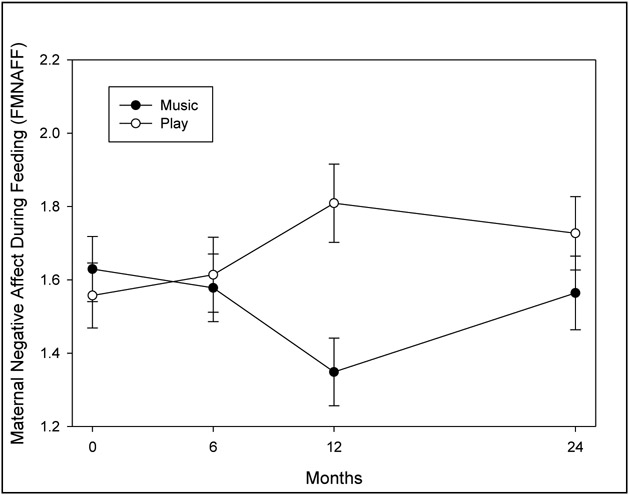
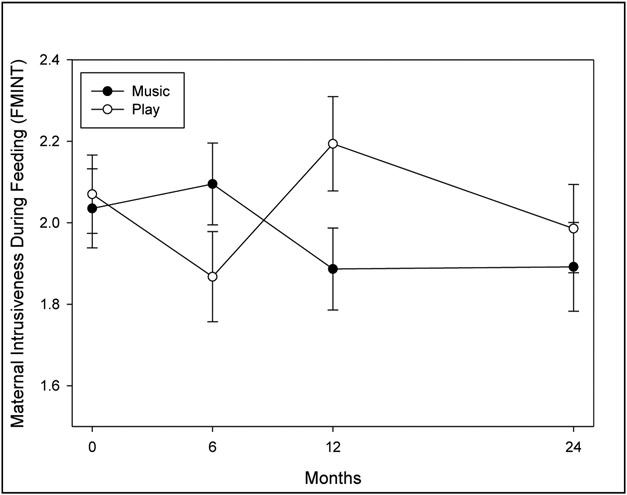
Results: There were significant differential group changes across time for negative affect during feeding (group*month; p = 0.02) in that those parents in the music group significantly decreased their negative affect score compared with the control group from baseline to month 12 (music change = -0.279 ± 0.129; control change = +0.254 ± 0.131.; p = 0.00). Additionally, we also observed significant differential group changes across time for parent intrusiveness during feeding (group*month; p = 0.04) in that those parents in the music group significantly decreased their intrusiveness score compared with the control group from month 6 to month 12 (music change = -0.209 ± 0.121; control change = 0.326 ± 0.141; p = 0.01). We did not find a significant association between any of the changes in parental negative affect and intrusiveness with child zWFL trajectories.
Conclusion: Participating in a music enrichment program from an early age may promote positive parent-child interactions during feeding, although this improvement in the quality of parent-child interactions during feeding was not associated with weight gain trajectories.
Keywords: Enriched environment; Infant obesity; Music; Parenting.
Copyright © 2023 Elsevier Ltd. All rights reserved.
Conflict of interest statement
Declaration of competing interest All authors declare no conflict of interest.
Figures
References
-
- Hollenstein T, Tighe AB, Lougheed JP. Emotional development in the context of mother–child relationships. Current opinion in psychology. 2017;17:140–144. - PubMed
Publication types
MeSH terms
Grants and funding
LinkOut - more resources
Full Text Sources
Medical
