


Systemic inflammation and cortical neurochemistry in never-medicated first episode-psychosis individuals
- PMID: 37149107
- PMCID: PMC10330452
- DOI: 10.1016/j.bbi.2023.05.001
Systemic inflammation and cortical neurochemistry in never-medicated first episode-psychosis individuals
Abstract
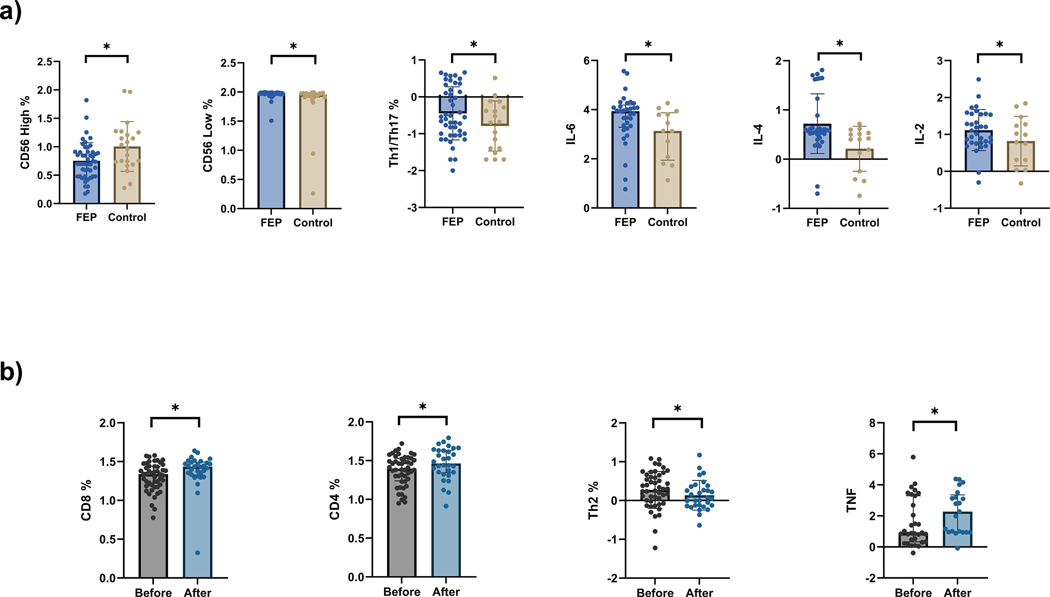
Studies of cellular and cytokine profiles have contributed to the inflammation hypothesis of schizophrenia; however, precise markers of inflammatory dysfunction remain elusive. A number of proton magnetic resonance spectroscopy (1H-MRS) studies in patients with first-episode psychosis (FEP) have shown higher brain levels of metabolites such as glutamate, myo-inositol (mI) and choline-containing compounds (tCho), suggesting neuroinflammation. Here, we present peripheral inflammatory profiles in antipsychotic-naive FEP patients and age-and-sex matched healthy controls, as well as cortical glutamate, mI and tCho levels using 1H-MRS. Inflammatory profiles were analyzed using cytokine production by peripheral blood mononuclear cells, that were either spontaneous or stimulated, in 48 FEP patients and 23 controls. 1H-MRS of the medial prefrontal cortex was obtained in 29 FEP patients and 18 controls. Finally, 16 FEP patients were rescanned after 4 weeks of treatment (open-label) with Risperidone. FEP patients showed a higher proportion of proinflammatory Th1/Th17 subset, and an increased spontaneous production of Interleukin (IL)-6, IL-2 and IL-4 compared with the control group. Results obtained from 1H-MRS showed no significant difference in either glutamate, mI or tCho between FEP and control groups. At baseline, CD8% showed a negative correlation with glutamate in FEP patients; after 4 weeks of risperidone treatment, the FEP group exhibited a decrease in glutamate levels which positively correlated with CD4 + T cells. Nevertheless, these correlations did not survive correction for multiple comparisons. FEP patients show evidence of immune dysregulation, affecting both the innate and adaptive immune response, with a predominantly Th2 signature. These findings, along with the changes produced by antipsychotic treatment, could be associated with both systemic and central inflammatory processes in schizophrenia.
Keywords: Cytokines; Inflammation; Magnetic resonance spectroscopy; Peripheral blood mononuclear cells; Psychosis.
Copyright © 2023 Elsevier Inc. All rights reserved.
Conflict of interest statement
Declaration of Competing Interest The authors declare the following financial interests/personal relationships which may be considered as potential competing interests: Pablo León-Ortiz and Francisco Reyes-Madrigal have received speaking fees from Janssen (Johnson & Johnson) outside the submitted work. The rest of the authors declare that they have no known competing financial interests or personal relationships that could have appeared to influence the work reported in this paper.
Figures
References
-
- Azizi E, Zavaran Hosseini A, Soudi S, Noorbala AA, 2019. Alteration of Serum Levels of Cytokines in Schizophrenic Patients before and after Treatment with Risperidone. Iran J Allergy Asthma Immunol 18, 262–268. - PubMed
-
- Bojesen KB, Broberg BV, Fagerlund B, Jessen K, Thomas MB, Sigvard A, Tangmose K, Nielsen MO, Andersen GS, Larsson HBW, Edden RAE, Rostrup E, Glenthoj BY, 2021. Associations Between Cognitive Function and Levels of Glutamatergic Metabolites and Gamma-Aminobutyric Acid in Antipsychotic-Naive Patients With Schizophrenia or Psychosis. Biol Psychiatry 89, 278–287. - PMC - PubMed
Publication types
MeSH terms
Substances
Grants and funding
LinkOut - more resources
Full Text Sources
Medical
Research Materials
