


Rhinoceros serum labile plasma iron and associated redox potential: interspecific variation, sex bias and iron overload disorder disconnect
- PMID: 37155459
- PMCID: PMC9040876
- DOI: 10.1093/conphys/coac025
Rhinoceros serum labile plasma iron and associated redox potential: interspecific variation, sex bias and iron overload disorder disconnect
Abstract
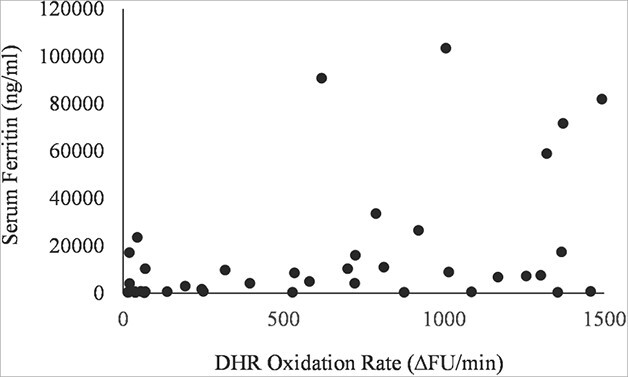
A consequence of the poaching crisis is that managed rhinoceros populations are increasingly important for species conservation. However, black rhinoceroses (BR; Diceros bicornis) and Sumatran rhinoceroses (SR; Dicerorhinus Sumatrensis) in human care often store excessive iron in organ tissues, a condition termed iron overload disorder (IOD). IOD research is impeded by the challenge of accurately monitoring body iron load in living rhinoceroses. The goals of this study were to (i) determine if labile plasma iron (LPI) is an accurate IOD biomarker and (ii) identify factors associated with iron-independent serum oxidative reduction potential (ORP). Serum (106 samples) from SRs (n = 8), BRs (n = 28), white rhinoceros (n = 24) and greater one-horned rhinoceros (GOH; n = 16) was analysed for LPI. Samples from all four species tested positive for LPI, and a higher proportion of GOH rhinoceros samples were LPI positive compared with those of the other three species (P < 0.05). In SRs, the only LPI-positive samples were those from individuals clinically ill with IOD, but samples from outwardly healthy individuals of the other three species were LPI positive. Serum ORP was lower in SRs compared with that in the other three species (P < 0.001), and iron chelation only reduced ORP in the GOH species (P < 0.01; ~5%). Serum ORP sex bias was revealed in three species with males exhibiting higher ORP than females (P < 0.001), the exception being the SR in which ORP was low for both sexes. ORP was not associated with age or serum iron concentrations (P ≥ 0.05), but was positively correlated with ferritin (P < 0.01). The disconnect between LPI and IOD was unanticipated, and LPI cannot be recommended as a biomarker of advanced rhino IOD. However, data provide valuable insight into the complex puzzle of rhinoceros IOD.
© Crown copyright 2022.
Figures



References
-
- Andrews GA, Chavey PS, Smith JE (1994) Enzyme-linked immunosorbent assay to measure serum ferritin and the relationship between serum ferritin and nonheme iron stores in cats. Vet Pathol 31: 674–678. - PubMed
-
- Ball R, Mueller S (2011) Hemosiderosis and clinical findings consistent with black rhino syndromes in greater one horned rhinoceros. In Proceedings of the 2011 International Elephant and Rhino Conservation and Research Symposium, pp. 1283–1308. International Elephant Foundation, Azle, Texas, USA.
-
- Beutler E, West C, Speir JA, Wilson IA, Worley M (2001) The HFE gene of browsing and grazing rhinoceroses: a possible site of adaptation to a low-iron diet. Blood Cells Mol Dis 27: 342–350. - PubMed
-
- Cabantchik ZI, Breuer W, Zanninelli G, Cianciulli P (2005) LPI-labile plasma iron in iron overload. Best Prac Res Clin Haematol 18: 277–287. - PubMed
LinkOut - more resources
Full Text Sources
Research Materials
