. 2023 May 16;120(20):e2302191120.
doi: 10.1073/pnas.2302191120. Epub 2023 May 8.

Circular RNA vaccine induces potent T cell responses

Affiliations

Circular RNA vaccine induces potent T cell responses

Laura Amaya et al. Proc Natl Acad Sci U S A. .

Abstract

Circular RNAs (circRNAs) are a class of RNAs commonly found across eukaryotes and viruses, characterized by their resistance to exonuclease-mediated degradation. Their superior stability compared to linear RNAs, combined with previous work showing that engineered circRNAs serve as efficient protein translation templates, make circRNA a promising candidate for RNA medicine. Here, we systematically examine the adjuvant activity, route of administration, and antigen-specific immunity of circRNA vaccination in mice. Potent circRNA adjuvant activity is associated with RNA uptake and activation of myeloid cells in the draining lymph nodes and transient cytokine release. Immunization of mice with engineered circRNA encoding a protein antigen delivered by a charge-altering releasable transporter induced innate activation of dendritic cells, robust antigen-specific CD8 T cell responses in lymph nodes and tissues, and strong antitumor efficacy as a therapeutic cancer vaccine. These results highlight the potential utility of circRNA vaccines for stimulating potent innate and T cell responses in tissues.

Keywords: CD8 T cells; circular RNA; vaccine.


Conflict of interest statement

H.Y.C. is a co-founder of Accent Therapeutics, Boundless Bio, Cartography Biosciences, Orbital Therapeutics and an advisor of 10x Genomics, Arsenal Biosciences, Chroma Medicine, and Spring Discovery. P.A.W. is a co-founder of BryoLogyx and N1 Life and an advisor to BryoLogyx, N1 Life, Synaptogenix, Cytokinetics, Evonik, SuperTrans Medical, Ativo, and Vault Pharma. B.P. serves on the External Immunology Network of GSK and on the scientific advisory board of Medicago, Sanofi, EdJen, and Boehringer-Ingelheim. Stanford University has filed a patent on circular RNA technology on which L.A., B.P., and H.Y.C. are named as inventors. The remaining authors declare no competing interests.

Figures
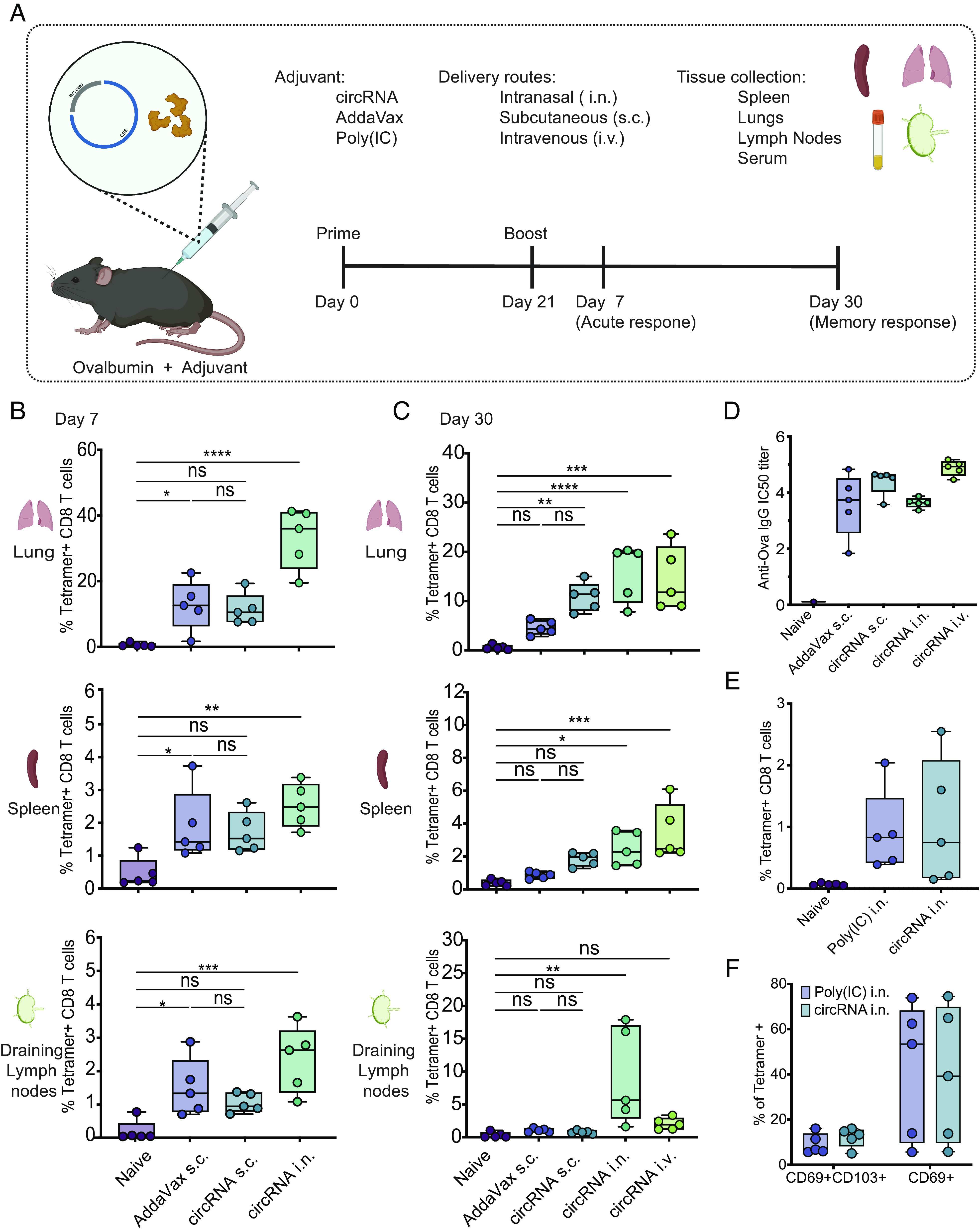
Fig. 1.
Fig. 1.
Adjuvant effect of circRNA by different routes of delivery. (A) Schematic representation of circRNA immunization strategy via different delivery routes and monitoring of immune responses. OVA protein (50 μg) and circRNA (25 μg), AddaVax (50 μL), or Poly(IC) (25 μg) was delivered by intranasal (i.n.), subcutaneous (s.c.), or intravenous (i.v.) injection. Serum, lung, lymph nodes, and spleen were analyzed at days 7 and 30 postboost. Percentage of OVA-specific T cell responses in lung, spleen, and lymph nodes after (B) 7 d or (C) 30 d postboost (n = 5, bars represent Min and Max). (D) Anti-OVA IgG antibodies in serum measured by ELISA at day 30 postboost after circRNA immunization by different delivery routes (n = 5, bars represent Min and Max). (E) Frequency of class I tetramer+ CD8 T cells at day 30 postboost of i.n. delivery of circRNA compared to Poly(IC) (n = 5, bars represent Min and Max). (F) Frequency of CD69+ and CD69+CD103+ CD8 TRM in the lungs at day 30 postboost (as percentage of antigen-specific CD8 T cells) (n = 5, bars represent Min and Max). One-way ANOVA was applied in BE, and two-way ANOVA in F. *P < 0.05, **P < 0.01, ***P < 0.001, ****P < 0.0001. Differences between groups were considered significant for P values < 0.05. ns, not significant.
Fig. 2.
Fig. 2.
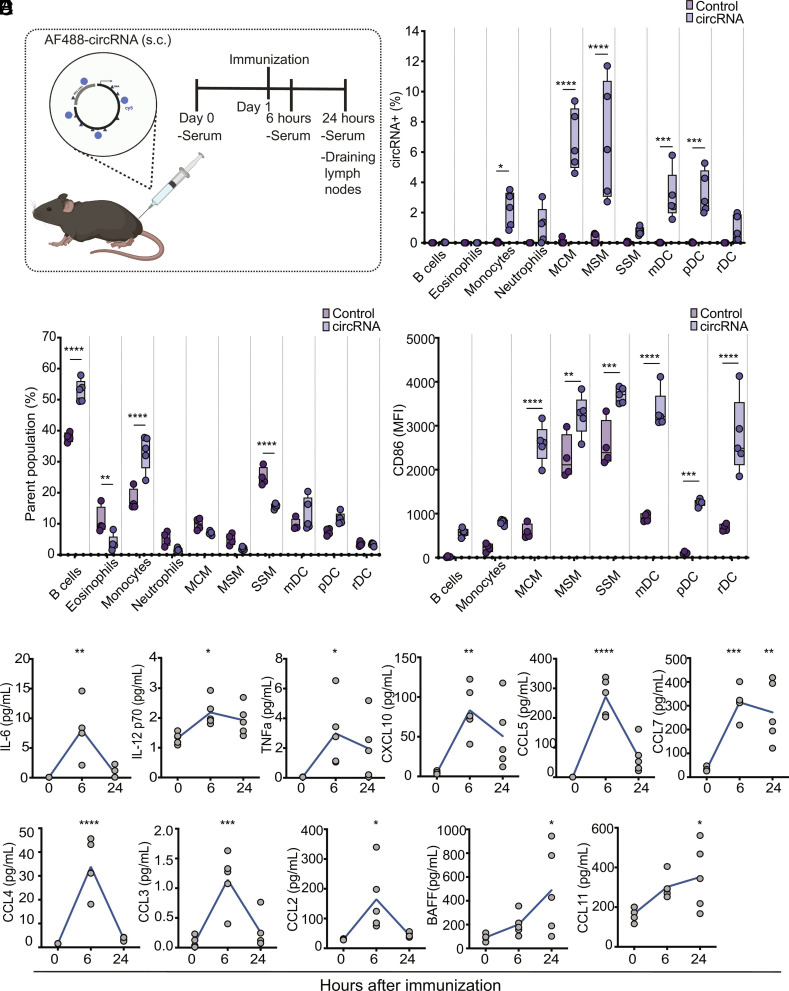
Biodistribution of circRNA and innate recognition. (A) Schematic representation of in vivo circRNA delivery and monitoring. Fifty micrograms of AF488-circRNA was delivered subcutaneously, and serum samples were collected 6 and 24 h after delivery. Draining lymph nodes were also analyzed after 24 h by flow cytometry. (B) Absolute fraction of fluorescently positive innate cell subsets that take up circRNA (n = 5, bars represent Min and Max). (C) Quantification of innate cell subsets proportions and (D) fluorescent intensity of activation marker CD86 in distinct innate immune cell subsets in lymph nodes, 24 h after s.c. delivery of fluorescently labeled circRNA (n = 5, bars represent Min and Max). (E) Time course analysis of cytokines in serum after circRNA delivery measured by Luminex (n = 5). Two-way ANOVA was applied in BD. One-way ANOVA was applied in E. *P < 0.05, **< 0.01, ***< 0.001, ****P < 0.0001.
Fig. 3.
Fig. 3.
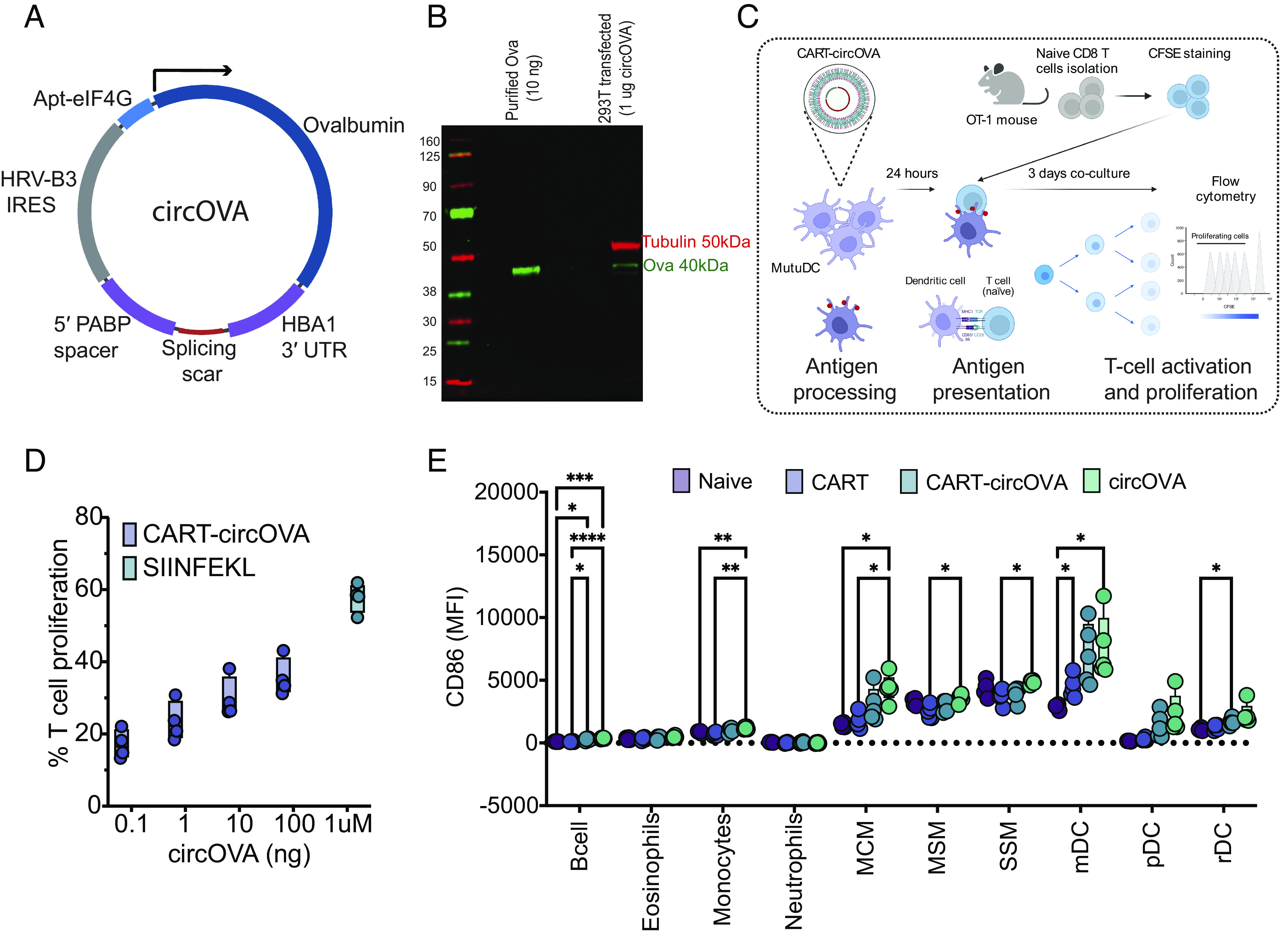
Circular RNA is translated and presented to the immune system. (A) Schematic representation of circOVA design and engineered components. Arrow indicates expected open-reading frame. (B) Detection of full-length Ovalbumin protein by western blot 24 h after transfection of 293T cells with circOVA. (C) Experimental design of proliferation assay used to measure antigen-specific T cell proliferation level of OT-I cells cocultured with MutuDC cells incubated with CART-circOVA. (D) CART-circOVA titration to determine the minimum amount required to induce antigen-specific T cell proliferation and peptide SINFEKL as positive control (n = 4, bars represent Min and Max). (E) CD86 expression of innate cell subsets 24 h after s.c. delivery of circRNA, circRNA delivered with CART (CART-circOVA), and CART alone (n = 5, bars represent Min and Max). Two-way ANOVA was applied *P < 0.05, **< 0.01, ***< 0.001, ****< 0.0001. Only differences between groups considered significant (P values < 0.05) are displayed.
Fig. 4.
Fig. 4.
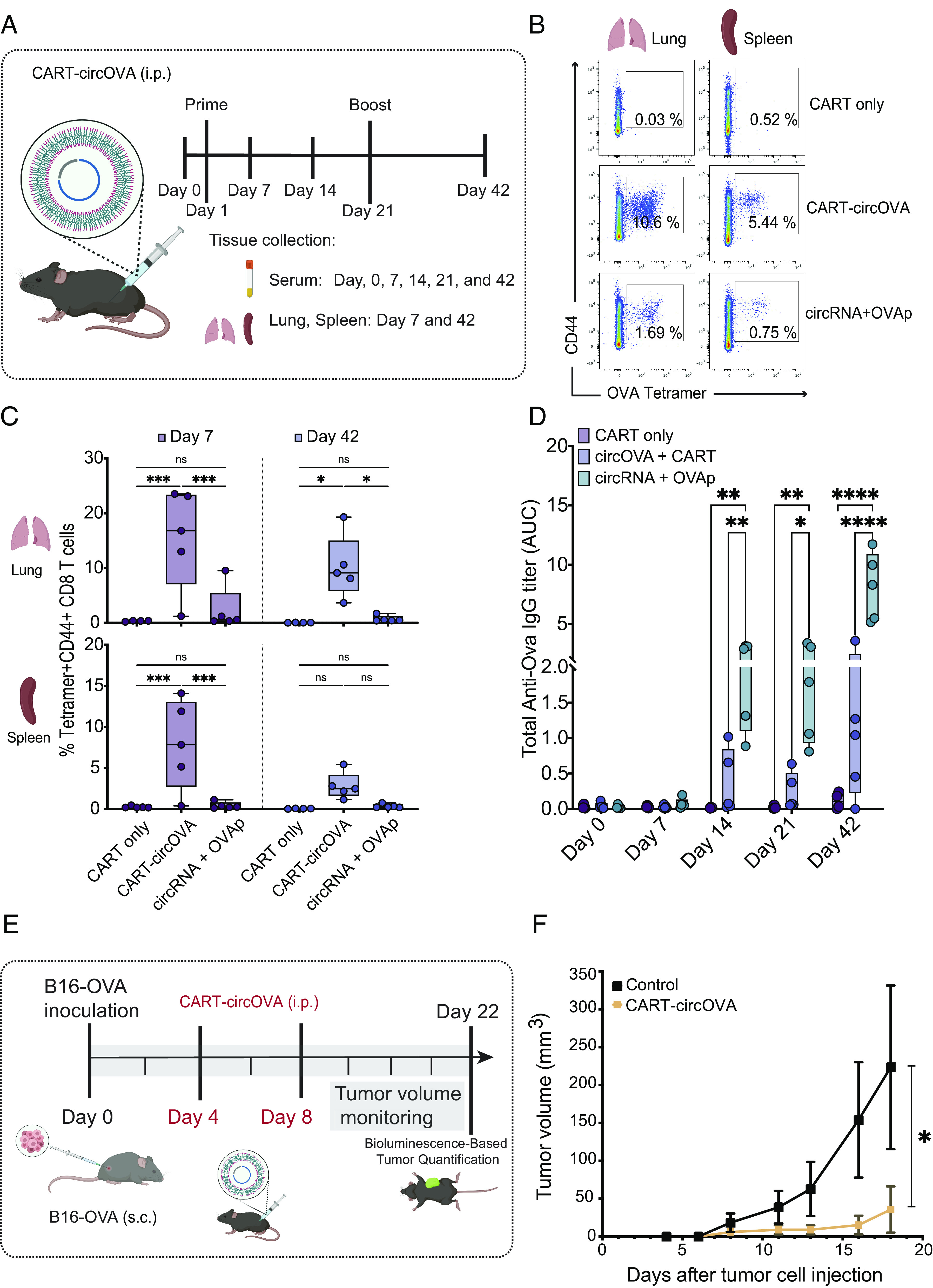
Circular RNA delivery in vivo activates T cell–specific responses. (A) Schematic representation of immunization strategy and monitoring of adaptive immune responses. Nine micrograms of circOVA was complexed with CART reagent and delivered intraperitoneally at days 0 and 21. Serum samples were collected weekly, and the spleen and lung were analyzed 7 d post prime and 21 d postboost. (B) Percentage of OVA-specific T cell responses in the lung and spleen at day 42 (representative sample). (C) Quantification of OVA-specific T cells in the lung and spleen at day 7 and day 42 (n = 5, bars represent Min and Max). (D) Time course analysis of anti-OVA IgG antibodies in serum measured by ELISA (n = 5, bars represent Min and Max). (E) Schematic representation of immunization strategy and monitoring of tumor volume after inoculation with B16-F10-OVA cells. Ten micrograms of circOVA was complexed with CART reagent and delivered intraperitoneally at days 4 and 8 after tumor cell inoculation. (F) Tumor volume monitoring over 22 d (n = 5, bars represent SEM). Results are representative of three independent experiments. Two-way ANOVA was applied in C and D. Repeated-measures ANOVA was applied in F. *P < 0.05, **P < 0.01, **< 0.001, ****< 0.0001. Differences between groups were considered significant for P values < 0.05. ns, not significant.

References

    1. Kristensen L. S., et al. , The biogenesis, biology and characterization of circular RNAs. Nat. Rev. Genet. 20, 675–691 (2019). - PubMed
    1. Memczak S., et al. , Circular RNAs are a large class of animal RNAs with regulatory potency. Nature 495, 333–338 (2013). - PubMed
    1. Hansen T. B., et al. , Natural RNA circles function as efficient microRNA sponges. Nature 495, 384–388 (2013). - PubMed
    1. Huang A., Zheng H., Wu Z., Chen M., Huang Y., Circular RNA-protein interactions: Functions, mechanisms, and identification. Theranostics 10, 3503–3517 (2020). - PMC - PubMed
    1. Ashwal-Fluss R., et al. , circRNA biogenesis competes with pre-mRNA splicing. Mol. Cell 56, 55–66 (2014). - PubMed

Publication types