Detection and quantification of breast arterial calcifications on mammograms: a deep learning approach
- PMID: 37160426
- PMCID: PMC10511622
- DOI: 10.1007/s00330-023-09668-z
Detection and quantification of breast arterial calcifications on mammograms: a deep learning approach
Abstract
Objective: Breast arterial calcifications (BAC) are a sex-specific cardiovascular disease biomarker that might improve cardiovascular risk stratification in women. We implemented a deep convolutional neural network for automatic BAC detection and quantification.
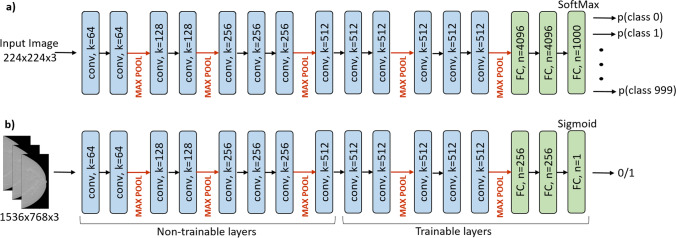
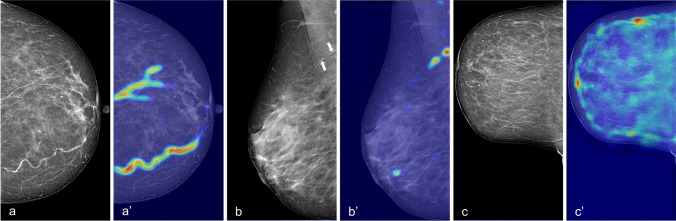
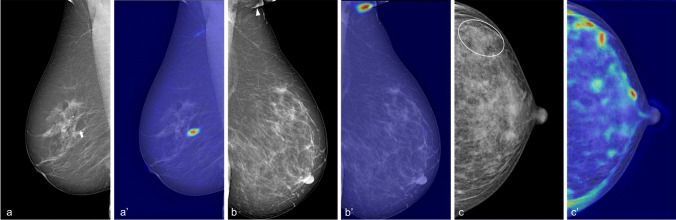
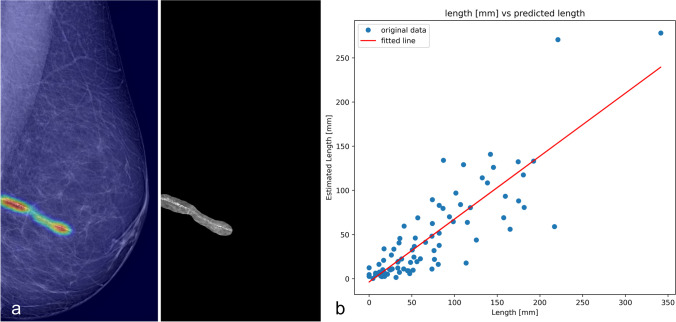
Methods: In this retrospective study, four readers labelled four-view mammograms as BAC positive (BAC+) or BAC negative (BAC-) at image level. Starting from a pretrained VGG16 model, we trained a convolutional neural network to discriminate BAC+ and BAC- mammograms. Accuracy, F1 score, and area under the receiver operating characteristic curve (AUC-ROC) were used to assess the diagnostic performance. Predictions of calcified areas were generated using the generalized gradient-weighted class activation mapping (Grad-CAM++) method, and their correlation with manual measurement of BAC length in a subset of cases was assessed using Spearman ρ.
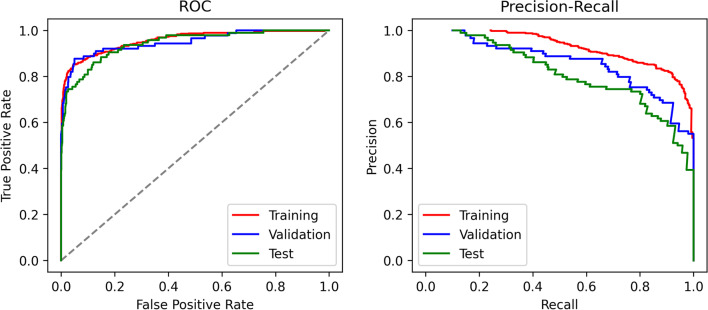
Results: A total 1493 women (198 BAC+) with a median age of 59 years (interquartile range 52-68) were included and partitioned in a training set of 410 cases (1640 views, 398 BAC+), validation set of 222 cases (888 views, 89 BAC+), and test set of 229 cases (916 views, 94 BAC+). The accuracy, F1 score, and AUC-ROC were 0.94, 0.86, and 0.98 in the training set; 0.96, 0.74, and 0.96 in the validation set; and 0.97, 0.80, and 0.95 in the test set, respectively. In 112 analyzed views, the Grad-CAM++ predictions displayed a strong correlation with BAC measured length (ρ = 0.88, p < 0.001).
Conclusion: Our model showed promising performances in BAC detection and in quantification of BAC burden, showing a strong correlation with manual measurements.
Clinical relevance statement: Integrating our model to clinical practice could improve BAC reporting without increasing clinical workload, facilitating large-scale studies on the impact of BAC as a biomarker of cardiovascular risk, raising awareness on women's cardiovascular health, and leveraging mammographic screening.
Key points: • We implemented a deep convolutional neural network (CNN) for BAC detection and quantification. • Our CNN had an area under the receiving operator curve of 0.95 for BAC detection in the test set composed of 916 views, 94 of which were BAC+ . • Furthermore, our CNN showed a strong correlation with manual BAC measurements (ρ = 0.88) in a set of 112 views.
Keywords: Artificial intelligence; Cardiovascular diseases; Mammography; Risk factors; Vascular calcification.
© 2023. The Author(s).
Conflict of interest statement
The authors of this manuscript declare relationships with the following companies: M. Codari is currently employed at Arterys Inc. Additionally, M. Codari is a member of the European Radiology Editorial board and has therefore not taken part in the review or selection process of this article. F. Sardanelli has received research grants from and has been a member of speakers’ bureau and of the advisory group for General Electric, Bayer, and Bracco. The other authors of this manuscript declare no relationships with any companies whose products or services may be related to the subject matter of the article.
Figures