. 2023 May 9;13(1):7559.
doi: 10.1038/s41598-023-34767-8.

Testing entanglement of annihilation photons

Affiliations

Testing entanglement of annihilation photons

Alexander Ivashkin et al. Sci Rep. .

Abstract

We present a new experimental study of the quantum entanglement of photon pairs produced in positron-electron annihilation at rest. Each annihilation photon has an energy that is five orders of magnitude higher than the energy of photons in optical experiments. It provides a unique opportunity for controlled Compton pre-scattering of initial photons before the polarization measurements. The experimental setup includes a system of Compton polarimeters to measure the angular correlations of annihilation photons in initial and thus prepared pre-scattered states. For the first time, a direct comparison of the polarization correlations of initial and pre-scattered annihilation photons has been carried out. The angular distributions of scattered in polarimeters photons turned out to be the same for both types of events. Moreover, the correlation function in the Bell's inequality is also the same for both states. We discuss the implications of our results for quantum measurement theory and for the quantum-entangled positron emission tomography.


Conflict of interest statement

The authors declare no competing interests.

Figures
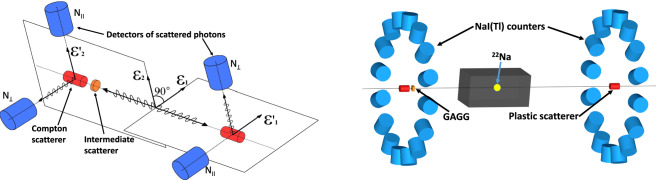
Figure 1
Figure 1
Left—principal scheme for measuring polarization correlations of initial and prepared pre-scattered states of annihilation photons. It includes two Compton polarimeters and an intermediate scatterer. Each Compton polarimeter consists of a scatterer and two orthogonal detectors of scattered gammas. ε1 (ε2) and ε1 (ε2) are the polarization vectors of the initial and scattered gammas, respectively. N and N denote detectors parallel (perpendicular) to the initial polarization vector. Right—scheme of a two-arm experimental setup. Each arm consists of a plastic scatterer on the setup axis and 16 NaI(Tl) counters orthogonal to the axis. The 22Na source of positrons is placed in a lead collimator between the arms closer to intermediate GAGG scatterer for preparing pre-scattered annihilation photons.
Figure 2
Figure 2
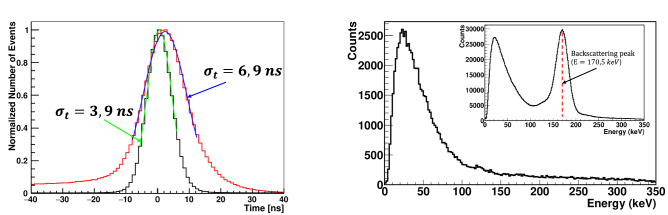
Left—time coincidence spectra between signals in intermediate GAGG and plastic scatterers. Red and black lines correspond to events with energy release in GAGG in the ranges of 2–40 keV and 40–120 keV, respectively. Blue and green lines are the results of the Gaussian fit of the corresponding distributions. The numbers indicate the time resolution for these two cases. Right—the energy spectra in GAGG scatterer for events within the true time coincidence peak. Here, events are selected that hit the NaI(Tl) counters. Insert shows the extended GAGG energy spectrum for all events, regardless of the hits in NaI(Tl) counters. The prominent peak at 170.5 keV corresponds to photons backscattered by the adjacent plastic scatterer and absorbed by GAGG. This peak is used for energy calibration of the intermediate scatterer.
Figure 3
Figure 3
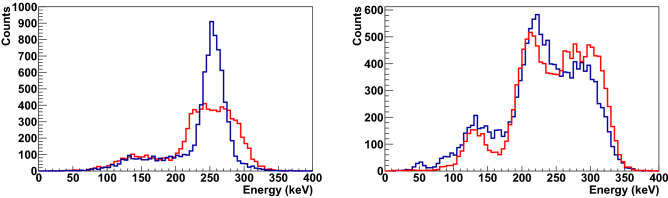
Left—energy spectra in NaI(Tl) counters for events in initial states without energy deposition in the intermediate GAGG scatterer (blue line) and for pre-scattered events with energy deposition in the intermediate GAGG scatterer below 30 keV (red line). Right—the energy spectra in NaI(Tl) counters for pre-scattered photons with energy deposition in the intermediate GAGG scatterer between 30 and 110 keV. The blue line is the experimental data. The red line is the result of a Monte Carlo simulation using the ideal energy resolution of the NaI(Tl) counters.
Figure 4
Figure 4
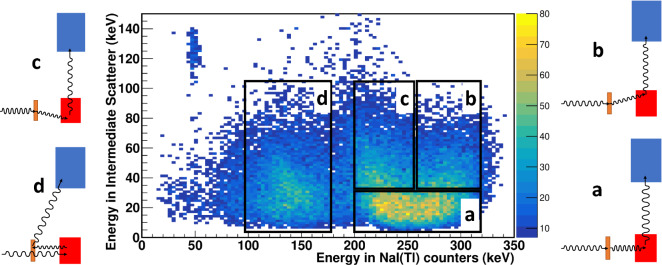
Correlation between energy depositions in the intermediate GAGG scatterer and in NaI(Tl) counters. Several groups of events in black boxes marked as “a”,“b”, “c” and “d” can be distinguished. They correspond to different Compton scattering kinematics in the GAGG scintillator, shown in the diagrams to the left/right of the correlation plot. The brown, red and blue boxes in the diagrams mark the intermediate GAGG scatterer, the plastic scatterer and the NaI(Tl) counter, respectively.
Figure 5
Figure 5
Dependence of coincidence counts in NaI(Tl) detectors on the azimuthal angle between these detectors for initial states (left) and events with pre-scattered in GAGG scintillator photons (right). The solid line corresponds to the fitting function Eq. (8). The numbers in the blue area on the graphs indicate the R ratio for the corresponding class of events.
Figure 6
Figure 6
Dependence of coincidence counts in NaI(Tl) detectors on the azimuthal angle between these detectors for four classes ( “a”, “b”, “c” and “d” in Fig. 4) of pre-scattered events. The solid line corresponds to the fitting function Eq. (8). The numbers in the blue area on the graphs indicate the R ratio for the corresponding class of events.
Figure 7
Figure 7
Dependence of the S-function on the relative azimuthal angle between polarimeters for initial (left) and pre-scattered events of class “a” (right). Data points are represented by triangles, error bars are within the symbols. The solid line corresponds to the fitting function Eq. (3).

References

    1. Schrödinger E. The present status of quantum mechanics. Die Naturwissenschaften. 1935;23:1–26.
    1. Schrödinger E. Die gegenwärtige situation in der quantenmechanik. Naturwissenschaften. 1935;23:823–849. doi: 10.1007/BF01491891. - DOI
    1. Wheeler J. Polyelectrons. Ann. N. Y. Acad. Sci. 1946;48:219–238. doi: 10.1111/j.1749-6632.1946.tb31764.x. - DOI
    1. Pryce MHL, Ward JC. Angular correlation effects with annihilation radiation. Nature. 1947;160:435. doi: 10.1038/160435a0. - DOI - PubMed
    1. Snyder HS, Pasternack S, Hornbostel J. Angular correlation of scattered annihilation radiation. Phys. Rev. 1948;73:440–448. doi: 10.1103/PhysRev.73.440. - DOI